
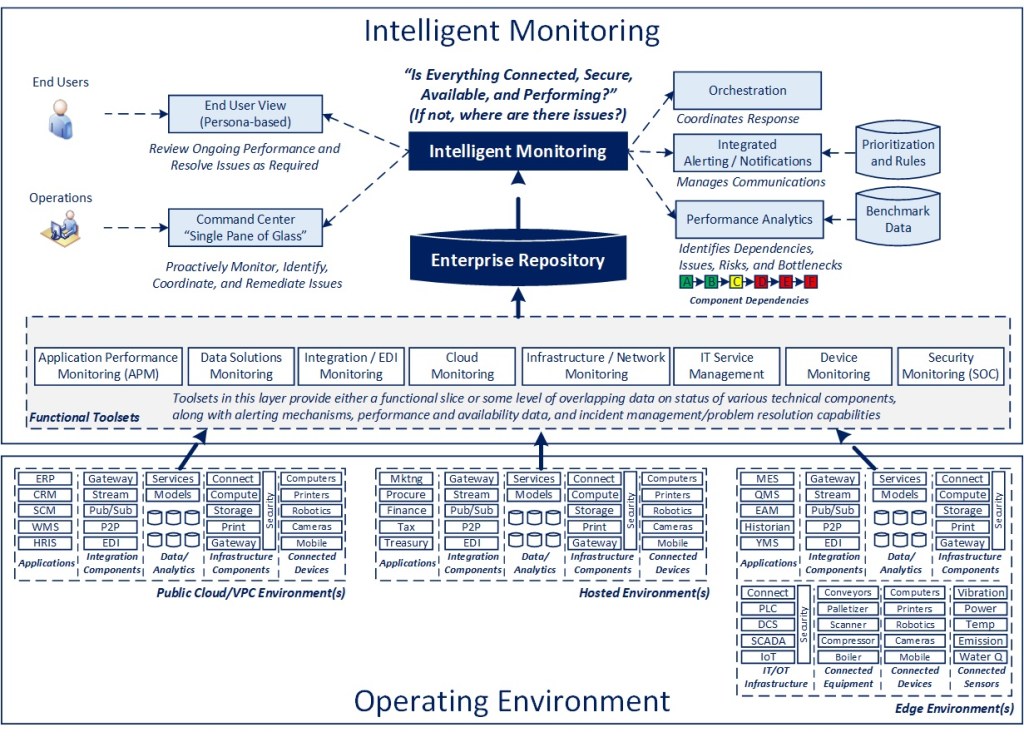
What It Is: There is an opportunity to rethink how we approach monitoring of operations, to better understand dependencies across components, proactively surface risks to avoid issues, and more effectively manage incidents when they occur
Why It Matters: The complexity of operations, particularly in Manufacturing, has increased substantially, both due to the introduction of digital capabilities and automation at facilities, as well as movement to a hybrid cloud environment. That complexity makes the effective identification of issues time consuming, which can cause significant and costly disruption to production and operating efficiency
Key Concepts
- Define a conceptual framework for how your environment is organized first, along with what elements are important to monitor in an integrated fashion
- Review existing toolsets in the market (cloud, APM, infrastructure monitoring) to determine whether they provide adequate capability to identify and manage issues effectively. If so, there may be no business reason to look any further
- If the complexity of the environment is such that there are a considerable number of critical components involved, the tools available don’t provide sufficient capability, and the cost of extended outages or inadequate operating performance is material… THEN it may make sense to explore a more integrated and intelligent solution
- It is important to note that this is not an either/or proposition. Even when pursuing a more elegant and integrated solution, for certain roles (e.g., security monitoring), existing tools likely should be leveraged in parallel with more advanced tools, so as not to need to replicate capabilities available across other tools that may be in place
- The goal is to aggregate data from across existing monitoring platforms (or from source components themselves), run analytics to determine dependencies across operating components, and then apply that understanding to both monitor and triage issues more effectively at the time of an incident, as well as to handle the resolution process more effectively by having a streamlined process for notification and problem resolution
- Once the infrastructure is established to perform the base capabilities described herein, additional components and data sets could be added over time to enrich the capability overall
Key Dimensions of the Solution
- Enterprise Repository – Aggregated availability, connectivity, performance, and security data
- Intelligent Monitoring – An AI-informed process that identifies risks and accelerates resolution
- Performance Analytics –AI capability that identifies dependencies and evaluates benchmarks
- Integrated Alerting / Notifications – Process to reduce duplication and manage communication
- Orchestration – Workflow rules for incident management depending on the existing conditions
- Command Center – A holistic view of operations across connected solution components
- End-User View – A subset of enterprise data, specific to the end user relevant to their need/role
For Additional Information: InBrief: The Intelligent Enterprise 2.0, InBrief: Digital Manufacturing, InBrief: IT Operations
Excellence doesn’t happen by accident. Courageous leadership is essential.
Put value creation first, be disciplined, but nimble.
Want to discuss more? Please send me a message. I’m happy to explore with you.
-CJG 03/03/2026

