
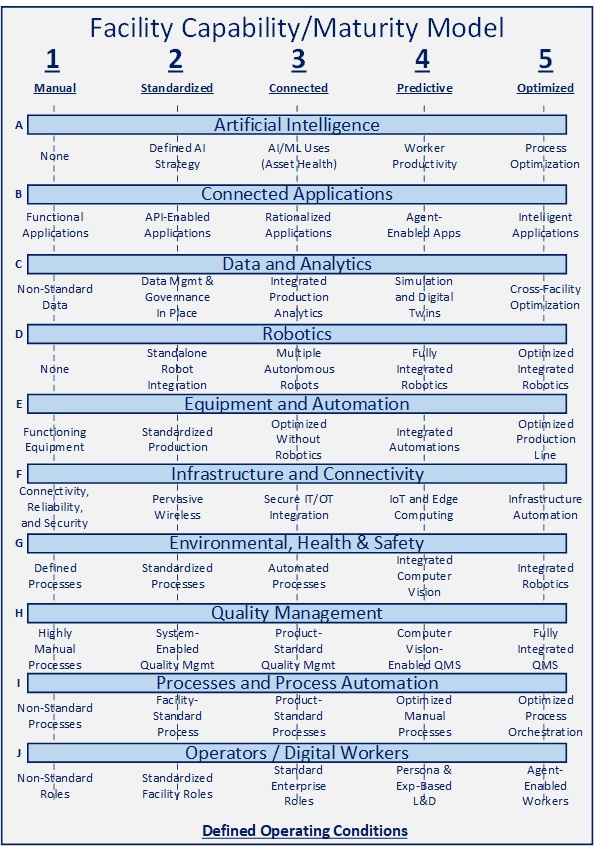
What It Is: Many models have been developed over the years to describe the factory environment and its structure and maturity, for various reasons, from the Purdue model to Industry 4.0. The purpose of this summary article is to share a concept on how to unpack and discuss the evolution of a facility across multiple dimensions. It is not meant to be prescriptive or “correct” from a content standpoint. It is intended to be used as a tool to inform a structured conversation
Why It Matters: As we continue to add elements to the manufacturing environment, whether it is additional monitoring through sensors, automation through robotics, or analytics leveraging more powerful AI models, our ability to be disciplined and intentional in how we not only define our desired/”ideal” future state but also measure and map out our transition is critical in reaching those desired outcomes efficiently and in a cost-effective way
Key Concepts
- Given the complexity and layers of process and automation involved, the “optimized” digital factory of the future needs to be architected, not just engineered
- The diagram above is a representation meant to enable a structured discussion on the various operating dimensions that are important in the environment, some of which may not apply at all, depending on the nature of the manufacturing process and goals of the organization
- The goal of the model is to break down the people, process, equipment, and technology dimensions (similar to the SIRI model from 2017) into relevant components and identify what a reasonable maturity curve looks like independent of other aspects of a facility. That maturity process could vary significantly by organization (or by product/facility), but the overall goal would be to identify meaningful states along a continuum from unstructured and non-standard ways of working to those that are more standardized, supported through automation, and optimized to the extent possible
- Through discussion of the various dimensions, a common vision and understanding can be reached in terms of “what good looks like” that is much more actionable and critical dependencies can be identified to help inform the prioritization of efforts that would be part of a modernization journey (e.g., the criticality of infrastructure to enable digital capabilities)
- With a general framework established, one or more “transition states” could be identified to create meaningful tollgates along an evolutionary journey towards whatever the desired state is, assuming more than one step may be required over a period of time
- Once the framework is defined, it could be used to establish a baseline of where a given facility is along the maturity curve, the “ideal” state, and any transition states and efforts that would be part of evolutionary journey as part of an overall, integrated transformation strategy
- Operating benchmarks could also be established for each of the transition states to evaluate performance across a set of facilities to look for additional opportunities for improvement
- In short, the transformation journey could be described as identifying the maturity curve and desired operating states, mapping the current state of facilities against the framework, then developing a roadmap for modernizing each facility (where required) as part of an overall transformation effort
For Additional Information: InBrief: Digital Manufacturing
Excellence doesn’t happen by accident. Courageous leadership is essential.
Put value creation first, be disciplined, but nimble.
Want to discuss more? Please send me a message. I’m happy to explore with you.
-CJG 03/16/2026
 Organized Chaos