

“Go West, Young Man”
I remember a situation where an organization decided to aggressively offshore work to reduce costs. The direction to IT leaders was no different than that of the Gold Rush above. Leaders were given a mandate, a partner with whom to work, and a massive amount of contracting ensued. The result? A significant number of very small staff augmentation agreements (e.g., 1-3 FTEs), a reduction in fixed, but a disproportionate increase in variable operating expenses, and a governance and administrative nightmare. How did it happen? Well, there was leadership support, a vision, and a desired benefit, but no commonly understood approach, plan, or governance. The organization then spent a considerable amount of time transitioning all of the agreements in place to something more deliberate, establishing governance, and optimizing what quickly became a very expensive endeavor.
The requirements of transformation are no different today than they ever have been. You need a vision, but also the conditions to promote success, and that includes an enabling culture, a clear approach, and governance to keep things on track and make adjustments where needed.
This is the final post in a series focused on where I believe technology is heading, with an eye towards a more harmonious integration and synthesis of applications, AI, and data… what I previously referred to in March of 2022 as “The Intelligent Enterprise”. The sooner we begin to operate off a unified view of how to align, integrate, and leverage these oftentimes disjointed capabilities today, the faster an organization will leapfrog others in their ability to drive sustainable productivity, profitability, and competitive advantage.
Overall Approach
Writing about IT operating models can be very complex for various reasons, and mostly because there are many ways to structure IT work based on the size and complexity of an organization, and there is nothing wrong with that in principle. A small- to medium-size IT organization, as an example, likely has little separation of concerns and hierarchy, people playing multiple roles, a manageable project portfolio, and minimal coordination required in delivery. Standardization is not as complex and requires considerably less “design” than a multi-national or large-scale organization, where standardization and reuse needs to be weighed against the cost of coordination and management involved as the footprint scales. There can also be other considerations, such as one I experienced where simplification of a global technology footprint was driven off of operating similarities across countries rather than geographic or regional considerations.
What tends to be common across ways of structuring and organizing is the various IT functions that exist (e.g., portfolio management, enterprise architecture, app development, data & analytics, infrastructure, IT operations), just at different scales and levels of complexity. These can be capability-based, organized by business partner, with some centralized capabilities and some federated, etc. but the same essential functions likely are in place, at varying levels of maturity and scale based on the needs of the overall organization. In multi-national or multi-entity organizations/conglomerates, these functions likely will be replicated across multiple IT organizations with some or no shared capability existing at the parent/holding company or global level.
To that end, I am going to explore how I think about integrating the future state concepts described in the earlier articles of this series in terms of an approach and conceptual framework that, hopefully, can be applied to a broad range of IT organizations, regardless of their actual structure.
The critical challenge with moving from our current environment to one where AI, apps, and data are synthesized and integrated is doing it in a way that follows a consistent approach and architecture while not centralizing so much that we either constrain progress or limit innovation that can be obtained by spreading the work across a broader percentage of an organization (business teams included). This is consistent with the templatized approach discussed in the prior article on Transition, but there can be many ways that that effort is planned and executed based on the scale and complexity of the organization undertaking the transformation itself.
Key Considerations
Define the Opportunities, Establish the Framework, Define the Standards
Before being concerned with how to organize and execute, we first need to have a mental model for how teams will engage with an AI-enabled technology environment in the future. Minimally, I believe that will manifest itself in four ways:
- Those who define and govern the overall framework
- Those who leverage AI-enabled capabilities to do their work
- Those who help create the future environment
- Those who facilitate transition to the future state operating model
I will explore the individual roles in the next section, but an important first step is defining the level of standardization and reuse that is desirable from an enterprise architecture standpoint. That question becomes considerably more complex in organizations with multiple entities, particularly when there are significant differences in the markets they serve, products/services they provide, etc. That doesn’t mean, however, that reuse and optimization opportunities don’t exist, but rather that they need to be more thoughtfully defined and developed so as not to slow any individual organization down in their ability to innovate and promote competitive advantage. There may be opportunities to look for common capabilities that make more sense to develop centrally and reuse that can actually accelerate speed-to-market if built in a thoughtful manner.
Regardless of whether capabilities in a larger organization are designed and developed in a highly distributed manner, having a common approach to the overall architecture and standards (as discussed in the Framework article in this series) could be a way to facilitate learning and optimization in the future (within and across entities), which will be covered in the third portion of this article.
Clarify the Roles and Expectations, Educate Everyone
The table below is not meant to be exhaustive, but rather to act as a starting point to consider how different individuals and teams will engage with the future enterprise technology environment and highlight the opportunity to clarify those various roles and expectations in the interest of promoting efficiency and excellence.
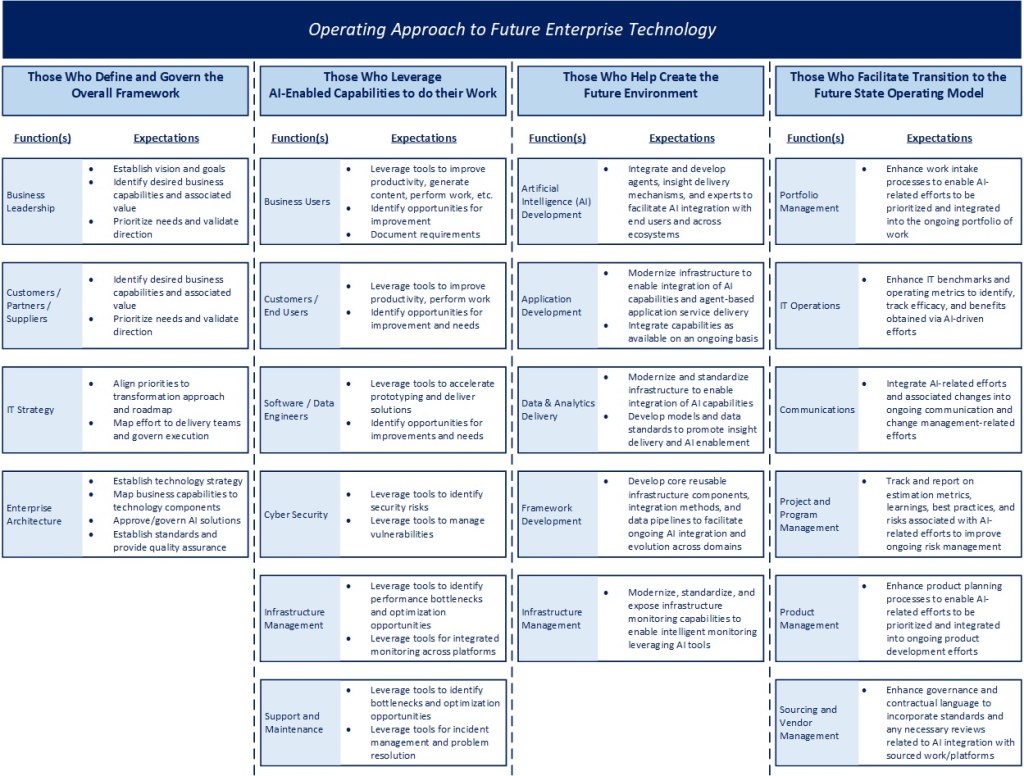
While I’m not going to elaborate on the individual data points in the diagram itself, a few points to note in relation to the table.
There is a key assumption that AI-related tools will be vetted, approved, and governed across an enterprise (in the above case, by the Enterprise Architecture function). This is to promote consistency and effectiveness, manage risk, and consider issues related to privacy, IP-protection, compliance, security, and other critical concerns that otherwise would be difficult to manage without some formal oversight.
It is assumed that “low hanging fruit” tools like Copilot, LLMs, and other AI tools will be used to improve productivity and look for efficiency gains while implementing a broader, modern and integrated future state technology footprint with integrated agents, insights, and experts. The latter of these things has touchpoints across an organization, which is why having a defined framework, standards, and governance are so important in creating the most cost-effective and rapid path to transforming the environment to one that create disproportionate value and competitive advantage.
Finally, there are adjustments to be made in various operating aspects of running IT, which is to reinforce the idea that AI should not be a separate “thing” or a “silver bullet”, it needs to become an integrated part of the way an organization leverages and delivers technology capabilities. To the extent it is treated as something different or special and separated from the ongoing portfolio of work and operational monitoring and management processes, it will eventually fail to integrate well, increase costs, and underdeliver on value contributions that are widely being chased after today. Everyone across the organization should also be made aware of the above roles and expectations, along with how these new AI-related capabilities are being leveraged so they can help identify continuing opportunities to leverage and improve their adoption across the enterprise.
Govern, Coordinate, Collaborate, Optimize
With a model in place and organizational roles and responsibilities clarified, there needs to be a mechanism to collect learnings, facilitate improvements to the “templatized approach” referenced in the previous article in this series, and drive continuous improvement in how the organization functions and leverages these new capabilities.
This can be manifest in several approaches when spread across a medium to large organization, namely:
- Teams can work in partnership or in parallel to try a new process or technology and develop learnings together
- One team can take the lead to attempt a new approach or innovation and share learnings with other in a fast-follower based approach
- Teams can try different approaches to the same type of solution (when there isn’t a clear best option), benchmark, and select the preferred approach based on the learning across efforts
The point is that, to achieve maximum efficiency, especially when there is scale, centralizing too much can hamper learning and innovation, and it is better to develop coordinated approaches that can be governed and leveraged than to have a “free for all” where the overall opportunity to innovate and capture efficiencies is compromised.
Summing Up
As I mentioned at the outset, the challenge in discussing IT implications from establishing a future enterprise environment with integrated AI is that there are so many possibilities for how companies can organize around it. That being said, I do believe a framework for the future intelligent enterprise should be defined, roles across the organization should be clarified, and transition to that future state should be governed with an eye towards promoting value creation, efficiency, and learning.
This concludes the series on my point of view related to the future of enterprise technology with AI, applications, and data and analytics integrated into one, aligned strategy. No doubt the concepts will evolve as we continue to learn and experiment with these capabilities, but I believe there is always room for strategy and a defined approach rather than an excess of ungoverned “experimentation”. History has taught us that there are no silver bullets, and that is the case with AI as well. We will obtain the maximum value from these new technologies when we are thoughtful and deliberate in how we integrate them with how we work and the assets and data we possess. Treating them as something separate and distinct will only suboptimize the value we create over time and those who want to promote excellence will be well served to map out their strategy sooner rather than later.
I hope the ideas across this series were worth considering. Thanks for spending the time to read them. Feedback is welcome as always.
-CJG 08/19/2025
 Organized Chaos
One thought on “The Intelligent Enterprise 2.0 – IT Organizational Implications”