InPractice: PMOs and Governance

What It Is: Governance (in a delivery context) is the process for reviewing a portfolio of ongoing work in the interest of enabling risk management, containing avoidable cost, and increasing on-time delivery.  PMOs (Project/Program Management Offices) are the mechanism through which governance is typically implemented in many organizations.Why It Matters: As the volume, risk, and complexity in a portfolio increase, there is typically a disproportionate increase in issues that come about, leading to cost overruns, missed expectations on scope or schedule (or both), and reduced productivity.  PMOs, meant to be a mechanism to mitigate these issues, are often set up or executed poorly, becoming largely administrative and not value-generating capabilities, which furthers or amplifies any underlying execution issues.  In an environment where organizations want to transform while managing a high level of value/cost efficiency, a disciplined and effective governance environment is critical to promoting IT excellence

Key Concepts

  • There are countless ways to set up an operating model in relation to PMOs and governance, but the culture and intent have to be right, or the rest of what follows will be more difficult
  • There is a significant difference between a “governing” and an “enabling” PMO in how people perceive the capability itself. While PMOs are meant to accomplish both ends, the priority is enabling successful, on-time, quality delivery, not establishing a “police state”
  • Where the focus of a PMO becomes “governance” that doesn’t drive engagement and risk management it can easily become an administrative entity that drives cost and doesn’t create value and ultimately undermines the credibility of the work as a whole
  • The structure of the overall operating model should align to the portfolio of work, scale of the organization, and alignment of customers to ongoing projects and programs
  • It can easily be the case that the execution of the governance model can adapt and change year-over-year but, if designed properly, the structure and infrastructure should be leverageable, regardless of those adjustments
  • The remainder of this article with introduce a concept for how to think about portfolio composition and then various dimensions to consider in creating an operating model for governance

Framing the Portfolio

In chalking out an approach to this article, I had to consider how to frame the problem in a way that could account for the different ways that IT portfolios are constructed.  Certainly, the makeup of work in a small- to medium-size organization is vastly different than a global, diversified organization.  It would also be different when there are a large number of “enterprise” projects versus a set of highly siloed, customer-specific efforts.  To that end, I’m going to introduce a way of thinking about the types of projects that typically make up an IT project portfolio, then an example governance model, the dimensions of which will be discussed in the next section.

The above graphic provides a conceptual way to organize delivery efforts, using the rocks, pebbles, and sand in a jar metaphor that is relatively well known, and also happens to apply to organizing technology delivery.

To establish effective governance, you generally first want to examine and classify delivery projects/programs based on scale (in effort and budget), risk, timeframe, and so on.  This is important so as not to apply a “one size fits all” approach to how you track and govern projects that encumbers lower complexity efforts with the same level of reporting that you would typically have on larger-scale, transformation programs.

In the model above, I went with a simple structure of four project types:

  • Sand – very low risk projects that can be something like a rate change in Insurance or data change in analytics
  • Pebbles – medium complexity work like incremental enhancements or an Agile sprint
  • Rocks – something material, like a package implementation, new technology introduction, product upgrade, or new business or technology capability delivery
  • Boulders – high complexity, multi-year transformation programs, like an ERP implementation where there are multiple material, related projects under one larger delivery umbrella

The characteristics of these projects and metrics you would ideally like to gather, along with the level of “review” needed on an ongoing basis would vary greatly, which will be explored in the next section. 

In a real-world scenario, it is possible that you might want to identify additional sub-categories to the degree it helps inform architecture or delivery governance processes (e.g., security, compliance, modernization, AI-related projects), most of which would likely be specialized kinds of “Pebbles” and “Rocks” in the above model.  It is very easy to become bloated quickly in terms of a governance process, so I am generally a proponent of tuning the model to the work and asking only questions relevant to the type of project being discussed.

What about Agile/SAFe and Product team-oriented environments?  In my experience, it is beneficial to segment delivery efforts because, even in product-based environments, there are normally a mix of projects that are more monolithic in nature (i.e., that would align to “Rocks” and “Boulders”).  Sprints within iterative projects (for a given product team) would likely align to “Pebbles” in the above model and the question would be how to align the outcome of retrospectives into the overall governance model, which will be addressed below.

So, coming back to the diagram, for the purposes of illustration, the assumption we will use is that the portfolio we’re supporting is a mix of all four project types (the “Portfolio Makeup” at right above), so that we can discuss how the governance can be layered and integrated across the different categories expressed in the model itself.

For the remainder of this article, we will assume the work in the delivery portfolio is divided equally between two business customer groups (A and B), with delivery teams supporting each as represented in the below diagram.

If your individual scenario involved a common customer, the model below could be simplified to one branch of the two represented.  If there were multiple groups, it could be scaled horizontally (adding branches for each additional organization) or if there were multiple groups across various geographies, it could be scaled by replicating and sizing the entire structure by entity (e.g., work organized by country in a global organization or by operating company in a conglomerate with multiple OpCos) and then adding one additional later for enterprise or global governance.

Key Dimensions

There are many dimensions to consider in establishing an enterprise delivery governance model.  The following breakdown is not intended to be exhaustive, but rather to highlight some key concepts that I believe are important to consider when designing the operating model for an IT organization.

General Design Principles

  • The goal is to enable decisions as close to the delivery as possible to improve efficiency and minimize the amount of “intervention” needed, unless it is a matter of securing additional resources (labor, funding, etc.) or addressing change control issues
  • The model should leverage a common operating infrastructure to the extent possible, to enable transparency and benchmarking across projects and portfolios. The more consistency and the more “plug and play” the infrastructure for monitoring and governance is, the faster (and more cost-effectively) projects and programs can typically be kicked off and accelerated into execution without having to define these processes independently
  • Metrics should move from summarized to more detailed as you move from oversight to execution, but the ability to “’drill down” should ideally be supported, so there is traceability

Business and IT PMOs versus “One” consolidated model

  • There is a proverbial question as to whether it is better to have “one”, integrated PMO construct, or an IT PMO separate from one that manages business dependencies (whether centralized or distributed)
  • From my perspective, this is a matter of scale and complexity. For smaller organizations, it may be efficient and practical to run everything through the same process, but as work scales, my inclination would be to separate concerns to keep the process from becoming too cumbersome and leverage the issue and risk management infrastructure to track and manage items relevant to the technology aspects of delivery.  There should be linkage and coordination to the extent that parallel organizations exist, but I would generally operate them independently so they can focus on their scope of concerns and be as effective as possible

Portfolio Management Integration

  • I’m assuming that portfolio management processes would operate “upstream” of the governance process and inform which projects are being slotted, address overall resource management and utilization, and release strategy
  • To the extent that change control in the course of delivery affects a planned release, a reverse dependency exists from the governance process back to the portfolio management process to see if schedule changes necessitate any bumping or reprioritization because of resource contention or deployment issues

IT Operations Integration

  • The infrastructure used to track and monitor delivery should come via the IT Operations capability, theoretically connecting at the IT Scorecard for executive level delivery metrics to portfolio and project metrics tracked at the execution level
  • IT Operations should own (or minimally help establish) the standards for reporting across the entire operating model

Participation

  • IT Operations should facilitate centralized governance processes as represented in the “Unit-level” and “Enterprise” governance processes in the diagram above. Program-level governance for “Boulders” would likely be best run by the delivery leadership accountable for those efforts
  • Participation should include whoever is needed to engage and resolve 80% (anecdotally) of the issues and risks that could be raised, but be limited to only people who need to be there
  • Governance processes should never be a “visibility” or “me too” exercise, they are a risk management and issue resolution activity, meant to drive engagement and support for delivery. Notes and decisions can and should be distributed to a broader audience as appropriate so additional stakeholders are informed
  • In the context of a RACI model (Responsible, Accountable, Consulted, Informed), meetings should include only “R” and “A” parties, who can reach out to extended stakeholders as needed (“C”), but very rarely anyone who would be defined as an “I” only
  • It is very easy to either overload a meeting to the point it becomes ineffective or not include the right participants to the extent it doesn’t accomplish anything, so this is a critical consideration for making a governance model effective

Session Scope and Scheduling

  • I’ve already addressed participation, but scheduling should consider the pace and criticality of interventions. Said differently, a frequent, recurring process may make sense when there is a significant volume of work, but something more episodic if there are a limited number of major milestones over the course of time where it makes sense to review progress and check in at specific points in time
  • Where an ongoing process is intended, “Boulders” and “Rocks” should have a standing spot on the agenda given the criticality and risk profiles of those efforts likely would be high. For “Pebbles”, some form of rotational involvement might make sense, such as including two of the four projects in the example above in every other meeting, or prioritizing any projects that are showing a Yellow or Red overall project health.  In the case of the “Sand”, those projects likely are so low risk that, beyond reporting some very basic operating metrics, they should only be included in a governance process when there is an issue that requires intervention or a schedule change that involves potential downstream impacts

Governance Processes

  • I mentioned this in concert with the example portfolio structure above, but it is important to consider tailoring the governance approach to the type of work so as not to create a cumbersome or bureaucratic environment for delivery teams where they focus on reporting and not managing and delivering their work
  • Compliance and security projects, as an example, are different than AI, modernization, or other types of efforts and should be reviewed with that in mind. To the extent a team is asked to provide a set of information as input to a governance process that doesn’t align cleanly to what they are doing, it becomes a distraction that creates no value.  That being said, there should be some core indicators and metrics that are collected regardless of the project type and reviewed consistently (as will be discussed in the next dimension)
  • The process should be designed and managed by IT Operations so it can be leveraged across an organization. While individual nuances can be applied that are specific to a particular delivery organization, it is important to have consistency to enable enterprise-level benchmarking and avoid the potential biases that can come from teams defining their own standards that could limit transparency and hinder effective risk management

Delivery Health and Metrics

  • I’ve written separately on Health and Transparency, but minimally every project should maintain a Red, Yellow, Green on Overall Health, and a second-level indicator on Schedule, Scope, Cost, Quality, and Resourcing that a project/program manager could supply very easily on an ongoing basis. That data should be collected at a defined interval to enable monitoring and inform governance processes on an ongoing basis, regardless of other quantitative metrics gather
  • Metrics on financials, resourcing, quality, issues, risks, and schedule can vary, but to the extent they can be drawn automatically from defined system(s) of record (e.g., MS Project, financial systems, a time tracking system with defined project coding, defect or incident management tools), the level of manual intervention required to enable governance should ideally be limited to data teams should be utilizing on an ongoing basis
  • In the event that there are multiple systems in place to track ongoing work, the IT Operations team should work with the delivery stakeholders to identify any enterprise-levels standards required to normalize them for reporting and governance purposes. To give a specific example, I encountered a situation once where there were five different defect management systems in place across a highly diversified IT organization.  In that case, the team developed a standard definition of how defects would be tracked and reported and the individual systems of record were mapped to that definition so that reporting was consistent across the organization

Change Control

  • Change is a critical area to monitor in any governance process because of the potential impact it has to resource consumption (labor, financials), customer delivery commitments, and schedule conflicts with other initiatives
  • Ideally a governance process should have the right information available to understand the implications of change as and when it is being reviewed as well as the right stakeholders present to make decisions with that information having been provided
  • To the extent that schedule, financial, or resource considerations change, information would need to be sent back to the IT Portfolio Management process to remedy any potential issues or disruptions that have been caused through decisions made. This is consistently missed in my experience in large delivery portfolios

Issue and Risk Management

  • Leveraging a common issue and risk management infrastructure both promotes a consistent way to track and report on these things across delivery efforts, but also creates a repository of “learnings” that could be reviewed and harvested in the interest of evaluating the efficacy of different approaches taken for similar issues/risks and promoting delivery health over time

Dependency/Integrated Plan Management

  • There are two dimensions to consider when it comes to dependencies. First is whether they exist within a project/program or are a dependency from that effort to others in the portfolio or downstream of it.  Second is whether the dependency is during the course of effort or connected to the delivery/deployment of the project
  • In my experience, teams are very good at covering project- or program-driven dependencies, but there can be major gaps in looking across delivery efforts to account for risks caused when things change. To that end, some level of dependency-related matrix should exist to identify and track dependencies across delivery efforts separate from a release calendar that focuses solely on deployment and “T-minus” milestones as projects near deployment
  • Once these dependencies are being tracked, changes that surface through the governance process can be escalated back to the IT Portfolio Management process and other delivery teams to understand and coordinate any adjustments required
  • This can include situations where there are sequential dependencies, as an example, where a schedule overrun requires additional resource commitment from a critical resource needed to kick off or participate in another delivery effort. Without a means to identify these dependencies, the downstream effort may be delayed or not have time to explore alternate resourcing options without having a ripple effect to that downstream delivery.  This is part of the argument for leveraging named resource planning (versus exclusively FTE-/role-based) for critical resources when slotting during the portfolio management process

Partner/Vendor Management

  • The IT Operations function should ideally help ensure that partners leverage internal reporting mechanisms or minimally conform to reporting standards and plug into existing governance processes where appropriate to do so
  • In the case of “Rocks” and “Boulders” that are largely partner-driven they likely will have a standalone governance process that leverages whatever process the partner has in place, but the goal should be to integrate and leverage whatever enterprise tools and standards are in place so that work can be benchmarked across delivery partners and also to compare the service delivery to internally-led efforts as well
  • It is very tempting to treat sourced work differently than projects delivered internal to IT, but who delivers a project should be secondary to whether the project is delivered on time, with quality and meets its objectives. The standards of excellence should apply regardless of who does the work

Learnings and Best Practices

  • Part of the potential benefit for having a shared infrastructure for executing governance discussions by comparison with distributing the work is that it enables you to see patterns in delivery, consistent bottlenecks, risks, and delays, and to leverage those learnings over time to improve delivery quality and predictability
  • Part of the governance process itself can also include having teams provide a post-mortem on their delivery efforts upon completion (successful or otherwise) so that other teams that participate in the governance process and the broader governance team can leverage those insights as appropriate

Change Management

  • While change management isn’t an explicit focus of a PMO/governance model, the dependency management surrounding deployment and learnings coming from various deployments should be coordinated with larger change management efforts and inform them on an ongoing basis in the interest of promoting more effective integration of new capabilities

Some Notes on Product Teams/Agile/SAFe Integration

  • It is tempting to treat product teams as isolated, independent, and discrete pieces of delivery. The issue with moving fully to that concept is that it becomes easy to lose transparency and benchmarking across delivery efforts that surface opportunities to more effectively manage risks and issues outside a given product/delivery team
  • To that end, part of the design process for the overall governance model should look at how to leverage and/or integrate the tooling for Agile projects with other enterprise project tracking tools as needed, along with integrating learnings from retrospectives with overall delivery improvement processes

Wrapping Up

Overall, there are many considerations that go into establishing an operating model for PMOs and delivery governance at end enterprise level.  The most important takeaway is to be deliberate and intentional about what you put in place, keep it light, do everything you can to leverage data that is already available, and keep the balance between the project and the portfolio in mind at all times.  The more project-centric you become, the more likely you will end up siloed and inefficient overall, and that will translate into missed dates, increased costs, and wasted utilization.

For Additional Information: On Health and Transparency, On Delivering at Speed, Making Governance Work, InBrief: IT Operations

Excellence doesn’t happen by accident.  Courageous leadership is essential.

Put value creation first, be disciplined, but nimble.

Want to discuss more?  Please send me a message.  I’m happy to explore with you.

-CJG 12/19/2025

InBrief: IT Operations

What It Is: IT Operations provides “IT for IT”, the infrastructure to track, monitor, and manage operating performance across various dimensions, depending on the scale and complexity of the organization

Why It Matters: The more an IT organization scales in headcount and complexity, the more important it becomes to have a way to benchmark performance and enable operational excellence

Key Concepts

  • IT Ops is a support organization meant to promote effectiveness, not create bureaucracy
  • Ops should be centralized regardless of the IT operating model (functional, product-based, etc.)
  • For large-scale organizations, a federated IT Ops model is preferable for overall org effectiveness

Key Dimensions

Transparency

  • Without visibility, it is nearly impossible to promote excellence and operational improvement
  • Focus should be on critical, minimum metrics that enable governance and benchmarking
  • Metrics can span from a leadership IT scorecard to portfolio and delivery metrics

Governance, Compliance, and Risk Management

  • IT Ops doesn’t need to provide PMO services, but it should ensure they exist and are effective
  • Compliance capabilities can be everything from regulatory and SOX to cyber security and audit

Portfolio Management

  • IT Ops may not provide the services, but should ensure that transparency and governance exist
  • Capabilities can span demand generation and prioritization to monitoring and value realization

Workforce and Sourcing Strategy

  • IT Ops should monitor internal/external performance, utilization, and workforce composition

Financial Management

  • IT Ops should help benchmark value/cost across IT at a service level and identify improvements

Continuous Improvement

  • IT Ops should identify and track operational excellence opportunities on an ongoing basis
  • Part of ongoing improvement should be reviewing and ensuring efficacy of IT services overall

For Additional Information: On Health and Transparency, Making Governance Work, Creating Value Through Strategy, Optimizing the Value of IT, On Managing Customer Relationships

Excellence doesn’t happen by accident.  Courageous leadership is essential.

Put value creation first, be disciplined, but nimble.

Want to discuss more?  Please send me a message.  I’m happy to explore with you.

– CJG 12/15/2025

InBrief: IT Portfolio Management

What It Is: IT Portfolio Management is the process whereby technology investments are prioritized, managed, and governed (from demand management through delivery) on an ongoing basis, in the interest of enabling business strategy, maximizing return, minimizing risk, and providing security and compliance.

Why It Matters: Organizations don’t have unlimited capacity in terms of people, funding, ability to adopt new solutions, etc. and ensuring investments is essential to maximizing value in relation to spend

Overall Concepts

  • Portfolio management is about leadership and business partnership first, and process second
  • Portfolio reviews should produce schedule changes, delivery engagement, or risk management
  • Understanding total cost of ownership and effective resource management are critical input
  • Performing named resource planning versus role-based is important for critical roles

Transparency and Governance

  • Provide visibility into demand, scope, value, complexity, critical resource needs
  • Monitor ongoing delivery to proactively address risk and maintain and adjust release calendar
  • Evaluate and report on value realization, adjust metrics on new demand to improve efficacy

Portfolio Allocation

  • Typically includes: Innovation, Business Projects, Modernization, Security, Compliance, Operate
  • Prioritization model balance local versus global efforts, short- and long-term value

Release Management

  • Have a structured release approach with deployment windows to reduce risk and ease adoption
  • Frontload the first half of the year to avoid excess resource availability issues near the holidays
  • Separate major and minor releases, maintenance, and experiments into defined release slots

Change Management

  • Manage a global view of deployments to avoid schedule conflicts and manage end user change
  • Maintain an end-user view of technology and consider integration to avoid being project-centric

Tools

  • Portfolio management tools should enable and support the process, never become the focus
  • Gather only critical data that is actionable, or it is administrative overhead and likely wasteful

For Additional Information: Thoughts on Portfolio Management, Fast and Cheap, Isn’t Good, Creating Value Through Strategy, Optimizing the Value of IT, On Managing Customer Relationships

Excellence doesn’t happen by accident.  Courageous leadership is essential.

Put value creation first, be disciplined, but nimble.

Want to discuss more?  Please send me a message.  I’m happy to explore with you.

-CJG 12/10/2025

InBrief: Developing IT Strategy

What It Is: An overall IT Strategy sets direction for an organization, providing a framework for the services IT provides, along with key dimensions and objectives, with flexibility to evolve over time

Why It Matters: With the ever-increasing demand for innovation in a competitive, but cost-conscious environment, a thoughtful strategy accelerates results, reduces cost and risk, and enables sustainability

Key Concepts

  • Technology strategy always needs to be rooted in a business-enabling approach
  • It is tempting to over-index on one dimension (e.g., cost management) and sacrifice capability
  • Excellence in IT is rooted in having business aligned objectives, with a disciplined approach
  • This model is organized around five key dimensions, which should be defined and prioritized
  • A simple IT scorecard could be created using how business partners evaluate each dimension
  • This article focuses on delivering IT objectives, IT Excellence focuses on “how to operate” in IT

Key Dimensions

Innovate – Promote Competitive Advantage

  • Map to business goals, establish a disciplined innovation process aligned to architecture strategy
  • Metrics: Increased competitive capabilities, Improved customer satisfaction (int/ext)

Accelerate – Deliver with Quality and Speed

  • Optimize investments, promote quality / standards / reuse, facilitate continuous improvement
  • Metrics: Reduced time-to-market, increased on-time delivery, increased quality

Optimize – Deliver at the Right Cost of Service

  • Reduce complexity, optimize costs, continually modernize, leverage workforce strategy
  • Metrics: Increased value/cost ratio, reduced technical debt, reduced complexity

Inspire – Promote Sustainable Productivity and Engagement

  • Promote a healthy culture, develop employees, enable collaboration, provide transparency
  • Metrics: Low voluntary attrition, high average utilization, high employee satisfaction

Perform – Ensure Production Security, Reliability, and Performance

  • Monitor and invest in production health, establish “zero trust”, manage critical vulnerabilities
  • Metrics: High availability, low unplanned outages, zero security incidents

For Additional Information: Creating Value Through Strategy, Enterprise Architecture in an Adaptive World

Excellence doesn’t happen by accident.  Courageous leadership is essential.

Put value creation first, be disciplined, but nimble.

Want to discuss more?  Please send me a message.  I’m happy to explore with you.

-CJG 11/25/2025

InBrief: IT Excellence

What It Is: Excellence is core to creating sustainable value through technology in any organization

Why It Matters: Technology advances so rapidly that most organizations can’t keep up.  The balance of agility and discipline, speed and quality are essential to optimizing the value of IT at the right cost

Key Dimensions

Courageous Leadership

  • Excellence requires tenacity, agility, flexibility, risk appetite, humility, and discipline
  • Given leadership sets the tone and direction for everything else, this is critical to get right
  • Need to be an advocate, champion, and business partner, knowing when to say “no” if needed

Transformative Culture

  • Remaining competitive in a continually evolving world requires a culture that enables change
  • Culture is expressed in what people see as much or more than anything they hear in speeches
  • Core values need to be consistently demonstrated from leaders to individual contributors

Relentless Innovation

  • Consider what happens in the technology strategy if core solutions are obsolete in 18-24 months
  • Make disciplined innovation part of the ongoing portfolio strategy to maintain competitive edge
  • Plan for “urban” renewal so there is minimal need for large scale, disruptive modernization

Operating with Agility

  • Establish strong business partnerships to respond to changes in portfolio composition/priorities
  • Create a minimally invasive, highly transparent operating infrastructure to drive efficiencies
  • Leverage workforce and sourcing strategy to provide the right capabilities at the right cost

Framework-Centric Design

  • Leverage enterprise architecture to establish a connected enterprise of intelligent ecosystems
  • Develop standards to enable ongoing integration of best-of-breed technology capabilities
  • Integrate artificial intelligence in thoughtful ways that scale and provide sustainable value

Delivering at Speed

  • Create a disciplined and repeatable environment for delivering solutions that can scale
  • Design with architecture, quality, and security in mind, not as an afterthought
  • Understand that total cost of ownership is as important as speed-to-market most of the time

For Additional Information: Excellence By Design, Why Excellence Matters, The Seeds of Transformation

Excellence doesn’t happen by accident.  Courageous leadership is essential.

Put value creation first, be disciplined, but nimble.

Want to discuss more?  Please send me a message.  I’m happy to explore with you.

-CJG 11/21/2025

InBrief: Digital Manufacturing

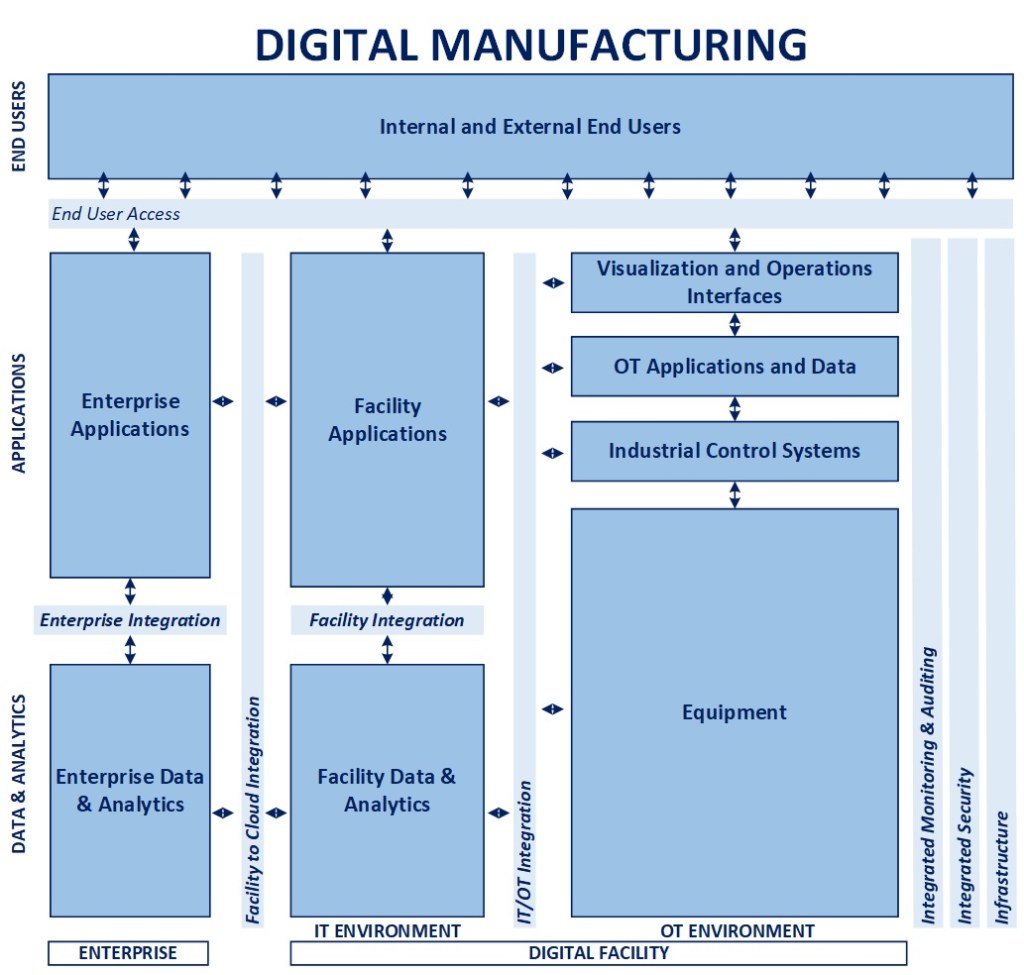
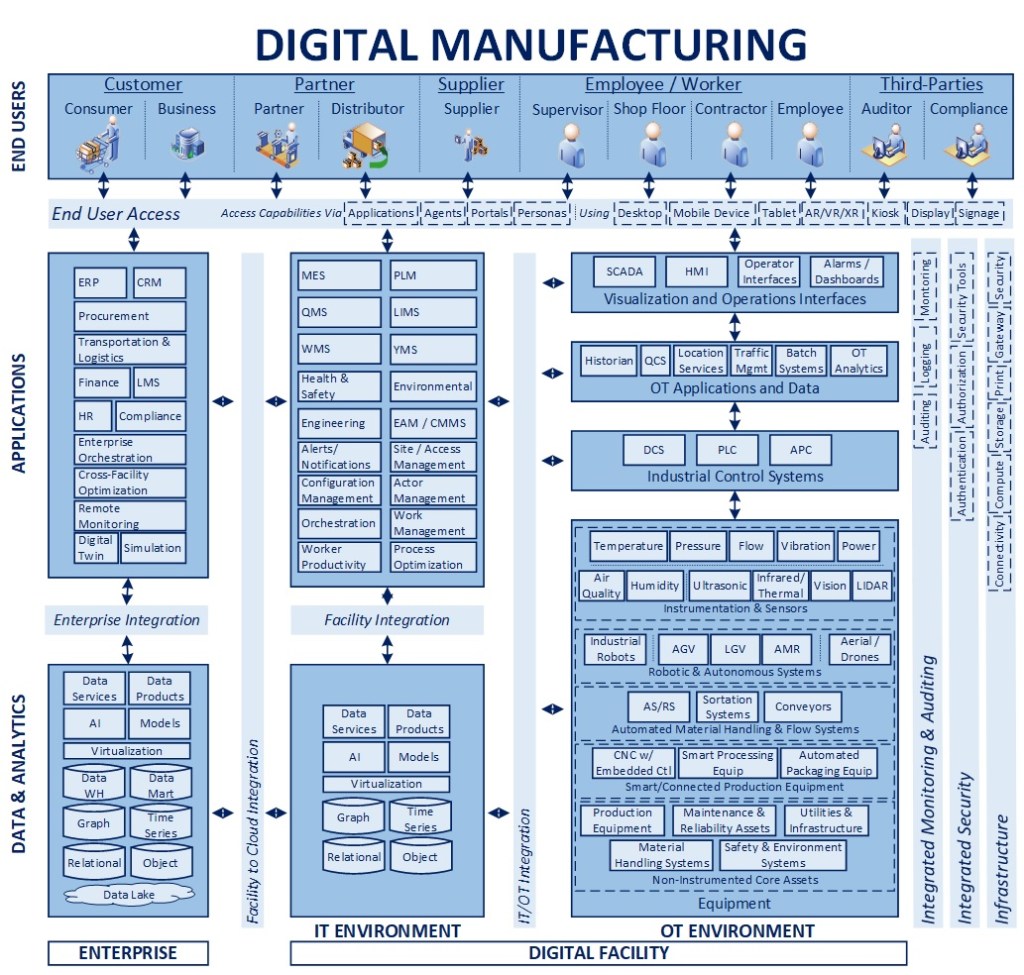
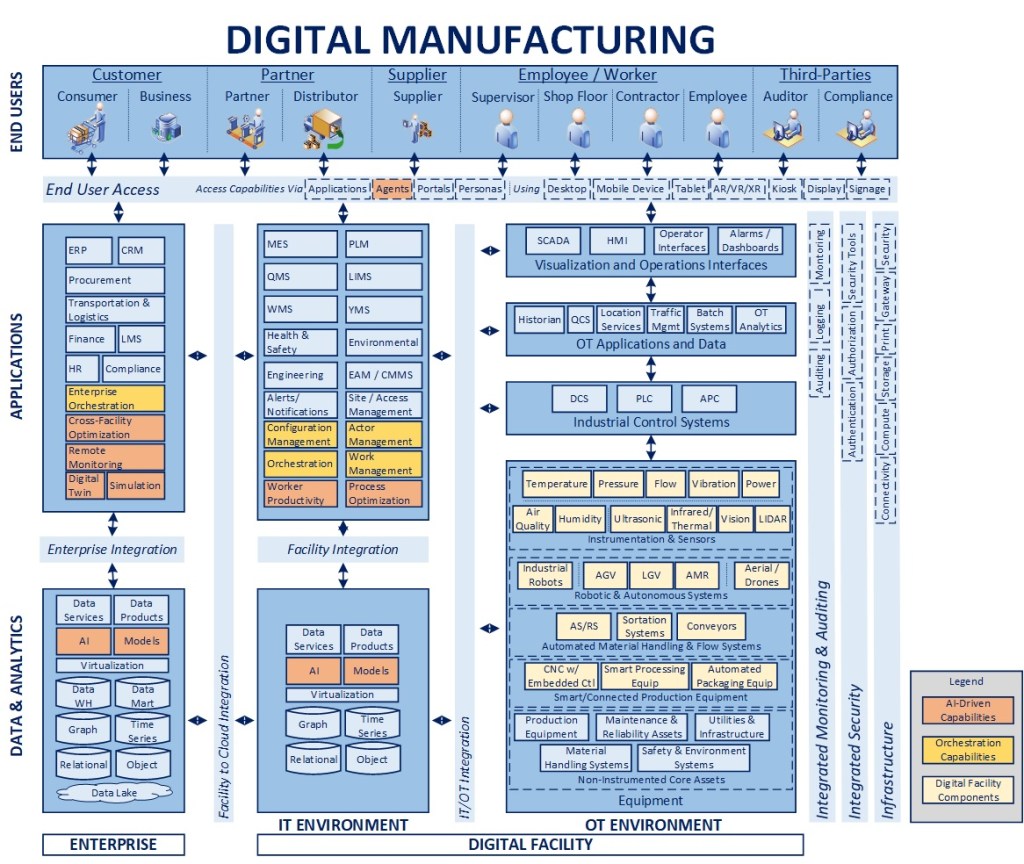
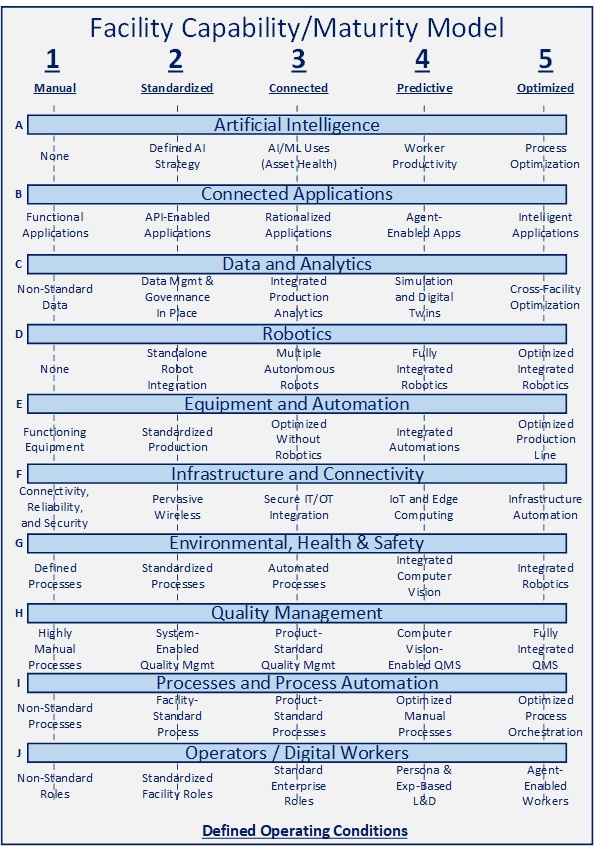
What It Is: Manufacturing continues to move rapidly down a continuum from the highly manual to the digital, from disconnected, asynchronous activities to integrated, orchestrated actions, across an ever-expanding and diverse set of components

Why It Matters: Defining a holistic strategy that enables agility and flexibility, that provides structure without limiting innovation, can be a highly complex activity, but one that is well worth the investment given the right strategy can unlock value in multiple ways (production capacity, productivity, improved quality and safety, etc.), particularly in situations where there is a diverse footprint in place

Key Concepts

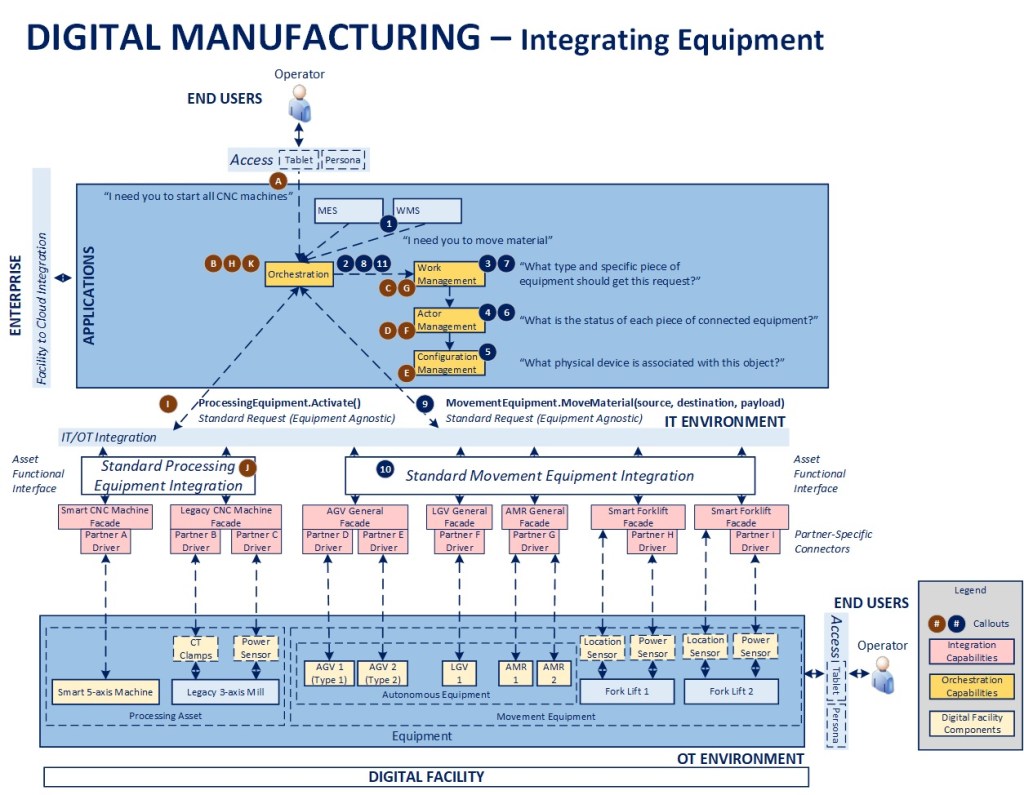
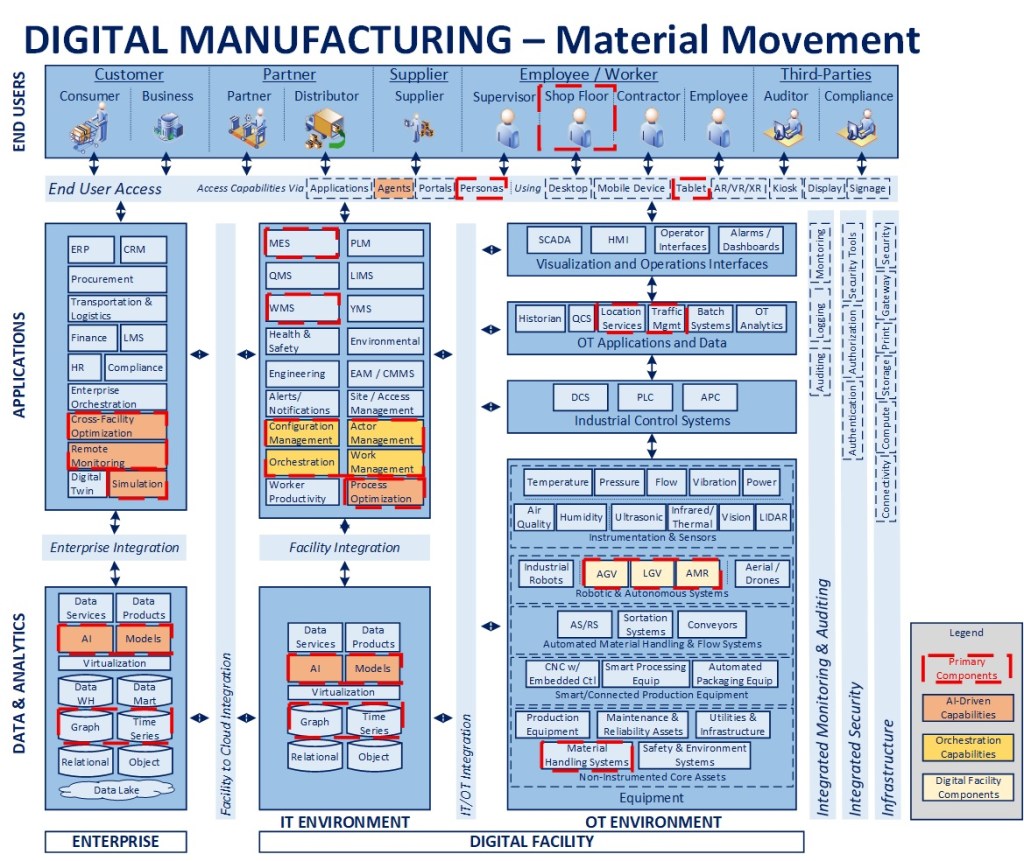
  • Design with a framework in mind, that is intended to connect, monitor, track, orchestrate, and optimize performance within and across digital facilities
  • Establish data ownership, data management, and data governance to enable long-term value
  • Think of individual facilities as having varied configurations of logically common components
  • Manage individual components so that they can be relatively commoditized and replaced easily
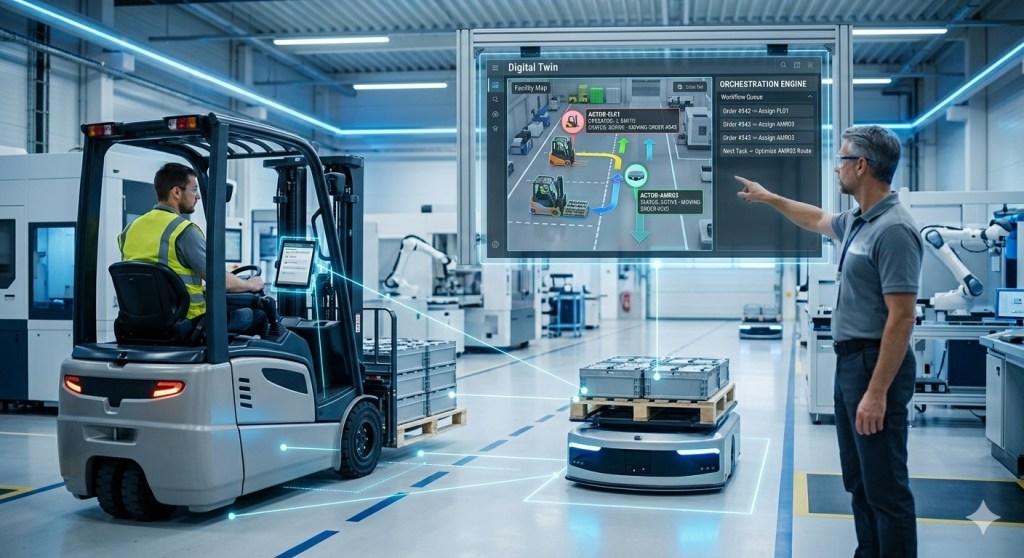
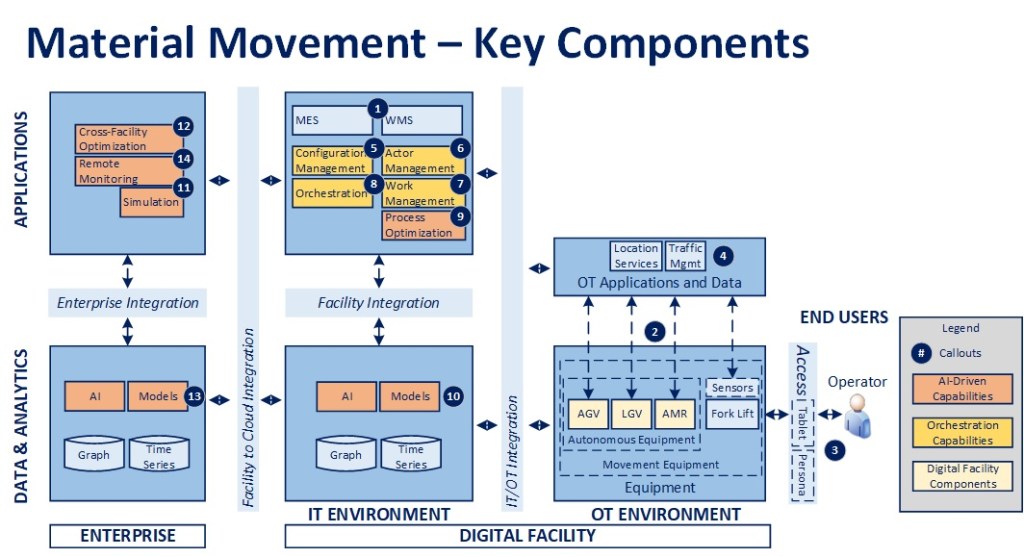
  • Understand that the goal is to optimize the overall system, harmonizing workers and equipment
  • Design the framework to enable adding individual components rapidly, with minimal disruption
  • Leverage the framework to create an environment that can simulate changes pre-deployment
  • Define strategies to insulate legacy equipment so that it integrates the same as modern assets
  • Work with OEMs to facilitate transition between bolt-on analytics to intelligent equipment
  • Integrate AR where it provides incremental value without adding complexity / distraction
  • Reduce complexity with AI, enabling operators to be more productive, effective, and safe
  • Integrate learning and development content dynamically based on operator experience

Approach

  • Provide required internal/external connectivity, infrastructure, and monitoring across locations
  • Identify connected components across facilities by function (equipment, devices, sensors, etc.)
  • Define relevant personas and capabilities to enable digital workers (shop floor to facility leaders)
  • Architect the environment to treat individual components as actors in a connected ecosystem
  • Identify integration standards and relevant characteristics per component to enable analytics
  • Design facility data solutions to allow for structured and unstructured data aligned to the cloud
  • Establish an infrastructure for orchestration that can coordinate activity across connected actors
  • Gather, analyze, and optimize processes given performance data and operating characteristics
  • Analyze observations centrally to leverage insights and opportunities across similar facilities
  • Extend the boundaries of orchestration incorporate customers, suppliers, and partners

For Additional Information: Transforming Manufacturing

Excellence doesn’t happen by accident.  Courageous leadership is essential.

Put value creation first, be disciplined, but nimble.

Want to discuss more?  Please send me a message.  I’m happy to explore with you.

-CJG 11/19/2025

InBrief: Workforce and Sourcing Strategy

What It Is: Workforce and Sourcing Strategy is the long-term approach that an organization uses to provide the necessary skills, internal and external, to enable capabilities to deliver on business commitments and support the current and future technology footprint

Why It Matters: Having a deliberate and thoughtful strategy not only creates an agile and responsive workforce to meet ongoing and variable business demand, but also does so at the right cost.  Where a defined strategy is not in place and being governed, there is very likely cost optimization opportunity

Key Concepts

  • Business and technology needs fluctuate.  A strategy helps mitigate the cost impact of change
  • Leverage a competency model internally and externally to benchmark roles, capacity, and costs
  • Generally speaking, it’s better to align variable capacity to areas of variable demand
  • Benchmark internal cost of service against best-in-class providers, make adjustments as needed
  • Understand that not everything needs differentiated service, keep the lights on is valid in cases
  • Invest in areas where technology creates competitive advantage and IP, outsource elsewhere
  • Actively manage and govern talent development and performance to optimize productivity
  • Never assume HC = FTE.  Used named resources for capacity planning of critical roles vs FTEs
  • Source where technology is emerging and immature to facilitate experiments and early learning
  • It is a reasonable strategy to engage partners in simplification efforts through mutual incentives
  • Never assume shifting sourcing to captives for arbitrage benefits is a 1:1 FTE exchange, it isn’t
  • Be mindful in how you manage overall tenure.  Motivated inexperience introduces risk and cost
  • Leverage role-based capacity agreements to shift contract labor costs to a defined model
  • Scrutinize contracting heavily to avoid inflated cost.  Convert or hire longer-term needs
  • Establish consistent contract language that aligns to service delivery roles and expectations
  • Define primary and secondary partners for individual sourcing needs, manage them consistently
  • Negotiate aggressively but fairly, “partnerships” produce more value than a “vendor” mentality
  • Benchmark and leverage consistent performance metrics across internal and external partners
  • Apply vendor management and governance processes to captives the same as external partners

Approach

  • Understand Current State – Benchmarking capacity by role across sources of staff, including cost
  • Determine What You Need – Evaluate business and industry trends, do the same for technology
  • Define Sourcing Approach – Identify critical skills to retain and source, and where to get them
  • Refine Talent Strategy – Clarify gaps between current and future IT staffing, skills and capacity
  • Develop Transition Plan – Plan change to talent pool and make explicit sourcing decisions
  • Manage Transition – Define metrics, establish vendor management processes, govern change

For Additional Information: Workforce and Sourcing Strategy – Overview

Excellence doesn’t happen by accident.  Courageous leadership is essential.

Put value creation first, be disciplined, but nimble.

Want to discuss more?  Please send me a message.  I’m happy to explore with you.

-CJG 11/05/2025

InBrief: The Intelligent Enterprise 2.0

What It Is: With the advent of AI, the question is how to integrate it effectively at an enterprise level.  The long-term view should be a synthesis of applications, AI, and data, working in harmony, providing integrated capabilities that maximize effectiveness and productivity for the end users of technology

Why It Matters: Much like the .com era, there are lofty expectations of what AI can deliver without a fundamental strategy for how those capabilities will be integrated and leveraged at scale.  Selecting the right approach that balances tactical gains with strategic infrastructure will be critical to optimizing and delivering differentiated value rapidly and consistently in a highly competitive business environment

Key Concepts

  • AI is a capability, not an end in itself.  User-centered design is more important than ever
  • Resist the temptation to treat AI as a one-off and integrate it with existing portfolio processes
  • The end goal is to expose and harness all of an organization’s capabilities in a consistent way
  • Agentic solutions will become much more mainstream, along with orchestration of processes
  • The more agentic solutions become standard, the less application-specific front ends are needed
  • Natural language input will become common to reduce manual entry in various processes
  • We will shift from content via LLMs to optimizing processes and transactions via causal models
  • AI should help personalize solutions, reduce complexity, and improve productivity
  • Only a limited number of sidecar applications can be deployed before overwhelming end users
  • The less standardized the environment is, the longer it will take to achieve enterprise AI benefits
  • As with any transformation, don’t try to boil the ocean, have a strategy and migrate over time

Approach

  • Ensure architecture governance is in place quickly to avoid accruing significant technical debt
  • Design towards an enterprise architecture framework to enable rapid scaling and deployment
  • Migrate towards domain-based ecosystems to facilitate evolution and rapid scaling of capability
  • Enable rapid, disciplined, and governed experiments to explore tools and solution approaches
  • Place heavy emphasis on integration standards as a means to deploy new AI services with speed
  • Develop a conceptual “template” for how AI capabilities will be integrated to facilitate reuse
  • Organize AI services into insights (inform), agents (assist), and experts (benchmark, train, act)
  • Separate internal from package-provided AI services to provide agility and manage overall costs
  • Evaluate internal and external solutions by their ability to integrate services and enable agents
  • Reinforce data management and data governance processes to enable quality insights
  • Define roles and expectations for those in the organization who develop, use, and manage AI

For Additional Information: Part 1: The Cost of Complexity, Part 2: A Framework for the Future, Part 3: Integrating Artificial Intelligence, Part 4: Evolving Applications, Part 5: Deconstructing Data-Centricity, Part 6: Managing Transition, Part 7: IT Organizational Implications

Excellence doesn’t happen by accident.  Courageous leadership is essential.

Put value creation first, be disciplined, but nimble.

Want to discuss more?  Please send me a message.  I’m happy to explore with you.

-CJG 11/03/2025

InBrief: IT Value/Cost Optimization

What It Is: IT Value/Cost Optimization is the process of adjusting IT spend relative to the value being created through IT services in the interest of finding the optimal balance for an organization

Why It Matters: When organizations face financial challenges, there is often a desire to reduce expense.  The challenge is that the activity is often managed as a cost cutting exercise focused on direct labor, without regard to other, less disruptive opportunities that exist if a more holistic approach was taken

Key Concepts

  • Optimization should be a continual activity.  Doing it periodically increases negative impacts
  • The activity requires a clear understanding of costs (direct and indirect) and value being created
  • Where spending isn’t governed, it is likely inflated and suboptimized
  • The scale and complexity of a technology footprint has a direct relationship to labor cost
  • Direct labor should be the last lever adjusted.  It represents the potential to create value
  • Every $1MM you save in other ways is 8 headcounts (@$125k) you could have to perform work
  • If you can eliminate >5% of your workforce for performance, you aren’t managing it effectively
  • In the event labor ever becomes “numbers on a spreadsheet”, ask someone else to manage cost
  • In my experience, people would take other levers more seriously if their headcount was in play

Approach

  • IT Operations – Provide critical, minimum data to enable benchmarking and governance
  • Portfolio Management – Ensure effective prioritization, slotting, and resource utilization
  • Release Strategy – Have a disciplined to minimize operating disruptions and optimize utilization
  • Enterprise Architecture – Establish a capability to develop blueprints, simplify, and standardize
  • Applications – Rationalize on an ongoing basis to manage costs and promote speed-to-market
  • Data – Promote interoperability, minimize data movement, and avoid monolithic solutions
  • Artificial Intelligence – Establish a disciplined and governed process for AI introduction and use
  • Technologies – Minimize duplication and manage end-of-life to avoid disruptive costs
  • Infrastructure – Unless there is a legal or compliance-related reason, shift to external providers
  • Cloud – Develop a FinOps capability to review and adjust resource consumption to avoid waste
  • Licensing – Establish an ongoing process to review, optimize, and manage license transitions
  • Modernization – Actively modernize solutions to avoid episodic efforts that increase costs
  • Services – Define a workforce and sourcing strategy, govern relationships, negotiate effectively
  • Labor – Establish a competency model, manage utilization effectively, handle underperformance

For Additional Information: Optimizing the Value of IT

Excellence doesn’t happen by accident.  Courageous leadership is essential.

Put value creation first, be disciplined, but nimble.

Want to discuss more?  Please send me a message.  I’m happy to explore with you.

-CJG 10/30/2025

InBrief: Application Rationalization

What It Is: App Rationalization is the process of reducing redundancies that exist in an application portfolio in the interest of reducing complexity, cost of ownership, and improving speed-to-market.

Why It Matters: Organizations typically spend anywhere between 50-80% of their IT budget maintaining and supporting systems in place.  That limits investment in innovation and competitive advantage.

Key Concepts

  • Understand that rationalization is more about change management than technology
  • Ensure there are healthy relationships in place and strong leadership support for the work
  • Focus in on critical areas of the portfolio that drive cost. Don’t boil the ocean
  • Don’t worry about creating the perfect infrastructure day one. Clean that up along the way
  • Start with how your business operates and simplify and standardize processes first
  • Align your future blueprint as cleanly to your desired operating footprint as possible
  • Consider your Artificial Intelligence (AI), cloud, and security strategies in the future vision
  • Simplification can come through reducing both unique applications and instances of applications
  • Address how systems will be supported and enhanced moving forward in your design
  • Explicitly include milestones for decommissioning in your roadmap. Don’t let that go undone
  • Expect the work to continually evolve and adapt. Plan for change and adjust responsively
  • Include rationalization as part of your ongoing portfolio strategy so it’s not a one-time event

Approach

  • Align – Obtain organizational support critical to defining vision, scope, and facilitating change
  • Understand – Gather an understanding of the current state and alignment to operations
  • Evaluate – Leverage something like the Gartner TIME model to evaluate portfolio quality and fit
  • Strategize – Develop a future state blueprint, CBA, and proposed changes to the environment
  • Socialize – Obtain feedback, iterate, clarify the vision, and finalize the initial roadmap
  • Mobilize – Launch first wave of delivery, realign ongoing work as required
  • Execute – Deliver on 30-, 60-, and 90-day goals, governing and adjusting the approach as you go

For Additional Information: Part 1: Managing the Intangibles, Part 2: Laying the Foundation, Part 3: Executing the Process

Excellence doesn’t happen by accident.  Courageous leadership is essential.

Put value creation first, be disciplined, but nimble.

Want to discuss more?  Please leave a comment and contact info.  I’m happy to explore with you.

-CJG 10/29/2025