What It Is: Transformation is the process of reshaping a way of working in the interest of achieving a significant and measurable impact in business results
Why It Matters: When faced with changing market conditions, competitive threats, technology advancements, etc., it is critical for organizations to reinvent themselves. This typically involves changes to process, organization, and technology and doing so in a thoughtful manner is critically important
Critical Dimensions
A Compelling Vision – The desired future state should be clear enough to create emotional investment and the commitment required to overcome the inertia that naturally resists change
Clear Business Outcomes –There should be tangible goals established (along with key financial and operating metrics) to inform prioritization and guide critical decisions throughout execution
Courageous, Committed Leadership – Transformation efforts are complex and require resilience, decisiveness, persistence, and determination to work through adversity along the way
A Supportive Culture – The environment and culture within an organization will have an impact on the degree of change that is possible to achieve overall and the rate at which it can be done
A Thoughtful Approach – It is tempting in larger programs to initiate too much work, too quickly, causing significant disruption and suboptimal results (or even programs to fail overall). Given that a lot of learnings tend to occur in terms of processes, standards, and governance in initial delivery efforts, it is often the case that incubating large programs with a smaller, expert team and extending and scaling afterward is a more effective way to build momentum and reduce risk
Results-Orientation – Another problem in large transformation efforts is taking on too much, too early in terms of scope that can substantially defer any benefit realization, by comparison with a consistent, incremental delivery environment that is both predictable and repeatable over time
Adaptability and Agility – Transformation efforts are messy, involve complexity, and typically run into a host of issues throughout execution. It is critical to maintain a high level of transparency into ongoing work, have an active and engaged governance process, and to make decisions efficiently and thoughtfully as they are needed during execution. Roadmaps produced at the start of large programs rarely remain unchanged for very long, and it’s important that every inflection point is taken as an opportunity to learn, improve, and respond versus react
Patience and Discipline – Sustainable change takes time. While it’s possible to force a level of change in the short-term and achieve incremental benefits, systemic and holistic changes to the way an organization operates take time. Managing the process in a disciplined way both helps achieve overall results faster as well as mitigate risk
What It Is: Technology organizations are sometimes led through a combination of CIO and CTO roles, working towards a shared vision, each having a clear focus in the interest of promoting IT excellence
Why It Matters: Technology continues to advance at a rate, particularly with the introduction of AI, that exceeds many organizations ability to respond effectively. Having the right leadership in place to develop strategy, consider longer-term implications of decisions made in ongoing delivery, and govern execution can be key to avoiding technical debt, while promoting delivery excellence over time
Five Types of CTOs
Technology Strategist – This is the most common modern orientation, focused on enablement, simplification, optimization, and capability delivery
Mistitled CIO – This occurs when the CTO actually has all the typical CIO responsibilities and they are fulfilling that role in every way, leading IT, setting direction, etc. without the CIO title
Futurist – This occurs where the CTO plays a more directional, but not action-oriented role, focused on white/position papers, and ideation
Infrastructure Lead – This is the historical role of a CTO, focused more on hosting, networking, reliability, performance, and operations with the CIO covering applications and data
Lead Designer / Senior Developer – This generally the case in start-up/smaller scale product environments, where the CTO leads the product design and helps code the solution
High-Level Differences
CIO focuses on the “what”, obtains business alignment and identifies capabilities, along with desired technology capabilities, focuses on the customer and providing vision and direction
CTO focuses on the “how”, understands desired business capabilities, determines how to provide technical capabilities and deliver on commitments, partnering with the broader team
Both roles participate in governance, CIO provides and aligns business priorities, CTO provides and aligns technical priorities in support of the CIO
When It Makes Sense to Have a CTO in Addition to a CIO
There is sufficient time required working with business partners that additional support is needed to define and evolve the technology strategy and work actively with delivery leaders
There is considerable complexity in the technology footprint, a high degree of transformation, or substantial integration required across ongoing delivery where having the CIO focused in the weeds of execution could result in underserving the business team and executive leadership
There is a need to move multiple levers (cloud platform migration, modernization, core platform implementation, AI integration, etc.) that a level of dedicated focus and oversight is needed to work through the risks and impacts of various strategies to define the best technology solution
When the scale of the organization in people, internally, externally, including customers, suppliers, and partners exceeds one person’s ability to manage relationships effectively
Where the CIO has a business background and it is helpful to supplement their capabilities with a more technology-focused leader overall
Benefits of Having a “Healthy Tension”
There can be a natural tension created when there is a separation of roles, because a CIO generally is incented to deliver new business capabilities at speed and the CTO should be incented to do things “right” to minimize long-term cost of ownership, managing technical debt, promoting standards and governance, and improving predictability of the delivery environment
Business delivery will generally be top priority, but having a CTO can mitigate the impact of tradeoffs made during delivery, particularly in large programs, where consequences are higher
The Downside:
There is incremental cost associated with adding leadership roles, there can be confusion across the broader IT leadership if roles and responsibilities aren’t clear, and a strong CIO/CTO partnership is important to making the role effective in practice
That being said, the value to any organization with a relatively large technology footprint would likely far exceed the cost of having a CTO focused on managing complexity and optimizing cost
The Difference Between CTO and Chief Architect
The CTO is the keeper of the overall technology strategy, apps, data, infrastructure, security integration with all of the above (working with the CISO), inclusive of the delivery environment
A “Chief Architect” tends to be more narrowly focused on application and data architecture strategy, but with awareness on how to incorporate cloud and platform strategy as well
A Chief Architect could be a role reporting to the CTO, depending on the scale of the organization, focused more on defining, modernizing, or rationalizing the enterprise ecosystem of connected components, acting more like a designer than a strategist, where a CTO without this role would generally do both at the enterprise level
What It Is: IT Operations provides “IT for IT”, the infrastructure to track, monitor, and manage operating performance across various dimensions, depending on the scale and complexity of the organization
Why It Matters: The more an IT organization scales in headcount and complexity, the more important it becomes to have a way to benchmark performance and enable operational excellence
Key Concepts
IT Ops is a support organization meant to promote effectiveness, not create bureaucracy
Ops should be centralized regardless of the IT operating model (functional, product-based, etc.)
For large-scale organizations, a federated IT Ops model is preferable for overall org effectiveness
Key Dimensions
Transparency
Without visibility, it is nearly impossible to promote excellence and operational improvement
Focus should be on critical, minimum metrics that enable governance and benchmarking
Metrics can span from a leadership IT scorecard to portfolio and delivery metrics
Governance, Compliance, and Risk Management
IT Ops doesn’t need to provide PMO services, but it should ensure they exist and are effective
Compliance capabilities can be everything from regulatory and SOX to cyber security and audit
Portfolio Management
IT Ops may not provide the services, but should ensure that transparency and governance exist
Capabilities can span demand generation and prioritization to monitoring and value realization
Workforce and Sourcing Strategy
IT Ops should monitor internal/external performance, utilization, and workforce composition
Financial Management
IT Ops should help benchmark value/cost across IT at a service level and identify improvements
Continuous Improvement
IT Ops should identify and track operational excellence opportunities on an ongoing basis
Part of ongoing improvement should be reviewing and ensuring efficacy of IT services overall
What It Is: IT Portfolio Management is the process whereby technology investments are prioritized, managed, and governed (from demand management through delivery) on an ongoing basis, in the interest of enabling business strategy, maximizing return, minimizing risk, and providing security and compliance.
Why It Matters: Organizations don’t have unlimited capacity in terms of people, funding, ability to adopt new solutions, etc. and ensuring investments is essential to maximizing value in relation to spend
Overall Concepts
Portfolio management is about leadership and business partnership first, and process second
Portfolio reviews should produce schedule changes, delivery engagement, or risk management
Understanding total cost of ownership and effective resource management are critical input
Performing named resource planning versus role-based is important for critical roles
Transparency and Governance
Provide visibility into demand, scope, value, complexity, critical resource needs
Monitor ongoing delivery to proactively address risk and maintain and adjust release calendar
Evaluate and report on value realization, adjust metrics on new demand to improve efficacy
Portfolio Allocation
Typically includes: Innovation, Business Projects, Modernization, Security, Compliance, Operate
Prioritization model balance local versus global efforts, short- and long-term value
Release Management
Have a structured release approach with deployment windows to reduce risk and ease adoption
Frontload the first half of the year to avoid excess resource availability issues near the holidays
Separate major and minor releases, maintenance, and experiments into defined release slots
Change Management
Manage a global view of deployments to avoid schedule conflicts and manage end user change
Maintain an end-user view of technology and consider integration to avoid being project-centric
Tools
Portfolio management tools should enable and support the process, never become the focus
Gather only critical data that is actionable, or it is administrative overhead and likely wasteful
What It Is: Excellence is core to creating sustainable value through technology in any organization
Why It Matters: Technology advances so rapidly that most organizations can’t keep up. The balance of agility and discipline, speed and quality are essential to optimizing the value of IT at the right cost
Key Dimensions
Courageous Leadership
Excellence requires tenacity, agility, flexibility, risk appetite, humility, and discipline
Given leadership sets the tone and direction for everything else, this is critical to get right
Need to be an advocate, champion, and business partner, knowing when to say “no” if needed
Transformative Culture
Remaining competitive in a continually evolving world requires a culture that enables change
Culture is expressed in what people see as much or more than anything they hear in speeches
Core values need to be consistently demonstrated from leaders to individual contributors
Relentless Innovation
Consider what happens in the technology strategy if core solutions are obsolete in 18-24 months
Make disciplined innovation part of the ongoing portfolio strategy to maintain competitive edge
Plan for “urban” renewal so there is minimal need for large scale, disruptive modernization
Operating with Agility
Establish strong business partnerships to respond to changes in portfolio composition/priorities
Create a minimally invasive, highly transparent operating infrastructure to drive efficiencies
Leverage workforce and sourcing strategy to provide the right capabilities at the right cost
Framework-Centric Design
Leverage enterprise architecture to establish a connected enterprise of intelligent ecosystems
Develop standards to enable ongoing integration of best-of-breed technology capabilities
Integrate artificial intelligence in thoughtful ways that scale and provide sustainable value
Delivering at Speed
Create a disciplined and repeatable environment for delivering solutions that can scale
Design with architecture, quality, and security in mind, not as an afterthought
Understand that total cost of ownership is as important as speed-to-market most of the time
What It Is: Workforce and Sourcing Strategy is the long-term approach that an organization uses to provide the necessary skills, internal and external, to enable capabilities to deliver on business commitments and support the current and future technology footprint
Why It Matters: Having a deliberate and thoughtful strategy not only creates an agile and responsive workforce to meet ongoing and variable business demand, but also does so at the right cost. Where a defined strategy is not in place and being governed, there is very likely cost optimization opportunity
Key Concepts
Business and technology needs fluctuate. A strategy helps mitigate the cost impact of change
Leverage a competency model internally and externally to benchmark roles, capacity, and costs
Generally speaking, it’s better to align variable capacity to areas of variable demand
Benchmark internal cost of service against best-in-class providers, make adjustments as needed
Understand that not everything needs differentiated service, keep the lights on is valid in cases
Invest in areas where technology creates competitive advantage and IP, outsource elsewhere
Actively manage and govern talent development and performance to optimize productivity
Never assume HC = FTE. Used named resources for capacity planning of critical roles vs FTEs
Source where technology is emerging and immature to facilitate experiments and early learning
It is a reasonable strategy to engage partners in simplification efforts through mutual incentives
Never assume shifting sourcing to captives for arbitrage benefits is a 1:1 FTE exchange, it isn’t
Be mindful in how you manage overall tenure. Motivated inexperience introduces risk and cost
Leverage role-based capacity agreements to shift contract labor costs to a defined model
Scrutinize contracting heavily to avoid inflated cost. Convert or hire longer-term needs
Establish consistent contract language that aligns to service delivery roles and expectations
Define primary and secondary partners for individual sourcing needs, manage them consistently
Negotiate aggressively but fairly, “partnerships” produce more value than a “vendor” mentality
Benchmark and leverage consistent performance metrics across internal and external partners
Apply vendor management and governance processes to captives the same as external partners
Approach
Understand Current State – Benchmarking capacity by role across sources of staff, including cost
Determine What You Need – Evaluate business and industry trends, do the same for technology
Define Sourcing Approach – Identify critical skills to retain and source, and where to get them
Refine Talent Strategy – Clarify gaps between current and future IT staffing, skills and capacity
Develop Transition Plan – Plan change to talent pool and make explicit sourcing decisions
What It Is: App Rationalization is the process of reducing redundancies that exist in an application portfolio in the interest of reducing complexity, cost of ownership, and improving speed-to-market.
Why It Matters: Organizations typically spend anywhere between 50-80% of their IT budget maintaining and supporting systems in place. That limits investment in innovation and competitive advantage.
Key Concepts
Understand that rationalization is more about change management than technology
Ensure there are healthy relationships in place and strong leadership support for the work
Focus in on critical areas of the portfolio that drive cost. Don’t boil the ocean
Don’t worry about creating the perfect infrastructure day one. Clean that up along the way
Start with how your business operates and simplify and standardize processes first
Align your future blueprint as cleanly to your desired operating footprint as possible
Consider your Artificial Intelligence (AI), cloud, and security strategies in the future vision
Simplification can come through reducing both unique applications and instances of applications
Address how systems will be supported and enhanced moving forward in your design
Explicitly include milestones for decommissioning in your roadmap. Don’t let that go undone
Expect the work to continually evolve and adapt. Plan for change and adjust responsively
Include rationalization as part of your ongoing portfolio strategy so it’s not a one-time event
Approach
Align – Obtain organizational support critical to defining vision, scope, and facilitating change
Understand – Gather an understanding of the current state and alignment to operations
Evaluate – Leverage something like the Gartner TIME model to evaluate portfolio quality and fit
Strategize – Develop a future state blueprint, CBA, and proposed changes to the environment
Socialize – Obtain feedback, iterate, clarify the vision, and finalize the initial roadmap
Mobilize – Launch first wave of delivery, realign ongoing work as required
Execute – Deliver on 30-, 60-, and 90-day goals, governing and adjusting the approach as you go
“Something needs to change… we’re not growing, we’re too slow, we’re not competitive, we need to manage costs…”
Change is an inevitable reality in business. Even the most successful company will face adversity, new competitors, market shifts, evolving customer needs, expense pressures, near-term shareholder expectations, etc. While it’s important to focus on adjusting course and remedying issues, the question is whether you will find yourself in exactly the same (or at least a relatively similar) situation again (along with how quickly) and that comes down to leadership and culture.
Culture issues tend to beget other business issues, whether it’s delayed or misaligned decisions, complacency and a lack of innovation, a lack of collaboration and cooperation, risk averse behaviors, redundant or ineffective solutions, high turnover resulting in lost expertise, and so on. The point is that excellence needs to start “at the top” and work its way throughout an organization, andthe mechanism for that proliferation is culture.
The focus of this article will be to explore what it takes to evolve culture in an organization, and to provide ways to think about what can happen when it isn’t positioned or aligned effectively.
It Starts with the Right Intentions
Conformance versus Performance
Before attempting to change anything, the fundamental question to be asked is why you want to have a culture in place to begin with? Certainly, over the course of time and multiple organizations (and clients), I’ve seen culture emphasized to varying degrees, from where it is core to a company’s DNA, to where it is relegated to a poster, web page, or item on everyone’s desk that is seldom noticed or referenced.
In cases where it’s rarely referenced, there is missed opportunity to establish mission and purpose, rallying people around core concepts that can facilitate an effective work environment.
That being said, focusing on culture doesn’t necessarily create a greater good in itself, as I’ve seen environments where culture is used in almost a punitive way, suggesting there are norms to which everyone must adhere and specific language everyone needs to use, or there will be adverse consequences.
That isn’t about establishing a productive work environment, it’s about control and conformance, and that can be toxic when you understand the fundamental issue it represents: employees aren’t trusted enough to do the right thing, be empowered, and enabled to act, so there needs to be a mechanism in place to drive conformity, enforce “common language”, and isolate those who don’t fit the mold to create a more homogenous organizational society.
So, what happens to innovation, diversity, and inclusion in these environments? It’s suppressed or destroyed, because the capabilities and gifts of the individual are lost to the push towards a unified, homogenized whole. That is a fairly extreme outcome of such authoritarian environments, but the point is that a strong culture is not, in itself, automatically good if the focus is control and not performance and excellence.
I’ve written multiple articles on culture and values that I believe are important in organizations, so I won’t repeat those messages here, but the goal of establishing culture should be fostering leadership, innovation, growth, collaboration, and optimizing the contribution of everyone in an organization to serve the greater good. If that doesn’t apply in equal measure to every employee, based on their individual capabilities and experience, that’s fine from my perspective, so long as they don’t detract from the performance of others in the process. The point is that culture isn’t about the words on the wall, it’s about the behaviors that you are aspiring to engender within an organization and the degree to which you live into them every day.
Begin with Leadership
Words and Actions
It is fairly obvious to say that culture needs to start “at the top” and work its way outward, but there are so many issues I’ve seen over time in this step alone, that it is worth repeating.
It is not uncommon for leaders to speak in town hall meetings or public settings and proclaim the merits of the company culture, asking others to follow the core values or principles as outlined, to the betterment of themselves and everyone else (customers and others included as appropriate). Now, the question is: what happens when that person returns to their desk and makes their next set of decisions? This is where culture is measured, and employees notice everything over time.
The challenge for leaders who want excellence and organizational performance is to take culture to heart and do what they can to live into it, even in the most difficult circumstances, which is where it tends to be needed the most. I remember hearing a speaker suggest that the litmus test of the strength of your commitment to culture could be expressed in whether you would literally walk away from business rather than compromise your values. That’s a pretty difficult bar to set in my experience, but an interesting way to think about the choices we make and their relative consequence.
Aligning Incentives versus Values
Building on the previous point, there is a difference between behaviors and values. The latter is what you believe and prioritize, the former is how you act. Behaviors are directly observable; values are indirectly observed through your words and actions.
Why is this important in the context of culture? It is important, because you can incent people in the interest of influencing their behavior, but you can’t change someone’s values, no matter how you incent them. To the extent you want to set up a healthy, collaborative culture and there are individual motivations that don’t align with doing the right thing, organizational performance will suffer in some way, and the more senior the individual(s) are in the organization, the more significant the impact will likely be.
This point ultimately comes down to doing the right level of due diligence during the hiring process, but also being willing to make difficult decisions during the performance management process, because sometimes individual performers with unhealthy behaviors cause a more significant impact than is evident without some level of engagement and scrutiny from a leadership standpoint.
Have a Thoughtful Approach
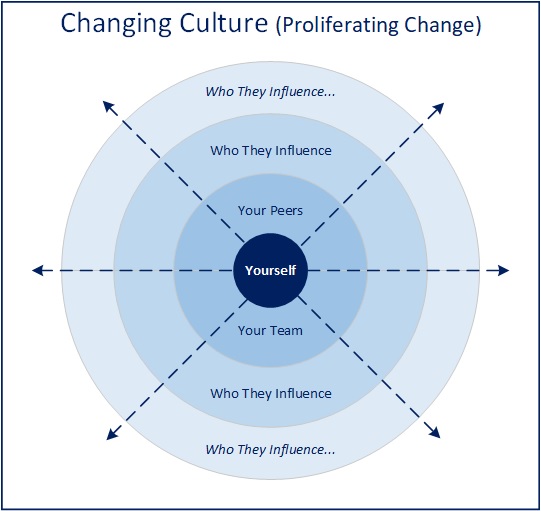
Incubate -> Demonstrate -> Extend
As the diagram above suggests, culture doesn’t change overnight, and being deliberate in the approach to change will have a significant impact to how effective and sustainable it is.
In general, the approach I’d recommend is to start from “center” with leadership, raise awareness, educate on the intent and value to the changes proposed, and incubate there. Broader communication in terms of the proposed shift is likely useful in preparing the next group to be engaged in the process, but the point is to start small, begin “living into” the desired model, evaluating its efficacy, and demonstrating the value it can create, THEN extend to the next (likely adjacent) set of people, and repeat the process over and over until the change has fully proliferated to the entire organization. The length of any given iteration would likely vary depending on the size of the employee population and the degree of change involved (more substantial = longer windows of time), but the point is to be conscious and deliberate in how it is approached so adjustments can be made along the way and to enable leaders to understand and internalize the “right” set of behaviors before expecting them to help advocate and reinforce it in others.
An Example (Building an Architecture Capability)
To provide a simple example, when trying to establish an architecture capability across an organization, it would need to ultimately span from the central enterprise architecture team down to technical leads on individual implementation teams. It would be impractical to implement the model all at once, so it would be more effective to stage it out, working from the top-down, first defining roles and responsibilities across the entire operating model, but then implementing one “layer” of roles at a time, until it is entirely in place.
Since architects are generally responsible for technical solution quality, but not execution, the deployment of the model would need to follow two coordinated paths: building the architecture capability itself and aligning it with the delivery leadership with which it is meant to collaborate and cooperate (e.g., project and program managers). Trying to establish the role without alignment and support from people leading and participating on delivery teams likely would fail or lead to ineffective implementation, which is another reason why a more thoughtful and deliberate approach to the change is required.
What does this have to do with culture? Well, architecture is fundamentally about solution quality in technology, reuse, managing complexity and cost of ownership, and enabling speed and disciplined innovation. Establishing roles with an accountability for quality will test the appetite within an organization when it comes to working beyond individual project goals and constraints to looking at more strategic objectives for simplification, speed, and reuse. Where courageous leadership and the right culture are not in place, evolving the IT operating model will be considerably more difficult, likely at every stage of the process.
Manage Reality
To this point, I’ve addressed change in a fairly uniform and somewhat idealistic manner, but reality is often quite different, so I wanted to explore a couple situations and how I think about the implications of each.
Non-Uniform Execution
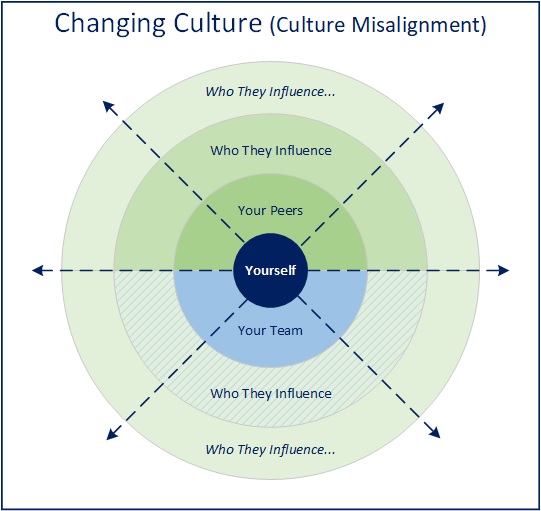
So, what happens when you change culture within your team, but it doesn’t extend into those who work directly with you? It depends on the nature of the change itself, of course, but likely the farther “out” from center you go, the more difficult it will be for your team to capitalize on whatever the intended benefits of the change were intended to be.
My assumptions here are in relation to medium- to larger-scale organizations, where the effects are magnified and it is impractical to “be everywhere, all the time” to engage in ways that help facilitate the desired change.
In the case that there isn’t broader alignment to whatever cultural adjustments you want to make within your team, depending on the degree of difference to the broader company culture, it may be necessary to clarify how “we operate internally” versus how “we engage with others”. The goal of drawing out that separation would be to try and drive performance improvement within your team, but not waste energy and create friction in your external interactions.
There is a potential risk in having teams with a very different culture than the broader organization if it creates an environment where there becomes an “us and them” mentality or a special treatment situation where that team demonstrates unhealthy organizational behaviors or is held to different standards than others. Ultimately those situations cause larger issues and should be avoided where possible.
Handling Disparate Cultures
Unlike the previous situation where there is one broader culture and a team operates in a slightly different manner; I’ve also seen situations where groups operate with very different cultures within the same overall organization and it can create substantial disconnects if not addressed effectively. When not addressed there can be a lot of internal friction, competition, and a lack of effective collaboration, which will hinder performance in one or more ways over time.
One way to manage a situation where there are multiple distinct cultures within a single organization, would first be to look for some level of core, universally accepted operating principles that can be applied to everyone, but then to focus entirely on the points of engagement across organizations, clarify roles and responsibilities for each constituent group, and manage to those dependencies the same as you would if working with a third-party provider or partner. The overall operating performance opportunity may not be fully realized, but this kind of approach could be used to provide clarity of expectations and reduce friction points to a large degree.
Wrapping Up
The purpose of this article was to come back to a core element that makes organizations successful over time, and that’s culture. To the degree that there are gaps or issues, it is always possible to adapt and evolve, but it takes a thoughtful approach, the right leadership, and time to make sustainable change. In my opinion, it is time worth spending to the degree that performance and excellence is your goal. It will never be “perfect” for many reasons, but thinking about how you establish, reinforce, and evolve it in a disciplined way can be the difference to remaining agile, competitive, and successful overall.
I hope the ideas were worth considering. Thanks for spending the time to read them. Feedback is welcome as always.
This is a question that I’ve heard asked many times, particularly when there is a strategic initiative or transformation effort being kicked off. Normally, the answer is an enthusiastic “Yes”, because most programs start with a lot of optimism (which is a good thing), but not always a full understanding of risk. The question is… How do you know whether you have the necessary capabilities to deliver?
In any type of organization, there is a blend of skills and experience, whether that is across a leadership team or within an individual team itself. Given that reality and the ongoing nature of organizations to evolve, realign, and reorganize, it is not uncommon to leverage some form of evaluation (such as a Kolbe assessment) to understand the natural strengths, communication, or leadership styles of various individuals to help facilitate understanding and improve collaboration.
But what about knowledge and experience? This part I haven’t seen done as often partially because, if not done well, it can lead to a cumbersome and manually intensive process that doesn’t create value.
The focus of this article is to suggest a means to understand and evaluate the breadth of knowledge and skills across a team. To the extent we can visualize collective capability, it can be a useful tool to inform various things from a management standpoint, which are outlined in the second section below.
Necessary caveats: The example used is not meant to be prescriptive or exhaustive and this activity doesn’t need to be focused on IT alone. The goal in the illustration used here was to provide enough specificity to help the reader visualize the concept at a practical level, but the data is entirely made up and not meant to be taken as a representation of an actual set of people.
On the Approach
Thinking through the Dimensions
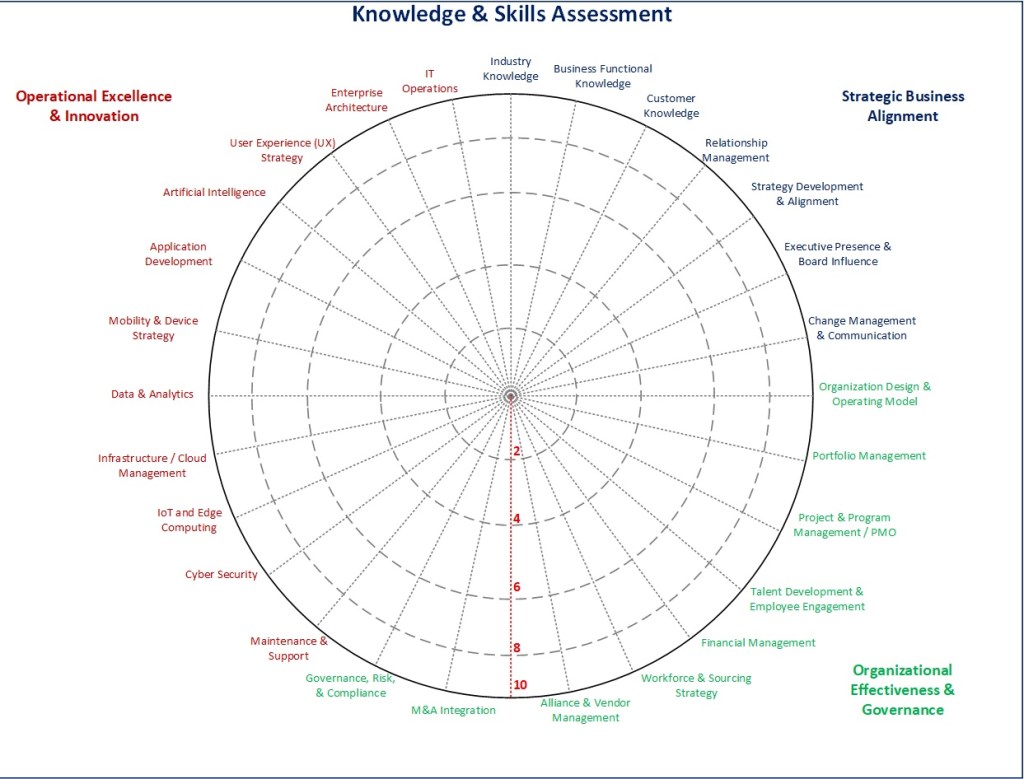
The diagram above breaks out 27 dimensions from a knowledge and skills standpoint, ranging from business understanding to operations and execution. The dimensions chosen for the purposes of this exercise don’t particularly matter, but I wanted to select a set that covered many of the aspects of an IT organization as a whole.
From an approach standpoint, the goal would be to identify what is being evaluated, select the right set of dimensions, define them, then determine “what good looks like” in terms of having a baseline for benchmarking (e.g., 10 means X, 8 means Y, 6 means Z, etc.). With the criteria established, one should then explain the activity to the group being evaluated, prepare a simple survey, and gather the data. The activity is meant to be rapid and directionally accurate, not to supplant individual performance evaluations, career development, or succession plans that should exist at a more detailed level. Ideally the dimensions should also align to the competency model for an organization, but the goal of this activity is directional, so that step isn’t critical if it requires too much effort.
Once data has been collected, individual results can be plotted in a spider graph like the one below to provide a perspective on where there are overlaps and gaps across a team.
Ways of Applying the Concept
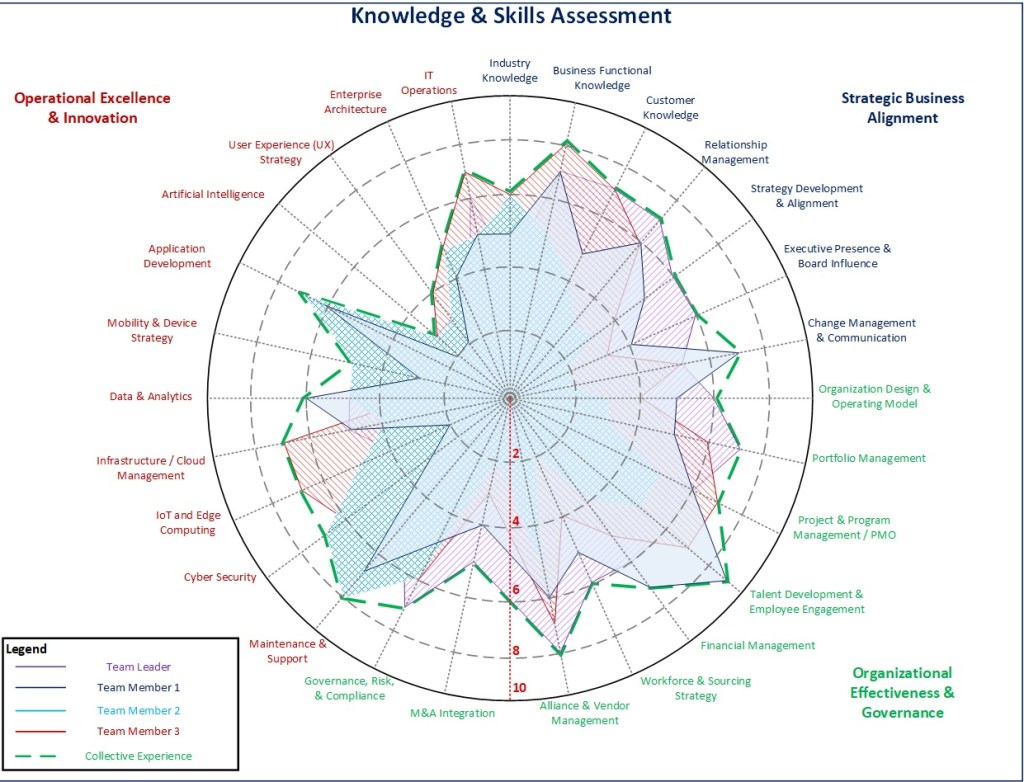
With the individual inputs from a team having been provided, it’s possible to think about the data in two different respects: how it reflects individual capabilities, gaps, and overlaps as well as what it shows as the collective experience of the team as a whole (the green dotted outline above).
The data now being assembled, there are a number of ways to potentially leverage the information outlined below.
Talent Development: The strengths and gaps in any individual view can be used to inform individual development plans or identify education needs for the team as a whole. It can also be used to sanity check individual roles and accountability against the actual experience of individuals on the team. This isn’t to suggest rotations and “learn on the job” situations aren’t a good thing, but rather to raise awareness of those situations so that they can be managed proactively with the individual or the team as a whole. To the extent that a gap with one person is a strength in another, there could be cross-training opportunities that surface through the process.
Coordination and Collaboration: With overlaps and gaps visible across a team, there can be areas identified where individual team members see opportunities to consult with others who have a similar skillset, and also perhaps a different background that could surface different ways to approach and solve problems. In larger organizations, it can often be difficult to know “who to invite” to a conversation, where the default becomes inviting everyone (or making everyone ‘mandatory’ versus ‘optional’), which ultimately can lead to less productive or over-attended conversations that lack focus.
Leaders and Teams: In the representative data above, I deliberately highlighted areas where team members were not as experienced as the person leading the team, but the converse situation as well. In my experience, it is almost never the case that the leader is the most experienced in everything within the scope of what a team has to do. If that was the case, it could suggest that the potential of that team could be limited to that leader’s individual capabilities and vision, because others lack the experience to help inform direction. In the event that team members have more experience than their leader, there can also be opportunities for individuals to step up and provide direction, assuming the team leader creates space and a supportive environment for that occur. Again, the point of the activity is to identify and determine what, if anything, to do with these disparities where they exist.
Sourcing Strategy: Where significant gaps exist (e.g., there is no one with substantial AI experience in the example data above), these could be areas where finding a preferred partner with a depth of experience in the topic could be beneficial while internal talent is acquired or developed (to the extent it is deemed strategic to the organization).
Business Partnership: The visibility could serve as input to a partnership discussion to align expectations for where business leaders expect support and capability from their technology counterparts versus areas where they are comfortable taking the lead or providing direction. This isn’t always a very deliberate conversation in my experience, and sometimes that can lead to missed expectations in complex delivery situations.
Risk Management: One of the most important things to recognize about a visualization like this is not just what it shows about a teams’ capability, it’s also what isn’t there.
Using Donald Rumsfeld’s now famous concept:
There is known – something for which we have facts and experience
There is known unknown – something we know is needed, but which is not yet clear
And the pure unknown – something outside our experience, and therefore a blind spot
The last category is where we should also focus in an activity like this, because the less experience that exists individually and collectively in a leadership team, there will be a substantial increase in risk because there is a lack of awareness of all the “known unknowns” that can have a material impact on delivering solutions and operating IT. To the extent that a team is relatively inexperienced, no matter how motivated they may be, there is an increased probability that something will be compromised, whether that is cost, quality, schedule, morale, or something else. To that end, this tool can be an important mechanism to identify and manage risk.
Wrapping Up
Having recently written a fairly thorough set of articles on the future of enterprise technology, I wanted to back up and look at something a little less complex, but also with a focus on improving transparency and informing leadership discussions on risk, development, and coordination.
Whether through a mechanism like this or some other avenue, I believe there is value in understanding the breadth of capabilities that exist within a team and across a leadership group as a means for promoting excellence overall.
I hope the ideas were worth considering. Thanks for spending the time to read them. Feedback is welcome as always.
Having had this blog for nearly four years, I took a look at the nature of the articles written to date, and subjects included therein, wondering if there were any patterns that emerged. I found the resulting chart (above) interesting as a reflection of the relative importance I associate with certain topics overall. To that end, I thought I’d provide some perspective on what’s been written to date before moving to the next article, whatever that may be.
Leadership and Culture
The two largest focus areas were leadership and culture, which isn’t surprising given I’ve worked for many years across corporate and consulting environments and have seen the relative impact that both can have on organizational performance on the whole. Nearly two-thirds of my articles to date touch on leadership and one-half on culture, because they are fundamental to setting the stage for everything else you want to accomplish.
In the case of organizational excellence, courageous leadership has to be at the top of the list, given that difficult decisions and a level of fearlessness are required to achieve great things. By contrast, hesitancy and complacency will almost always lead to suboptimized results, because there will be apprehension about innovating, challenging the status quo, and effectively managing relationships where the ability to be a partner and advisor may require difficult conversations at times.
With leadership firmly rooted, it becomes possible to establish a culture that promotes integrity, respect, collaboration, innovation, productivity, and results. Where one or more of these dimensions is missing, it is nearly impossible to be effective without compromising performance somewhere. That isn’t to say that you can’t deliver in an unhealthy environment, you certainly can and many organizations do. It is very likely, however, that those gains will be short-lived and difficult to repeat or sustain because of the consequential impact of those issues on the people working in those conditions over time. In this case, the metrics will likely tell the tale, between delivery performance, customer feedback, solution quality, and voluntary attrition (to name a few).
Delivery and Innovation
With the above foundation in place, the next two areas of focus were delivery and innovation, which is reassuring given that I believe strongly in the concept of actionable strategy versus one that is largely theoretical in nature. Having worked in environments that leaned heavily on innovation without enough substantive delivery as well as ones that delivered consistently but didn’t innovate enough, the answer is to ensure both are occurring on a continual basis and managed in a very deliberate way.
Said differently, if you innovate without delivering, you won’t create tangible business value. If you deliver without ever innovating, at some point, you will lose competitive advantage or risk obsolescence in some form or other.
The Role of Discipline
While not called out as a topic in itself, in most cases where I discuss delivery or IT operations, I mention discipline as well, because I believe it is a critical component of pursuing excellence in anything. The odd contradiction that exists, is the notion that having discipline somehow implies bureaucracy or moving slowly, when the reality is the exact opposite.
Without defined, measurable, and repeatable processes, it is nearly impossible to drive continuous improvement and establish a more predictable operating environment over time. From a delivery standpoint, having methodology isn’t about being prescriptive to the point that you lose agility, as an example, it’s about having an understood approach that you can estimate and plan effectively. It also defines rules of engagement within and across teams so that you can partner and execute efficiently in a repeatable fashion. Having consistent processes also allows for monitoring, governing, and improving the efficiency and efficacy of how things are done over time.
The same could be said for leveraging architectural frameworks, common services, and design patterns as well. There is a cost for establishing these things, but if you amortize these investments over time, they ultimately improve speed, reduce risk, improve quality, and thereby reduce TCO and complexity of an environment once they are in place. This is because every team doesn’t invent their own way of doing things, ultimately creating complexity that needs to be maintained and supported down the road. Said differently, it would be very difficult to have reliable estimation metrics when you never do something in a consistent way and analyze variance.
Mental Models and Visualization
The articles also reflect that I prefer having a logical construct and visualizations to organize, illustrate, analyze, and evaluate complex situations, such as AI and data strategy, workforce and sourcing strategy, digital manufacturing facilities, and various other situations. Any of these topics involve many dimensions and layers of associated complexity. Having a mental model, whether it is a functional decomposition, component model, or some other framework, is helpful for both identifying the dimensions of a problem, and also surfacing dependencies and relationships in the interest of driving transformation.
Visualizations also can help facilitate alignment across broader groups of stakeholders where a level of parallel execution is required, making dependencies and relationships more evident and easier to coordinate.
Wrapping Up
Overall, the purpose of writing this article was simply to pause and reflect on what has become a fairly substantive body of work over the last several years, along with recognizing the themes that reoccur time and again because they matter when excellence is your goal. Achieving great things consistently is a byproduct of having vision, effective leadership, discipline, commitment, and a lot of tenacity.
I hope the ideas were worth considering. Thanks for spending the time to read them. Feedback is welcome as always.













 Organized Chaos