What It Is: An overall IT Strategy sets direction for an organization, providing a framework for the services IT provides, along with key dimensions and objectives, with flexibility to evolve over time
Why It Matters: With the ever-increasing demand for innovation in a competitive, but cost-conscious environment, a thoughtful strategy accelerates results, reduces cost and risk, and enables sustainability
Key Concepts
Technology strategy always needs to be rooted in a business-enabling approach
It is tempting to over-index on one dimension (e.g., cost management) and sacrifice capability
Excellence in IT is rooted in having business aligned objectives, with a disciplined approach
This model is organized around five key dimensions, which should be defined and prioritized
A simple IT scorecard could be created using how business partners evaluate each dimension
This article focuses on delivering IT objectives, IT Excellence focuses on “how to operate” in IT
Key Dimensions
Innovate – Promote Competitive Advantage
Map to business goals, establish a disciplined innovation process aligned to architecture strategy
What It Is: Manufacturing continues to move rapidly down a continuum from the highly manual to the digital, from disconnected, asynchronous activities to integrated, orchestrated actions, across an ever-expanding and diverse set of components
Why It Matters: Defining a holistic strategy that enables agility and flexibility, that provides structure without limiting innovation, can be a highly complex activity, but one that is well worth the investment given the right strategy can unlock value in multiple ways (production capacity, productivity, improved quality and safety, etc.), particularly in situations where there is a diverse footprint in place
Key Concepts
Design with a framework in mind, that is intended to connect, monitor, track, orchestrate, and optimize performance within and across digital facilities
Establish data ownership, data management, and data governance to enable long-term value
Think of individual facilities as having varied configurations of logically common components
Manage individual components so that they can be relatively commoditized and replaced easily
Understand that the goal is to optimize the overall system, harmonizing workers and equipment
Design the framework to enable adding individual components rapidly, with minimal disruption
Leverage the framework to create an environment that can simulate changes pre-deployment
Define strategies to insulate legacy equipment so that it integrates the same as modern assets
Work with OEMs to facilitate transition between bolt-on analytics to intelligent equipment
Integrate AR where it provides incremental value without adding complexity / distraction
Reduce complexity with AI, enabling operators to be more productive, effective, and safe
Integrate learning and development content dynamically based on operator experience
Approach
Provide required internal/external connectivity, infrastructure, and monitoring across locations
Identify connected components across facilities by function (equipment, devices, sensors, etc.)
Define relevant personas and capabilities to enable digital workers (shop floor to facility leaders)
Architect the environment to treat individual components as actors in a connected ecosystem
Identify integration standards and relevant characteristics per component to enable analytics
Design facility data solutions to allow for structured and unstructured data aligned to the cloud
Establish an infrastructure for orchestration that can coordinate activity across connected actors
Gather, analyze, and optimize processes given performance data and operating characteristics
Analyze observations centrally to leverage insights and opportunities across similar facilities
Extend the boundaries of orchestration incorporate customers, suppliers, and partners
It ought to be easier (and cheaper) to run a business than this…
Complexity and higher than desirable operating cost are prevalent in most medium- to large-scale organizations. With that, generally some interest follows in exploring ways to reduce and simplify the technology footprint, to reduce ongoing expenses, mitigate risk and limit security exposure, and free up capital either to reinvest in more differentiated and value-added activity, or to contribute directly to the bottom line overall.
The challenge is really in trying to find the right approach to simplification that is analytically sound while providing insight at speed so you can get to the work and not spend more time “analyzing” than is required at any step of the process.
In starting to outline the content for this article, aside from identifying the steps in a rationalization process and working through a practical example to illustrate some scenarios that can occur, I also started noting some other, more intangible aspects to the work that have come up in my experience. When that list reached ten different dimensions, I realized that I needed to split what was intended to be a single article on this topic into two parts: one that addresses the process aspects of simplification and one that addresses the more intangible and organizational/change management-oriented dimensions. This piece is focused on the intangibles, because the environment in which you operate is critical to setting the stage for the work and ultimate results you achieve.
The Remainder of this Article…
The dimensions that came to mind fell into three broader categories, into which they are organized below, they are:
Leading and Managing Change
Guiding the Process and Setting Goals
Planning and Governance
For each dimension, I’ll try to provide some perspective on why it matters and some potential ideas to consider in the interest of addressing them in the context of a simplification effort overall.
Leading and Managing Change
At its core, simplification is a change management and transformational activity and needs to be approached as such. It is as much about managing the intangibles and maintaining healthy relationships as anything to do with the process you follow or opportunities you surface. Certainly, the structural aspects and the methodology matter, but without giving attention to the items below, likely you will have either some very rough sledding in execution, suboptimize your outcomes, or fail altogether. Said differently: the steps you follow are only part of the work, improving your operating environment is critically important.
Leadership and Culture Matter
Like anything else that corresponds to establishing excellence in technology, courageous leadership and an enabling culture are fundamental to a simplification activity. The entire premise associated with this work rests in change and, wherever change is required,there will be friction and resistance, and potentially significant resistance at that.
Some things to consider:
Putting the purpose and objective of the change front and center and reinforcing it often (likely reducing operating expense in the interest of improving profitability or freeing up capital for discretionary spending)
Working with a win-win mindset, looking for mutual advantage, building partnerships, listening with empathy, and seeking to enroll as many people in the cause as possible over time
Being laser-focused on impact, not solely on “delivery”, as the outcomes of the effort matter
Remaining resilient, humble (to the extent that there will be learnings along the way), and adaptable, working with key stakeholders to find the right balance between speed and value
It’s Not About the Process, It’s About Your Relationships
Much like portfolio management, it is easy to become overly focused on the process and data with simplification work and lose sight of the criticality of maintaining a healthy business/technology partnership. If IT has historically operated in an order taker mode, suggesting potentially significant changes to core business applications that involve training large numbers of end users (and the associated productivity losses and operating disruptions that come with that) may go nowhere, regardless of how analytically sound your process is.
Some things to consider:
Know and engage your customer. Different teams have different needs, strategies, priorities, risk tolerance, and so on
You can gather data and analyze your environment (to a degree) independent of your business partners, but they need to be equally invested in the vision and plan for it to be successful
Establishing a cadence, individually and collectively, with key stakeholders, aligned to the pace of the work, minimally to maintain a healthy, transparent, and open dialogue on objectives, opportunities, risks, and required inventions and support, is important
Be a Historian as Much as You are an Auditor
Back to the point above on improving the operating environment being as important as your process/ methodology, it is important to recognize something up front in the simplification process: you need to understand how you got where you are as part of the exercise, or you may end right back there as you try to make things “better”. It could be that complexity is a result of a sequence of acquisitions, a set of decentralized decisions without effective oversight or governance, functional or capability gaps in enterprise solutions being addressed at a “local” level, underlying culture or delivery issues, etc. Knowing the root causes matters.
As an example, I once saw a situation where two teams implemented different versions of the same application (in different configurations) purely because the technology leaders didn’t want to work with each other. The same application could’ve supported both organizations, but the decisions were made without enterprise-level governance, the operating complexity and TCO increased, and the subsequent cost to consolidate into a single instance was deemed “lower priority” than continuing work. While this is a very specific example, the point is that understanding how complexity is created can be very important in pivoting to a more streamlined environment.
Some things to consider:
As part of the inventory activity, look beyond pure data collection to having an opportunity to understand how the various portfolios of applications came about over time, the decisions that led to the complexity that exists, the pain points, and what is viewed as working well (and why)
Use the insights obtained to establish a set of criteria to consider in the formation of the vision and roadmap for the future so you have a sense whether the changes you’re making will be sustainable. These considerations could also help identify risks that could surface during implementation that could reintroduce the kind of complexity in place today
What Defines “Success”
Normally, a simplification strategy is based on a snapshot of a point in time, with an associated reduction in overall cost (or shift in overall spend distribution) and/assets (applications, data solutions, etc.). This is generally a good way to establish the case for change and desired outcome of the activity itself, but it doesn’t necessarily cover what is “different” about the future state beyond a couple core metrics. I would argue that it is also important to consider what I mentioned in the previous point, which is how the organization developed a complex footprint to begin with.
As an example, if complexity was caused by a rapid series of acquisitions, even if I do a good job of reducing or simplifying the footprint in place, if I continue to acquire new assets, I will end up right back where I was, with a higher operating cost than I’d like. In this case, part of your objective could be to have a more effective process for integrating acquisitions.
Some things to consider:
Beyond the financial and operating targets, identify any necessary process or organizational changes needed to facilitate sustainability of the environment overall
This could involve something as simple as reviewing enterprise-level governance processes, or more structural changes in how the underlying technology footprint is managed
Guiding the Process and Setting Goals
A Small Amount of Good Data is Considerably Better than a Lot of Bad
As with any business situation, it’s tempting to assume that having more data is automatically a good thing. In the case of maintaining an asset inventory, the larger and more diverse an organization is, the more difficult it is to maintain the data with any accuracy. To that end, I’m a very strong believer in maintaining as little information as possible, doing deep dives into detail only as required to support design-level work.
As an example, we could start the process by identifying functional redundancies (at a category/component level) and spend allocations within and across portfolios as a means to surface overall savings opportunity and target areas for further analysis. That requires a critical, minimum set of data, but at a reasonable level of administrative overhead. Once specific target areas are identified and prioritized, further data gathering in the interest of comparing different solutions, performing gap analyses, and identifying candidate future state solutions can be done as a separate process. This approach is prioritizing going broad (to Define opportunities) versus going deep (to Design the solution), and I would argue it is a much more effective and efficient way to go about simplification, especially if the underlying footprint has any level of volatility where the more detailed information will become outdated relatively quickly.
Some things to consider:
Prioritize a critical, minimum set of data (primary functions served by an application, associated TCO, level of criticality, businesses/operating units supported, etc.) to understand spend allocation in relation to the operating and technology footprint
Deep dive into more particulars (functional differences across similar systems within a given category) as part of a specific design activity downstream of opportunity identification
Be Greedy, But Realistic
The simplification process is generally going to be iterative in nature, insofar as there may be a conceptual target for complexity and spend reduction/reallocation at the outset, some analysis is performed, the data provides insight on what is possible, the targets are adjusted, further analysis or implementation is performed, the picture is further refined, and so on.
In general, my experience is that there are always going to be issues in what you can practically pursue, and therefore, it is a good idea to overshoot your targets. By this, I mean that we should strive to identify more than our original savings goals because if we limit the level of opportunities we identify to a preconceived goal or target, we may either suboptimize the business outcome if things go well, or fall short of expectations in the event we are able to pursue only a subset of what is originally identified for various business, technology, or implementation-related issues.
Some things to consider:
Review opportunities, asking what would be different if you could only pursue smaller, incremental efforts, had a target that was twice what you’ve identified, could start from scratch and completely redefine your footprint with an “optimal case” in mind… and consider what, if anything would change about your scope and approach
Planning and Governance
Approach Matters
Part of the challenge with simplification is knowing where to begin. Do you cover all of the footprint, the fringe (lower priority assets), the higher cost/core systems? The larger an organization is, the more important it is to target the right opportunities quickly in your approach and not try to boil the ocean. That generally doesn’t work.
I would argue that the primary question to understand in terms of targeting a starting point is where you are overall from a business standpoint. The first iteration of any new process tends to generate learnings and improvements, so there will be more disruption than expected the first time you execute the process end-to-end. To that point, if there is a significant amount of business risk to making widespread, foundational changes, it may make sense to start on lower risk, clean up type activities on non-core/supporting applications (e.g., Treasury, Tax, EH&S, etc.) by comparison with core solutions (like an ERP, MES, Underwriting, Policy Admin, etc.). On the other hand, if simplification is meant to help streamline core processes, enable speed-to-market and competitive advantage, or some form of business growth, it could be that focusing on core platforms first is the right approach to take.
The point is that the approach should not be developed independent of the overall business environment and strategy, they need to align with each other.
Some things to consider:
As part of the application portfolio analysis, understand the business criticality of each application, level of planned changes and enhancements, how those enable upcoming strategic business goals, etc.
Consider how the roadmap will enable business outcomes over time; whether that is ideally a slow, build process of incremental gains, or more of a big bets, high impact changes that materially affect business value and IT spend
Accuracy is More Important Than Precision
This point may seem to contradict what I wrote earlier in terms of having a smaller amount of good data, but the point here is that it’s important to acknowledge in a transformation effort that there is a directly proportional relationship between the degree of change involved in the effort and the associated level of uncertainty in the eventual outcome. Said differently: the more you change, the less you can predict the result with any precision.
This is true because there is a limited level of data generally available in terms of the operating impact of changes to people, process, and technology. Consequently, the more you change in terms of one or more of those elements, your ability to predict the exact outcome from a metrics standpoint (beyond a more anecdotal/conceptual level) will be limited. In line with the concepts that I shared in the recent “Intelligent Enterprise 2.0” series, with orchestration and AI, I believe we can gather, analyze, and leverage a greater base of this kind of data, but the infrastructure to do this largely doesn’t exist in most organizations I’ve seen today.
Some things to consider:
Be mindful not to “overanalyze” the impact of process changes up front in the simplification effort. The business case will generally be based on the overall reduction in assets/ complexity, changes in TCO, and shifts (or reductions) in staffing levels from the current state
It is very difficult to predict the end state when a large number of applications are transitioned as part of a simplification program, so allow for a degree of contingency in the planning process (in schedule and finances) rather than spending time. Some things that may not appear critical generally will reveal themselves to be only in implementation, some applications that you believe you can decommission will remain for a host of reasons, and so on. The best laid plans on paper rarely prove out exactly in the course of execution depending on the complexity of the operating environment and culture in place
Expect Resistance and Expect a Mess
Any large program in my experience tends to go through an “optimism” phase, where you identify a vision and fairly significant, transformative goal, the business case and plan looks good, it’s been vetted and stakeholders are aligned, and you have all the normal “launch” related events that generate enthusiasm and momentum towards the future… and then reality sets in, and the optimism phase ends.
Having written more than once on Transformation, the reality is that it is messy and challenging, for a multitude of reasons, starting with patience, adaptability, and tenacity it takes to really facilitate change at a systemic level. Status quo feels safe and comforting, it is known, and upsetting that reality will necessarily lead to friction, resistance, and obstacles throughout the process.
Some things to consider:
Set realistic goals for the program at the outset, acknowledge that it is a journey, that sustainable change takes time, the approach will evolve as you deliver and learn, and that engagement, communication, and commitment are the non-negotiables you need throughout to help inform the right decisions at the right time to promote success
Plan with the 30-, 60-, and 90-day goals in mind, but acknowledge that any roadmap beyond the immediate execution window will be informed by delivery and likely evolve over time. I’ve seen quite a lot of time wasted on detailed planning more than one year out where a goal-based plan with conceptual milestones would’ve provided equal value from a planning and CBA standpoint
Govern Efficiently and Adjust Responsively
Given the scale and complexity of simplification efforts, it would be relatively easy to “over-report” on a program of this type and cause adverse impact on the work itself. In line with previous articles that I’ve written on governance and transparency, my point of view is that the focus needs to be on enabling delivery and effective risk management, not administrative overhead.
Some things to consider:
Establish a cadence for governance early on to review ongoing delivery, identify interventions and support needed, learnings that can inform future planning, and adjust goals as needed
Large programs succeed or fail in my experience based on maintaining good transparency to where you are, identifying course corrections when needed, and making those adjustments quickly to minimize the cost of “the turns” when they inevitably happen. Momentum is so critical in transformation efforts that minimizing these impacts is really important to keeping things on track
Wrapping Up
Overall, the reason for separating the process from the change in addressing simplification was deliberate, because both aspects matter. You can have a thoughtful, well executed process and accomplish nothing in terms of change and you can equally be very mindful of the environment and changes you want to bring about, but the execution model needs to be solid, or you will lose any momentum and good will you’ve built in support of your effort.
Ultimately, recognizing that you’re both engaging in a change and a delivery activity is the critical takeaway. Most medium- to large-scale environments end up complex for a host of reasons. You can change the footprint, but you need to change the environment as well, or it’s only a matter of time before you’ll find yourself right back where you started, perhaps with a different set of assets, but a lot of same problems you had in the first place.
I hope the ideas were worth considering. Thanks for spending the time to read them. Feedback is welcome as always.
Does having more data automatically make us more productive or effective?
When I wrote the original article on “The Intelligent Enterprise”, I noted that the overall ecosystem for analytics needed to change. In many environments, data is moved from applications to secondary solutions, such as data lakes, marts, or warehouses, enriched and integrated with other data sets, to produce analytical outputs or dashboards to provide transparency into operating performance. Much of this is reactive and ‘after-the-fact’ analysis of things we want to do right or optimize the first time, as events occur. The extension of that thought process was to move those insights to the front of the process, integrate them with the work as it is performed, and create a set of “intelligent applications” that would drive efficiency and effectiveness to different levels than we’ve been able to accomplish before. Does this eliminate the need for downstream analytics, dashboards, and reporting? No, for many reasons, but the point is to think about how we can make the future data and analytics environment about establishing a model that enables insight-driven, orchestrated action.
This is the fifth post in a series focused on where I believe technology is heading, with an eye towards a more harmonious integration and synthesis of applications, AI, and data… what I previously referred to in March of 2022 as “The Intelligent Enterprise”. The sooner we begin to operate off a unified view of how to align, integrate, and leverage these oftentimes disjointed capabilities today, the faster an organization will leapfrog others in their ability to drive sustainable productivity, profitability, and competitive advantage.
Design Dimensions
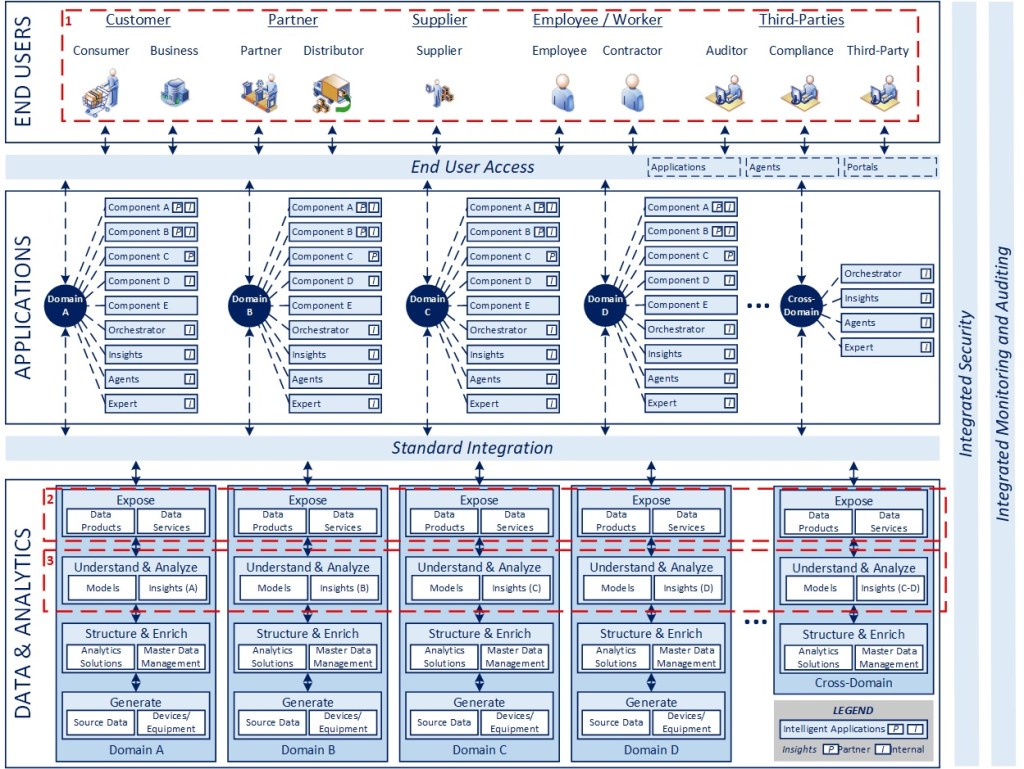
In line with the blueprint above, articles 2-5 highlight key dimensions of the model in the interest of clarifying various aspects of the conceptual design. I am not planning to delve into specific packages or technologies that can be used to implement these concepts as the best way to do something always evolves in technology, while design patterns tend to last. The highlighted areas and associated numbers on the diagram correspond to the dimensions described below.
Starting with the Consumer (1)
“Just give me all the data” is a request that isn’t unusual in technology. Whether that is a byproduct of the challenges associated with completing analytics projects, a lack of clear requirements, or something else, these situations cause an immediate issue in practice: what is the quality of the underlying data and what are we actually trying to do with it?
It’s tempting to start an analytics effort from the data storage and to work our way up the stack to the eventual consumer. Arguably, this is a central premise in being “data-centric.” While I agree with the importance of data governance and management (the next topic), it doesn’t mean everything is relevant or useful to an end consumer, and too much data very likely just creates management overhead, technical complexity, and information overload.
A thoughtful approach needs to start with identifying the end consumers of the data, their relative priority, information and insights needs, and then developing a strategy to deliver those capabilities over time. In a perfect world, that should leverage a common approach and delivery infrastructure so that it can be provided in iterations and elaborated to include broader data sets and capabilities across domains over time. The data set should be on par with having an integrated data model and consistent way of delivering data products and analytics services that can be consumed by intelligent applications, agents, and solutions supporting the end consumer.
As an interesting parallel, it is worth noting that ChatGPT is looking to converge their reasoning and large language models from 4x into a single approach for their 5x release so that end customers don’t need to be concerned with having selected the “right” model for their inquiry. It shouldn’t matter to the data consumer. The engine should be smart enough to leverage the right capabilities based on the nature of the request, and that is what I am suggesting in this regard.
Data Management and Governance (2)
Without the right level of business ownership, the infrastructure for data and analytics doesn’t really matter, because the value to be obtained from optimizing the technology stack will be limited by the quality of the data itself.
Starting with master data, it is critical to identify and establish data governance and management for the critical, minimum amount of data in each domain (e.g., customer in sales, chart of accounts in finance), and the relationship between those entities in terms of an enterprise data model.
Governing data quality has a cost and requires time, depending on the level of tooling and infrastructure in place, and it is important to weigh the value of the expected outcomes in relation to the complexity of the operating environment overall (people, process, and technology combined).
From Content to Causation (3)
Finally, with the level of attention given to Generative AI and LLMs, it is important to note the value to be realized when we shift our focus from content to processes and transactions in the interest of understanding causation and influencing business outcomes.
In a manufacturing context, the increasing level of interplay between digital equipment, digital sensors, robotics, applications, and digital workers, there is a significant opportunity to orchestrate, gather and analyze increasing volumes of data, and ultimately optimize production capacity, avoid unplanned events, and increase the safety and efficacy of workers on the shop floor. This requires deliberate and intentional design, with outcomes in mind.
The good news is that technologies are advancing in their ability to analyze large data sets and derive models to represent the characteristics and relationships across various actors in play and I believe we’ve only begun to scratch the surface on the potential for value creation in this regard.
Summing Up
Pulling back to the overall level, data is critical, but it’s not the endgame. Designing the future enterprise technology environment is about exposing and delivering the services that enable insightful, orchestrated action on behalf of the consumers of that technology. That environment will be a combination of applications, AI, and data and analytics, synthesized into one meaningful, seamless experience. The question is how long it will take us to make that possible. The sooner we begin the journey of designing that future state with agility, flexibility, and integration in mind, the better.
Having now elaborated the framework and each of the individual dimensions, the remaining two articles will focus on how to approach moving from the current to future state and how to think about the organizational implications on IT.
Up Next: Managing Transition
I hope the ideas were worth considering. Thanks for spending the time to read them. Feedback is welcome as always.
No one builds applications or uses new technology with the intention of making things worse… and yet we have and still do at times.
Why does this occur, time and again, with technology? The latest thing was supposed to “disrupt” or “transform” everything. I read something that suggested this was it. The thing we needed to do, that a large percentage of companies were planning, that was going to represent $Y billions of spending two years from now, generating disproportionate efficiency, profitability, and so on. Two years later (if that), there was something else being discussed, a considerable number of “learnings” from the previous exercise, but the focus was no longer the same… whether that was windows applications and client/server computing, the internet, enterprise middleware, CRM, Big Data, data lakes, SaaS, PaaS, microservices, mobile applications, converged infrastructure, public cloud… the list is quite long and I’m not sure that productivity and the value/cost equation for technology investments is any better in many cases.
The belief that technology can have such a major impact and the degree of continual change involved have always made the work challenging, inspiring, and fun. That being said, the tendency to rush into the next advance without forming a thoughtful strategy or being deliberate about execution can be perilous in what it often leaves behind, which is generally frustration for the end users/consumers of those solutions and more unrealized benefits and technical debt for an organization. We have to do better with AI, bringing intelligence into the way we work, not treating it as something separate entirely. That’s when we will realize the full potential of the capabilities these technologies provide. In the case of an application portfolio, this is about our evolution to a suite of intelligent applications that fit into the connected ecosystem framework I described earlier in the series.
This is the fourth post in a series focused on where I believe technology is heading, with an eye towards a more harmonious integration and synthesis of applications, AI, and data… what I previously referred to in March of 2022 as “The Intelligent Enterprise”. The sooner we begin to operate off a unified view of how to align, integrate, and leverage these oftentimes disjointed capabilities today, the faster an organization will leapfrog others in their ability to drive sustainable productivity, profitability, and competitive advantage.
Design Dimensions
In line with the blueprint above, articles 2-5 highlight key dimensions of the model in the interest of clarifying various aspects of the conceptual design. I am not planning to delve into specific packages or technologies that can be used to implement these concepts as the best way to do something always evolves in technology, while design patterns tend to last. The highlighted areas and associated numbers on the diagram correspond to the dimensions described below.
Before exploring various scenarios for how we will evolve the application landscape, it’s important to note a couple overall assumptions:
End user needs and understanding should come first, then the capabilities
Not every application needs to evolve. There should be a benefit to doing so
I believe the vast majority of product/platform providers will eventually provide AI capabilities
Providing application services doesn’t mean I have to have a “front-end” in the future
Governance is critical, especially to the extent that citizen development is encouraged
If we’re not mindful how many AI apps we deploy, we will cause confusion and productivity loss because of the fragmented experience
Purchased Software (1)
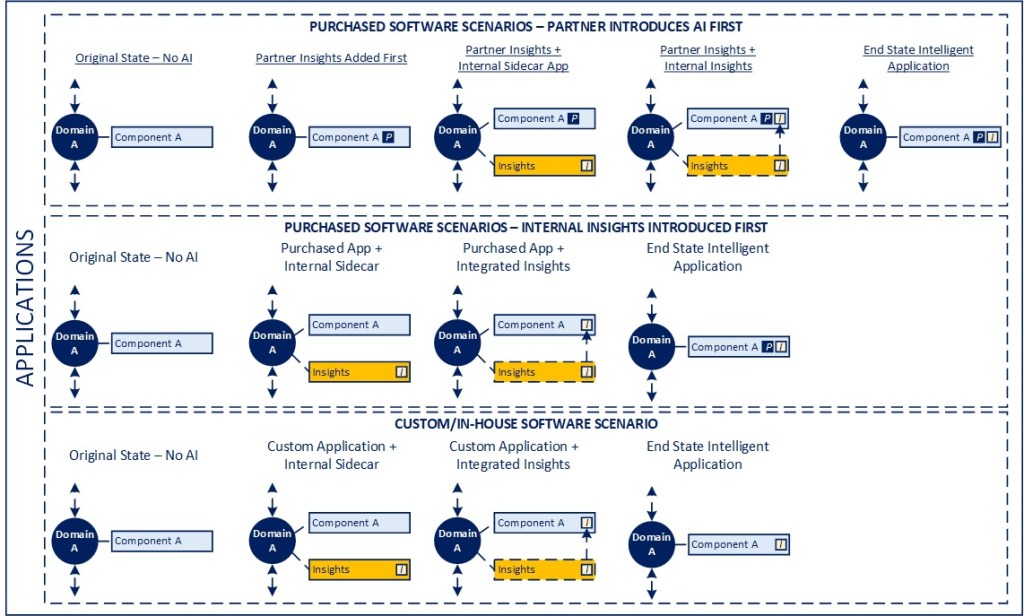
The diagram below highlights a few different scenarios for how I believe intelligence will find its way into applications.
In the case of purchased applications, between the market buzz and continuing desire for differentiation, it is extremely likely that a large share of purchased software products and platforms will have some level of “AI” included in the future, whether that is an AI/ML capability leveraging OLTP data that lives within its ecosystem, or something more causal and advanced in nature.
I believe it is important to delineate between internally generated insights and ones coming as part of a package for several reasons. First, we may not always want to include proprietary data on purchased solutions, especially to the degree they are hosted in the public cloud and we don’t want to expose our internal data to that environment from a security, privacy, or compliance standpoint. Second, we may not want to expose the rules and IP associated with our decisioning and specific business processes to the solution provider. Third, to the degree we maintain these as separate things, we create flexibility to potentially migrate to a different platform more easily than if we are tightly woven into a specific package. And, finally, the required data ingress to comingle a larger data set to expand the nature of what a package could provide “out of the box” may inflate operating costs of the platforms unnecessarily (this can definitely be the case with ERP platforms).
The overall assumption is that, rather than require custom enhancements of a base product, the goal from an architecture standpoint would be for the application to be able to consume and display information from an external AI service that is provided from your organization. This is available today within multiple ERP platforms, as an example.
The graphic below shows two different migration paths towards a future state where applications have both package and internally provided AI capabilities, one where the package provider moves first, internal capabilities are developed in parallel as a sidecar application, and then eventually fully integrated into the platform as a service, and the other way around, assuming the internal capability is developed first, run in parallel, then folded into the platform solution.
Custom-Developed Software (2)
In terms of custom software, the challenge is, first, evaluating whether there is value in introducing additional capabilities for the end user and, second, understanding the implications for trying to integrate the capabilities into the application itself versus leaving them separate.
In the event that there is uncertainty on the end user value of having the capability, implementing the insights as a side car / standalone application, then looking to integrate them within the application as an integrated capability a second step may be the best approach.
If a significant amount of redesign or modernization is required to directly integrate the capabilities, it may make sense to either evaluate market alternatives as a replacement to the internal application or to leave the insights separate entirely. Similar to purchased products, the insights should be delivered as a service and integrated into the application versus being built as an enhancement to provide greater flexibility for how they are leveraged and to simplify migrations to a different solution in the future.
The third scenario in the diagram above is meant to reflect a separate insights application that is then folded into the custom application as a service over time, so that it is a more seamless experience for the end user over time.
Either way, whether it be a purchased or custom-built solution, the important points are to decouple the insights from the applications to provide flexibility, but also to think about both providing a front-end for users to interact with the applications, but also to allow for a service-based approach as well, so that an agent acting on behalf of the user or the system itself could orchestrate various capabilities exposed from that application without the need for user intervention.
From Disconnected to Integrated Insights (3)
One of the reasons for separating out these various migration scenarios is to highlight the risk that introducing too many sidecar or special/single purpose applications could cause significant complexity if not managed and governed carefully. Insights should serve a process or need, and if the goal is to make a user more productive, effective, or safer, those capabilities should ultimately be used to create more intelligent applications that are easier to use. To that end, there likely would be value in working through a full product lifecycle when introducing new capabilities, to determine whether it is meant to be preserved, integrated with a core application (as a service), or tested and possibly decommissioned once a more integrated capability is available.
Summing Up
While the experience of a consumer of technology likely will change and (hopefully) become more intuitive and convenient with the introduction of AI and agents, the need to be thoughtful in how we develop an application architecture strategy, leverage components and services, and put the end user first will be priorities if we are going to obtain the value of these capabilities at an enterprise level. Intelligent applications is where we are headed and our ability to work with an integrated vision of the future will be critical to realizing the benefits available in that world.
The next article will focus on how we should think about the data and analytics environment in the future state.
Up Next: Deconstructing Data-Centricity
I hope the ideas were worth considering. Thanks for spending the time to read them. Feedback is welcome as always.
Why does it take so much time to do anything strategic?
This not an uncommon question to hear in technology and, more often than not, the answer is relatively simple: because the focus in the organization is delivering projects and not establishing an environment to facilitate accelerated delivery at scale. Those are two very different things and, unfortunately, it requires more thought, partnership, and collaboration between business and technology teams than headlines like “let’s implement product teams” or “let’s do an Agile transformation” imply. Can those mechanisms be part of how you execute in a scaled environment? Absolutely, but choosing an operating approach and methodology shouldn’t precede or take priority over having a blueprint to begin with, and that’s the focus of this article.
This is the second post in a series focused on where I believe technology is heading, with an eye towards a more harmonious integration and synthesis of applications, AI, and data… what I previously referred to in March of 2022 as “The Intelligent Enterprise”. The sooner we begin to operate off a unified view of how to align, integrate, and leverage these oftentimes disjointed capabilities today, the faster an organization will leapfrog others in their ability to drive sustainable productivity, profitability, and competitive advantage.
Design Dimensions
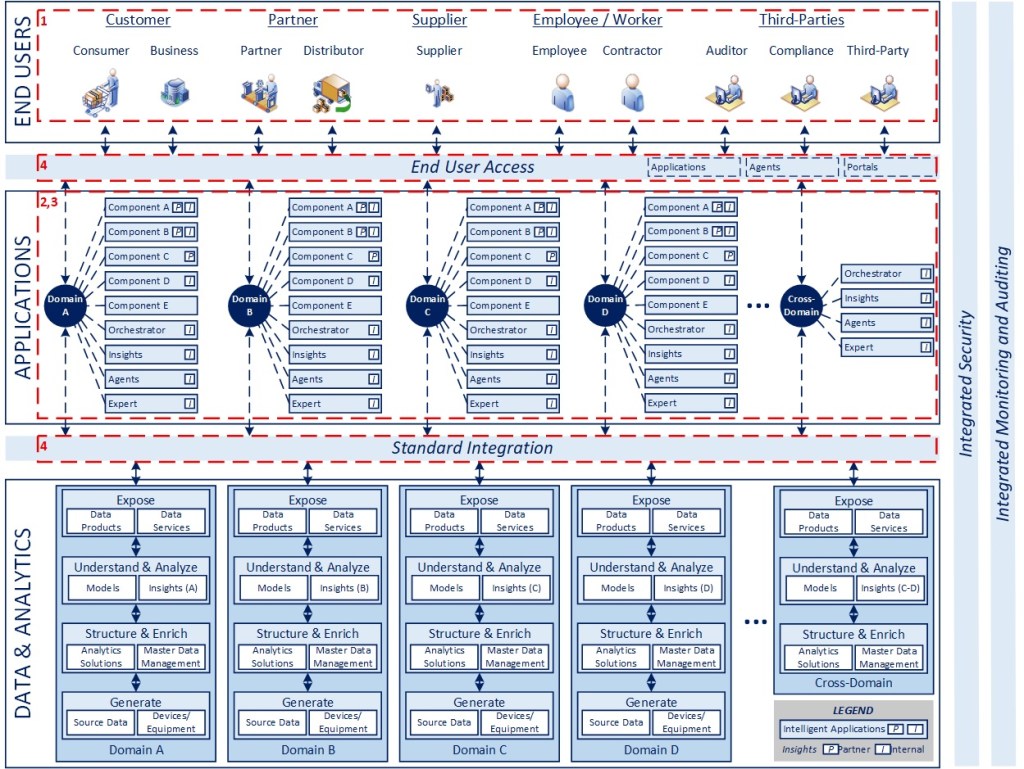
In line with the blueprint above, articles 2-5 highlight key dimensions of the model in the interest of clarifying various aspects of the conceptual design. I am not planning to delve into specific packages or technologies that can be used to implement these concepts as the best way to do something always evolves in technology, while design patterns tend to last. The highlighted areas and associated numbers on the diagram correspond to the dimensions described below.
User-Centered Design (1)
A firm conducts a research project on behalf of a fast-food chain. There is always a “coffee slick” in the drive thru, where customers stop and pour out part of their beverage. Is there something wrong with the coffee? No. Customers are worried about burning themselves. The employees are constantly overfilling the drink, assuming that they are being generous, but actually creating a safety concern by accident. Customers don’t want to spill their coffee, so that excess immediately goes to waste.
In the world of technology, the idea of putting enabling technology in the hands of “empowered” end users or delivering that one more “game changing” tool or application is tempting, but often doesn’t deliver the value that is originally expected. This can occur for a multitude of reasons, but what can often be the case is an inadequate understanding of the end user’s mental model, approach to performing their work, or a fundamental misunderstanding that more technology in the hands of a user is always a good thing (when it definitely isn’t the case).
Two learnings that came out of the dotcom era were, first, the value to be derived from investing in user-centered design, thinking through their needs and workflow, and designing experiences around that. The other common practice was assuming that a disruptive technology (the internet in this case) was cause to spin out a separate organization (the “eBusiness” teams of the time) meant to incubate and accelerate development of capabilities that embraced the new technology. These teams generally lacked a broader understanding of the “traditional” business and its associated operating requirements, and thus began the ”bricks versus clicks” issues and channel conflict that eventually led to these capabilities being folded back into the broader organization, but only after having spent time and (in many cases) a considerable amount of money experimenting without producing sustainable business value.
In the case of artificial intelligence, it’s tempting to want to stand up new organizations or repurpose existing ones to mobilize the technology or to assume everything will eventually be relegated to a natural language-based interface where a user provides a description of what they want into an agent acting at their personal virtual assistant, with system deriving the appropriate workflow and orchestrating the necessary actions to support the request. While that may be a part of our future reality, taking an approach similar to the dotcom era would be a mistake and there will lost opportunity where this is the chosen path.
To be effective in a future digital world with AI, we need to think of how we want things integrated at the outset, starting with that critical understanding of the end user and how they want to work. Technology is meant to enable and support them, not the other way around, and leading with technology versus a need is never going to be an optimal approach… a lesson we’ve been shown many times over the years, no matter how disruptive the technology advancement has been.
I will address some of the organizational implications of the model in the seventh article in this series, so the remainder of this post will be on the technology framework itself.
Designing Around Connected Ecosystems (2)
Domain-driven design is not a new concept in technology.
As I mentioned in the first article, the technology footprint of most medium- to large-scale organizations is complex and normally steeped in redundancies, varied architectures, unclear boundaries between custom and purchased software, hosted and cloud-based based environments, hard coded integrations, and standard ways of moving data within and across domains.
While package solutions offer some level of logical separation of concerns between different business capabilities, the natural tendency in the product and platform space is to move towards more vertically or horizontally integrated solutions that create customer lock in and make interoperability very challenging, particularly in the ERP space. What also tends to occur is that an organization’s data model is biased to conform to what works best for a package or platform, but not necessarily the best representation of their business or their consumers of technology (something I will address in article 5 on Data & Analytics).
In terms of custom solutions, given they are “home grown”, there is a reasonable probability that, unless they were well-architected at the outset, they very likely provide multiple capabilities, without clear separation of concerns in ways that make them difficult to integrate with other systems in “standard” ways.
While there is nothing unique about these kinds of challenges, the problem comes when new technology capabilities like AI are available and we want to either replace or integrate things in a different way. This is where the lack of enterprise-level design and a broader, component-based architecture takes its toll, because there likely will be significant remediation, refactoring, and modernization required to enable existing systems to interoperate with the new capabilities. These things take time, add risk, and ultimately cost to our ability to respond when these opportunities arise, and no one wants to put new plumbing in a house that is already built with a family living in it.
On the other hand, in an environment with defined, component-based ecosystems that uses standard integration patterns, replacing individual components becomes considerably easier and faster, with much less disruption at both a local- and an enterprise-level. In a well-defined, component-based environment, I should be able to replace my Talent Acquisition application without having to impact my Performance Management, Learning & Development, or Compensation & Benefits solutions from an HR standpoint. Similarly, I shouldn’t need to make changes to my Order Management application within my Sales ecosystem because I’m transitioning to a different CRM package. To the extent that you are using standard business objects to support integration across systems, the need to update downstream systems in other domains should be minimized as well. Said differently, if you want to be fast, be disciplined in your design.
Modular, Composable, Standardized (3)
Beyond designing towards a component-based environment, it is also important to think about capabilities independent of a given process so you have more agility in how you ultimately leverage and integrate different things over time.
Using a simple example from personal lines insurance, I want to be able to support a third-party rating solution by exposing a “GetQuote” function that takes necessary customer information and coverage-related parameters and sends back a price. From a carrier standpoint, the process may involve ordering credit and pulling a DMV report (for accidents and violations) as inputs to the process. I don’t necessarily want these capabilities to be developed internal to the larger “GetQuote”, because I may want to leverage them for any one of a number of other reasons, so that smaller grained (more atomic) transactions should also be defined as services that can be leveraged by the larger one. While this is a fairly trivial case, there are often situations where delivery efforts move at such a rapid pace that things are tightly coupled or built together that really should be discreet and separate, providing more flexibility and leverage of those individual services over time.
This also can occur in the data and analytics space, where there are normally many different tools and platforms between the storage and consumption layers and ideally you want to optimize data movement and computing resources such that only the relevant capabilities are included in a data pipeline based on specific customer needs.
The flexibility described above is predicated on a well-defined architecture that is service-based and composable, with standard integration patterns, that leverages common business objects for as many transactions as practical. That isn’t to say that there are times where the economics make sense to custom code something or to leverage point-to-point integration, rather that thinking about reuse and standardized approaches up front is a good delivery practice to avoid downstream cost and complexity, especially when the rate of new technologies being introduced is as high as it is today.
Leveraging Standard Integration (4)
Having mentioned standard integration above, my underlying assumption is that we’re heading towards a near real-time environment where streaming infrastructure and publish and subscribe models are going to be critical infrastructure to enable delivery of key insights and capabilities to consumers of technology. To the extent that we want that infrastructure to scale and work efficiently and consistently, there is a built-in incentive to be intentional about the data we transmit (whether that is standard business objects or smaller data sets coming from connected equipment and devices) as well as the ways we connect to these pipelines across application and data solutions. Adding a data publisher or consumer shouldn’t require rewriting anything per se, any more than plugging in a new appliance to a power outlet in your home should require you to either unplug something else or change the circuit board and wiring itself (except in extreme cases).
Summing Up
I began this article with the observation about delivering projects by comparison with establishing an environment for delivering repeatably at scale. In my experience, depending on the scale of an organization, there will be some level of many of the things I’ve mentioned above in place, but then a potentially large set of pain points and opportunities across the footprint where things are suboptimized.
This is not about boiling the ocean or suggesting we should start over. The point of starting with the framework itself is to raise awareness that the way we establish the overall environment has a significant ripple effect into our ability to do things we want to do downstream to leverage new capabilities and get the most out of our technology investments later on. The time spent in design is well worth the investment, so long as it doesn’t become analysis paralysis.
To that end, in summary:
Design from the end user and their needs first
Think and design with connected ecosystems in mind
Be purposeful in how you design and layer services to promote reuse and composability
Leverage standards in how you integrate solutions to enable near real-time processing
It is important to note that, while there are important considerations in terms of hosting, security, and data movement across platforms, I’m focusing largely on the organization and integration of the portfolios needed to support an organization. From a physical standpoint, the conceptual diagram isn’t meant to suggest that any or all of these components or connected ecosystems need to be managed and/or hosted internal to an organization. My overall belief is that, the more we move to a service-driven environment, the more of a producer/consumer model will emerge where corporations largely act as an integrator and orchestrator (aka “consumer”) of services provided by third-parties (the “producers”). To the extent that the architecture and standards referenced above are in place, there shouldn’t be any significant barriers to moving from a more insourced and hosted environment to a more consumption-based, outsourced, and cloud-native environment in the future.
With the overall framework in place, the next three articles will focus on the individual elements of the environment of the future, in terms of AI, applications, and data.
Up Next: Integrating Artificial Intelligence
I hope the ideas were worth considering. Thanks for spending the time to read them. Feedback is welcome as always.
In my first blog article back in 2021, I wrote that “we learn to value experience only once we actually have it”… and one thing I’ve certainly realized is that it’s much easier to do something quickly than to do it well. The problem is that excellence requires discipline, especially when you want to scale or have sustainable results, and that often comes into conflict with a natural desire to achieve speed in delivery.
There is a tremendous amount of optimism in the transformative value AI can create across a wide range of areas. While much continues to be written about various tools, technologies, and solutions, there is value in having a structured approach to developing AI strategy and how we will govern it once it is implemented across an organization.
Why? We want results.
Some historical examples on why there is a case for action:
Many organizations have leveraged SharePoint as a way to manage documents. Because it’s relatively easy to use, access to the technology generally is provided to a broad set of users, with little or no guidance on how to use it (e.g., metatagging strategy), and over time there becomes a sprawl of content that may contain critical, confidential, or proprietary information with limited overall awareness of what exists and where
In the last number of years, Citizen Development has become popular, with the rise of low code, no code, and RPA tools, creating accessibility to automation that is meant to enable business (and largely non-technical) resources to rapidly create solutions, from the trivial to relatively complex. Quite often these solutions aren’t considered part of a larger application portfolio, are managed with little or no oversight, and become difficult to integrate, leverage, or support effectively
In data and analytics, tools like Alteryx can be deployed across a broad set of users who, after they are given access to requested data sources, create their own transformations, dashboards, and other analytical outputs to inform ongoing business decisions. The challenge occurs when the underlying data changes, is not understood properly (and downstream inferences can be incorrect), or these individuals leave or transition out of their roles and the solutions they built are not well understood or difficult for someone else to leverage or support
What these situations have in common is the introduction of something meant to serve as an enabler that has relative ease of use and accessibility across a broad audience, but where there also may be a lack of standards and governance to make sure the capabilities are introduced in a thoughtful and consistent manner, leading to inefficiency, increased cost, and lost opportunity. With the amount of hype surrounding AI, the proliferation of tools, and general ease of use that they provide, the potential for organizations to create a mess in the wake of their experimentation with these technologies seems very significant.
The focus of the remainder of this article is to explore some dimensions to consider in developing a strategy for the effective use and governance of AI in an organization. The focus will be on the approach, not the content of an AI strategy, which can be the subject of a later article. I am not suggesting that everything needs to be prescriptive, cumbersome, or bureaucratic to the point that nothing can get done, but I believe it is important to have a thoughtful approach to avoid the pitfalls that are common to these situations.
To the extent that, in some organizations, “governance” implies control versus enablement or there are historical real or perceived IT delivery issues, there may be concern with heading down this path. Regardless of how the concepts are implemented, I believe they are worth considering sooner rather than later, given we are still relatively early in the adoption process of these capabilities.
Dimensions to Consider
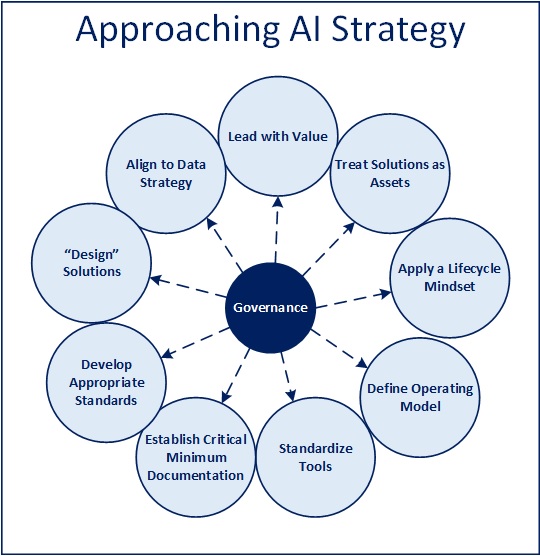
Below are various aspects of establishing a strategy and governance process for AI that are worth consideration. I listed them somewhat in a sequential manner, as I’d think about them personally, though that doesn’t imply you can’t explore and elaborate as many as are appropriate in parallel, and in whatever order makes sense. The outcome of the exercise doesn’t need to be rigid mandates, requirements, or guidelines per se, but nearly all of these topics likely will come up implicitly or otherwise as we delve further into leveraging these technologies moving forward.
Lead with Value
The first dimension is probably the most important in forming an AI strategy, which is to articulate the business problems being solved and value that is meant to be created. It is very easy with new technologies to focus on the tools and not the outcomes and start implementing without a clear understanding of the impact that is intended. As a result, measuring the value created and governing the efficacy of the solutions delivered becomes extremely difficult.
As a person who does not believe in deploying technology for technology’s sake, identifying, tracking, and measuring impact is important in knowing we will ultimately make informed decisions in how we leverage new capabilities and invest in them appropriately over time.
Treat Solutions as Assets
Along the lines of the above point, there is risk associated with being consumed by what is “cool” versus what is “useful” (something I’ve written about previously), and treating new technologies like “gadgets” versus actual business solutions. Where we treat our investments as assets, the associated discipline we apply in making decisions surrounding them should be greater. This is particularly important in emerging technology because the desire to experiment and leverage new tools could quickly become unsustainable as the number of one-off solutions grows and is unsupportable, eventually draining resources from new innovation.
Apply a Lifecycle Mindset
When leveraging a new technical capability, I would argue that we should look for opportunities to think of the full product lifecycle when it comes to how we identify, define, design, develop, manage, and retire solutions. In my experience, the identify (finding new tools) and develop (delivering new solutions) aspects of the process receive significant emphasis in a speed-to-market environment, but the others much less so, and often to the overall detriment of an organization when they quickly are saddled with the resulting technical debt that comes from neglecting some of the other steps in the process. This doesn’t necessarily imply a lot of additional steps, process overhead, or time/effort to be expended, but there is value created in each step of a product lifecycle (particularly in the early stages) and all of them need to be given due consideration if you want to establish a sustainable, performant environment. The physical manifestation of some these steps could be as simple as a checklist to make sure there aren’t blind spots that arise later on that were avoidable or that create business risk.
Define Operating Model
Introducing new capabilities, especially ones where the barrier to entry/ease of use allows for a wide audience of users can cause unintended consequences if not managed effectively. While it’s tempting to draw a business/technology dividing line, my experience has been that there can be very technically capable business consumers of technology and very undisciplined technologists who implement it as well. The point of thinking through the operating model is to identify roles and responsibilities in how you will leverage new capabilities so that expectations and accountability is clear, along with guidelines for how various teams are meant to collaborate over the lifecycle mentioned above.
Whether the goal is to “empower end users” by fully distributing capabilities across teams, with some level of centralized support and governance, or fully centralizing with decentralized demand generation (or any flavor in between), the point is to understand who is best positioned to contribute at different steps of the process and promote consistency to an appropriate level so performance and efficacy of both the process and eventual solutions is something you can track, evaluate, and improve over time. As an example, it would likely be very expensive and ineffective to hire a set of “prompt engineers” that operate in a fully distributed manner in a larger organization by comparison with having a smaller, centralized set of highly skilled resources who can provide guidance and standards to a broader set of users in a de-centralized environment.
Following onto the above, it is also worthwhile to decide whether and how these kinds of efforts should show up in a larger portfolio management process (to the extent one is in place). Where AI and agentic solutions are meant to displace existing ways of working or produce meaningful business outcomes, the time spent delivering and supporting these solutions should likely be tracked so there is an ability to evaluate and manage these investments over time.
Standardize Tools
This will likely be one of the larger issues that organizations face, particularly given where we are with AI in a broader market context today. Tools and technologies are advancing at such a rapid rate that having a disciplined process for evaluating, selecting, and integrating a specific set of “approved” tools is and will be challenging for some time.
While asking questions of a generic large language model like ChatGPT, Grok, DeepSeek, etc. and changing from one to the other seems relatively straightforward, there is a lot more complexity involved when we want to leverage company-specific data and approaches like RAG to produce more targeted and valuable outcomes.
When it comes to agentic solutions, there is also a proliferation of technologies at the moment. In these cases, managing the cost, complexity, performance, security, and associated data privacy issues will also become complex if there aren’t “preferred” technologies in place and “known good” ways in which they can be leveraged.
Said differently, if we believe effective use of AI is critical to maintaining competitive advantage, we should know that the tools we are leveraging are vetted, producing quality results, and that we’re using them effectively.
Establish Critical Minimum Documentation
I realize it’s risky to use profanity in a professional article, but documentation has to be mentioned if we assume AI is a critical enabler for businesses moving forward. Its importance can probably be summarized if you fast forward one year from today, hold a leadership meeting, and ask “what are all the ways we are using artificial intelligence, and is it producing the value we expected a year ago?” If the response contains no specifics and supporting evidence, there should be cause for concern, because there will be significant investment made in this area over the next 1-2 years, and tracking those investments is important to realizing the benefits that are being promised everywhere you look.
Does “documentation” mean developing a binder for every prompt that is created, every agent that’s launched, or every solution that’s developed? No, absolutely not, and that would likely be a large waste of money for marginal value. There should be, however, a critical minimum amount of documentation that is developed in concert with these solutions to clarify their purpose, intended outcome/use, value to be created, and any implementation particulars that may be relevant to the nature of the solution (e.g. foundational model, data sets leveraged, data currency assumptions, etc.). An inventory of the assets developed should exist, minimally so that it can be reviewed and audited for things like security, compliance, IP, and privacy-related concerns where applicable.
Develop Appropriate Standards
There are various types of solutions that could be part of an overall AI strategy and the opportunity to develop standards that promote quality, reuse, scale, security, and so forth is significant. Whether it takes the form of a “how to” guide for writing prompts, to data sourcing and refresh standards with RAG-enabled solutions, reference architecture and design patterns across various solution types, or limits to the number of agents that can be developed without review for optimization opportunities… In this regard, something pragmatic, that isn’t overly prescriptive but that also doesn’t reflect a total lack of standards would be appropriate in most organizations.
In a decentralized operating environment, the chance that solutions will be developed in a one-off fashion, with varying levels of quality, consistency, and standardization is highly probable and that could create issues with security, scalability, technical debt, and so on. Defining the handshake between consumers of these new capabilities and those developing standards, along with when it is appropriate to define them, could be important things to consider.
Design Solutions
Again, as I mentioned in relation to the product lifecycle mindset, there can be a strong preference to deliver solutions without giving much thought to design. While this is often attributed to “speed to market” and a “bias towards action”, it doesn’t take long for tactical thinking to lead to a considerable amount of technical debt, an inability to reuse or scale solutions, or significant operating costs that start to slow down delivery and erode value. These are avoidable consequences when thought is given to architecture and design up front and the effort nearly always pays off over time.
Align to Data Strategy
This topic could be an article in itself, but suffice is to say that having an effective AI strategy is heavily dependent on an organization’s overall data strategy and the health of that portfolio. Said differently: if your underlying data isn’t in order, you won’t be able to derive much in terms of meaningful insights from it. Concerns related to privacy and security, data sourcing, stewardship, data quality, lineage and governance, use of multiple large language models (LLMs), effective use of RAG, the relationship of data products to AI insights and agents, and effective ways of architecting for agility, interoperability, composability, evolution, and flexibility are all relevant topics to be explored and understood.
Define and Establish a Governance Process
Having laid out the above dimensions in terms of establishing and operationalizing an AI strategy, there needs to be a way to govern it. The goal of governance is to achieve meaningful business outcomes by promoting effective use and adoption of the new capabilities, while managing exposure related to introducing change into the environment. This could be part of an existing governance process or set up in parallel and coordinated with others in place, but the point is that you can’t optimize what you don’t monitor and manage, and the promise of AI is such that we should be thoughtful about how we govern its adoption across an organization.








 Organized Chaos