Approaching AI Strategy

Overview

In my first blog article back in 2021, I wrote that “we learn to value experience only once we actually have it”… and one thing I’ve certainly realized is that it’s much easier to do something quickly than to do it well.  The problem is that excellence requires discipline, especially when you want to scale or have sustainable results, and that often comes into conflict with a natural desire to achieve speed in delivery.

There is a tremendous amount of optimism in the transformative value AI can create across a wide range of areas.  While much continues to be written about various tools, technologies, and solutions, there is value in having a structured approach to developing AI strategy and how we will govern it once it is implemented across an organization.

Why?  We want results.

Some historical examples on why there is a case for action:

  • Many organizations have leveraged SharePoint as a way to manage documents. Because it’s relatively easy to use, access to the technology generally is provided to a broad set of users, with little or no guidance on how to use it (e.g., metatagging strategy), and over time there becomes a sprawl of content that may contain critical, confidential, or proprietary information with limited overall awareness of what exists and where
  • In the last number of years, Citizen Development has become popular, with the rise of low code, no code, and RPA tools, creating accessibility to automation that is meant to enable business (and largely non-technical) resources to rapidly create solutions, from the trivial to relatively complex. Quite often these solutions aren’t considered part of a larger application portfolio, are managed with little or no oversight, and become difficult to integrate, leverage, or support effectively
  • In data and analytics, tools like Alteryx can be deployed across a broad set of users who, after they are given access to requested data sources, create their own transformations, dashboards, and other analytical outputs to inform ongoing business decisions. The challenge occurs when the underlying data changes, is not understood properly (and downstream inferences can be incorrect), or these individuals leave or transition out of their roles and the solutions they built are not well understood or difficult for someone else to leverage or support

What these situations have in common is the introduction of something meant to serve as an enabler that has relative ease of use and accessibility across a broad audience, but where there also may be a lack of standards and governance to make sure the capabilities are introduced in a thoughtful and consistent manner, leading to inefficiency, increased cost, and lost opportunity.  With the amount of hype surrounding AI, the proliferation of tools, and general ease of use that they provide, the potential for organizations to create a mess in the wake of their experimentation with these technologies seems very significant. 

The focus of the remainder of this article is to explore some dimensions to consider in developing a strategy for the effective use and governance of AI in an organization.  The focus will be on the approach, not the content of an AI strategy, which can be the subject of a later article.  I am not suggesting that everything needs to be prescriptive, cumbersome, or bureaucratic to the point that nothing can get done, but I believe it is important to have a thoughtful approach to avoid the pitfalls that are common to these situations.

To the extent that, in some organizations, “governance” implies control versus enablement or there are historical real or perceived IT delivery issues, there may be concern with heading down this path.  Regardless of how the concepts are implemented, I believe they are worth considering sooner rather than later, given we are still relatively early in the adoption process of these capabilities.

Dimensions to Consider

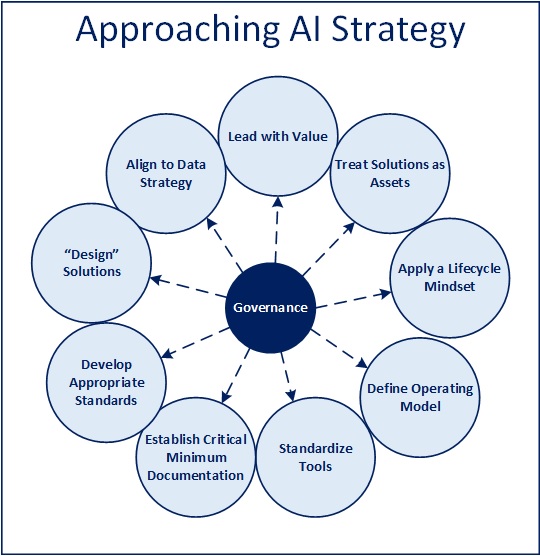
Below are various aspects of establishing a strategy and governance process for AI that are worth consideration.  I listed them somewhat in a sequential manner, as I’d think about them personally, though that doesn’t imply you can’t explore and elaborate as many as are appropriate in parallel, and in whatever order makes sense.  The outcome of the exercise doesn’t need to be rigid mandates, requirements, or guidelines per se, but nearly all of these topics likely will come up implicitly or otherwise as we delve further into leveraging these technologies moving forward.

Lead with Value

The first dimension is probably the most important in forming an AI strategy, which is to articulate the business problems being solved and value that is meant to be created.  It is very easy with new technologies to focus on the tools and not the outcomes and start implementing without a clear understanding of the impact that is intended.  As a result, measuring the value created and governing the efficacy of the solutions delivered becomes extremely difficult.

As a person who does not believe in deploying technology for technology’s sake, identifying, tracking, and measuring impact is important in knowing we will ultimately make informed decisions in how we leverage new capabilities and invest in them appropriately over time.

Treat Solutions as Assets

Along the lines of the above point, there is risk associated with being consumed by what is “cool” versus what is “useful” (something I’ve written about previously), and treating new technologies like “gadgets” versus actual business solutions.  Where we treat our investments as assets, the associated discipline we apply in making decisions surrounding them should be greater.  This is particularly important in emerging technology because the desire to experiment and leverage new tools could quickly become unsustainable as the number of one-off solutions grows and is unsupportable, eventually draining resources from new innovation.

Apply a Lifecycle Mindset

When leveraging a new technical capability, I would argue that we should look for opportunities to think of the full product lifecycle when it comes to how we identify, define, design, develop, manage, and retire solutions.  In my experience, the identify (finding new tools) and develop (delivering new solutions) aspects of the process receive significant emphasis in a speed-to-market environment, but the others much less so, and often to the overall detriment of an organization when they quickly are saddled with the resulting technical debt that comes from neglecting some of the other steps in the process.  This doesn’t necessarily imply a lot of additional steps, process overhead, or time/effort to be expended, but there is value created in each step of a product lifecycle (particularly in the early stages) and all of them need to be given due consideration if you want to establish a sustainable, performant environment.  The physical manifestation of some these steps could be as simple as a checklist to make sure there aren’t blind spots that arise later on that were avoidable or that create business risk.

Define Operating Model

Introducing new capabilities, especially ones where the barrier to entry/ease of use allows for a wide audience of users can cause unintended consequences if not managed effectively.  While it’s tempting to draw a business/technology dividing line, my experience has been that there can be very technically capable business consumers of technology and very undisciplined technologists who implement it as well.  The point of thinking through the operating model is to identify roles and responsibilities in how you will leverage new capabilities so that expectations and accountability is clear, along with guidelines for how various teams are meant to collaborate over the lifecycle mentioned above.

Whether the goal is to “empower end users” by fully distributing capabilities across teams, with some level of centralized support and governance, or fully centralizing with decentralized demand generation (or any flavor in between), the point is to understand who is best positioned to contribute at different steps of the process and promote consistency to an appropriate level so performance and efficacy of both the process and eventual solutions is something you can track, evaluate, and improve over time.  As an example, it would likely be very expensive and ineffective to hire a set of “prompt engineers” that operate in a fully distributed manner in a larger organization by comparison with having a smaller, centralized set of highly skilled resources who can provide guidance and standards to a broader set of users in a de-centralized environment.

Following onto the above, it is also worthwhile to decide whether and how these kinds of efforts should show up in a larger portfolio management process (to the extent one is in place).  Where AI and agentic solutions are meant to displace existing ways of working or produce meaningful business outcomes, the time spent delivering and supporting these solutions should likely be tracked so there is an ability to evaluate and manage these investments over time.

Standardize Tools

This will likely be one of the larger issues that organizations face, particularly given where we are with AI in a broader market context today.  Tools and technologies are advancing at such a rapid rate that having a disciplined process for evaluating, selecting, and integrating a specific set of “approved” tools is and will be challenging for some time.

While asking questions of a generic large language model like ChatGPT, Grok, DeepSeek, etc. and changing from one to the other seems relatively straightforward, there is a lot more complexity involved when we want to leverage company-specific data and approaches like RAG to produce more targeted and valuable outcomes.

When it comes to agentic solutions, there is also a proliferation of technologies at the moment.  In these cases, managing the cost, complexity, performance, security, and associated data privacy issues will also become complex if there aren’t “preferred” technologies in place and “known good” ways in which they can be leveraged.

Said differently, if we believe effective use of AI is critical to maintaining competitive advantage, we should know that the tools we are leveraging are vetted, producing quality results, and that we’re using them effectively.

Establish Critical Minimum Documentation

I realize it’s risky to use profanity in a professional article, but documentation has to be mentioned if we assume AI is a critical enabler for businesses moving forward.  Its importance can probably be summarized if you fast forward one year from today, hold a leadership meeting, and ask “what are all the ways we are using artificial intelligence, and is it producing the value we expected a year ago?”  If the response contains no specifics and supporting evidence, there should be cause for concern, because there will be significant investment made in this area over the next 1-2 years, and tracking those investments is important to realizing the benefits that are being promised everywhere you look.

Does “documentation” mean developing a binder for every prompt that is created, every agent that’s launched, or every solution that’s developed?  No, absolutely not, and that would likely be a large waste of money for marginal value.  There should be, however, a critical minimum amount of documentation that is developed in concert with these solutions to clarify their purpose, intended outcome/use, value to be created, and any implementation particulars that may be relevant to the nature of the solution (e.g. foundational model, data sets leveraged, data currency assumptions, etc.).  An inventory of the assets developed should exist, minimally so that it can be reviewed and audited for things like security, compliance, IP, and privacy-related concerns where applicable.

Develop Appropriate Standards

There are various types of solutions that could be part of an overall AI strategy and the opportunity to develop standards that promote quality, reuse, scale, security, and so forth is significant.  Whether it takes the form of a “how to” guide for writing prompts, to data sourcing and refresh standards with RAG-enabled solutions, reference architecture and design patterns across various solution types, or limits to the number of agents that can be developed without review for optimization opportunities… In this regard, something pragmatic, that isn’t overly prescriptive but that also doesn’t reflect a total lack of standards would be appropriate in most organizations.

In a decentralized operating environment, the chance that solutions will be developed in a one-off fashion, with varying levels of quality, consistency, and standardization is highly probable and that could create issues with security, scalability, technical debt, and so on.  Defining the handshake between consumers of these new capabilities and those developing standards, along with when it is appropriate to define them, could be important things to consider.

Design Solutions

Again, as I mentioned in relation to the product lifecycle mindset, there can be a strong preference to deliver solutions without giving much thought to design.  While this is often attributed to “speed to market” and a “bias towards action”, it doesn’t take long for tactical thinking to lead to a considerable amount of technical debt, an inability to reuse or scale solutions, or significant operating costs that start to slow down delivery and erode value.  These are avoidable consequences when thought is given to architecture and design up front and the effort nearly always pays off over time.

Align to Data Strategy

This topic could be an article in itself, but suffice is to say that having an effective AI strategy is heavily dependent on an organization’s overall data strategy and the health of that portfolio.  Said differently: if your underlying data isn’t in order, you won’t be able to derive much in terms of meaningful insights from it.  Concerns related to privacy and security, data sourcing, stewardship, data quality, lineage and governance, use of multiple large language models (LLMs), effective use of RAG, the relationship of data products to AI insights and agents, and effective ways of architecting for agility, interoperability, composability, evolution, and flexibility are all relevant topics to be explored and understood.

Define and Establish a Governance Process

Having laid out the above dimensions in terms of establishing and operationalizing an AI strategy, there needs to be a way to govern it.  The goal of governance is to achieve meaningful business outcomes by promoting effective use and adoption of the new capabilities, while managing exposure related to introducing change into the environment.  This could be part of an existing governance process or set up in parallel and coordinated with others in place, but the point is that you can’t optimize what you don’t monitor and manage, and the promise of AI is such that we should be thoughtful about how we govern its adoption across an organization.

Wrapping Up

I hope the ideas were worth considering.  For more on my thoughts on AI in particular, my articles Exploring Artificial Intelligence and Bringing AI to the End User can provide some perspective for those who are interested.

Thanks for spending the time to read them.  Feedback is welcome as always.

-CJG 03/17/2025

The Seeds of Transformation

Introduction

I believe that this nation should commit itself to achieving the goal, before this decade is out, of landing a man on the moon and returning him safely to the Earth.” – John F Kennedy, May 25, 1961

When JFK made his famous pronouncement in 1961, the United States was losing in the space race.  The Soviet Union was visibly ahead, to the point that the government shuffled the deck, bringing together various agencies to form NASA, and set a target far out ahead of where anyone was focused at the time: landing on the Moon.  The context is important as the U.S. was not operating from a position of strength and JFK didn’t shoot for parity or to remain in a defensive posture. Instead, he leaned in and set an audacious goal that redefined the playing field entirely.

I spoke at a town hall fairly recently about “The Saturn V Story”, a documentary that covers the space race and journey leading to the Apollo 11 moon landing on July 20, 1969.  The scale and complexity of what accomplished in a relatively short timeframe was truly incredible and feels like a good way to introduce a Transformation discussion.  The Apollo program engaged 375,000 people at its peak, required extremely thoughtful planning and coordination (including the Mercury and Gemini programs that preceded it), and presented a significant number of engineering challenges that needed to be overcome to achieve its ultimate goal.  It’s an inspiring story, as any successful transformation effort should be.

The challenge is that true transformation is exceptionally difficult and many of these efforts fail or fall short of their stated objectives.  The remainder of this article will highlight some key dimensions that I believe are critical in increasing the probability of success.

Transformation is a requirement of remaining competitive in a global digital economy.  The disruptions (e.g., cloud computing, robotics, orchestration, artificial intelligence, cyber security exposure, quantum computing) have and will continue to occur, and success will be measured, in part, based on an organization’s ability to continuously transform, leveraging advanced capabilities to its’ maximum strategic benefit.

Successful Transformation

Culture versus Outcome

Before diving into the dimensions themselves, I want to emphasize the difference I see between changing culture and the kind of transformation I’m referencing in this article.  Culture is an important aspect to affecting change, as I will discuss in the context of the dimensions themselves, but a change in culture that doesn’t lead to a corresponding change in results is relatively meaningless.

To that end, I would argue that it is important to think about “change management” as a way to transition between the current and desired ways of working in a future state environment, but with specific, defined outcomes attached to the goal

It is insufficient, as an example, to express “we want to establish a more highly collaborative workplace that fosters innovation” without also being able to answer the questions: “To what end?” or “In the interest of accomplishing what?”  Arguably, it is the desired outcome that sets the stage for the nature of the culture that will be required, both to get to the stated goal as well as to operate effectively once those goals are achieved.  In my experience, this balance isn’t given enough thought when change efforts are initiated, and it’s important to make sure culture and desired outcomes are both clear and aligned with each other.

For more on the fundamental aspects of a healthy environment, please see my article on The Criticality of Culture.

What it Takes

Successful transformation efforts require focus on many levels and in various dimensions to manage what ultimately translates to risk.

The set that come to mind as most critical are having:

  • An audacious goal
    • Transformation is, in itself, a fundamental (not incremental) change in what an organization is able to accomplish
    • To the extent that substantial change is difficult, the value associated with the goal needs to outweigh the difficulties (and costs) that will be required to transition from where you are to where you need to be
    • If the goal also isn’t compelling enough, likely there won’t be the requisite level of individual and collective investment required to overcome the adversity that is typically part of these efforts. This is not just about having a business case.  It’s a reason for people to care… and that level of investment matters where transformation is the goal
  • Courageous, committed leadership
    • Change is, by its’ nature, difficult and disruptive. There will be friction and resistance that comes from altering the status quo
    • The requirements of leadership in these efforts tend to be very high, because of the adversity and risk that can be involved, and a degree of fearlessness and willingness to ride through the difficulties is important
    • Where this level of leadership isn’t present, it will become easy to focus on obstacles versus solutions and to avoid taking risks that lead to suboptimized results or overall failure of the effort. If it was easy to transform, everyone would be doing it all the time
    • It is worth noting that, in the case of the Apollo missions, JFK wasn’t there to see the program through, yet it survived both his passing and significant events like the Apollo fire without compromising the goal itself
    • A question to consider in this regard: Is the goal so compelling that, if the vision holder / sponsor were to leave, the effort would still move forward? There are many large-scale efforts I’ve seen over the years where a change in leadership affects the commitment to a strategy.  There may be valid reasons for this to be the case, but arguably both a worthy goal and strong leadership are necessary components in transformation overall
  • An aligned and supportive culture
    • There is a significant aspect of accomplishing a transformational agenda that places a burden on culture
    • On this point, the going-in position matters in the interest of mapping out the execution approach, because anything about the environment that isn’t conducive to facilitating and enabling collaboration and change will ultimately create friction that needs to be addressed and (hopefully) overcome
    • To the extent that the organization works in silos or that there is significant and potentially unhealthy internal competition within and across leaders, the implications of those conflicts need to be understood and mitigated early on (to the degree possible) so as to avoid what could lead to adverse impacts on the effort overall
    • As a leader said to me very early in my career, “There is room enough in success for everybody.” Defining success at an individual and collective level may be a worthwhile activity to consider depending on the nature of where an organization is when starting to pursue change
    • On this final point, I have been in the situation more than once professionally where a team worked to actively undermine transformation objectives because those efforts had an adverse impact to their broader role in an organization. This speaks, in part, to the importance of engaged, courageous leadership to bring teams into alignment, but where that leadership isn’t present, it definitely makes things more difficult.  Said differently, the more established the status quo is, the harder it may resist change
  • A thoughtful approach
    • “Rome was not built in a day” is probably the best way to summarize this point
    • Depending on the level of complexity and degree of change involved, the more thought and attention that needs to be paid to planning out the approach itself
    • The Apollo program is a great example of this, because there were countless interim stages in the development of the Saturn V rocket, creating a safe environment for manned space flight, procedures for rendezvous and docking of the spacecraft, etc.
    • In a technology delivery environment, these can be program increments in a scaled Agile environment, selective “pilots” or “proof-of-concept” efforts, or interim deliveries in a more component-based (and service-driven) architecture. The overall point being that it’s important to map out the evolution of current to future state, allowing for testing and staging of interim goals that help reduce risk on the ultimate objectives
    • In a different example, when establishing an architecture capability in a large, complex organization, we established an operating model to define roles and responsibilities, but then operationalized the model in layers to help facilitate change with defined outcomes spread across multiple years. This was done purposefully and deliberately in the interest of making the changes sustainable and to gradually shift delivery culture to be more strategically-aligned, disciplined, and less siloed in the process
  • Agility and adaptiveness
    • The more advanced and innovative the transformation effort is, the more likely it will be that there is a higher degree of unknown (and knowledge risk) associated with the effort
    • To that end, it is highly probable that the approach to execution will evolve over time as knowledge gaps are uncovered and limitations and constraints need to be addressed and overcome
    • There are countless examples of this in the Apollo program, one of the early ones being the abandonment of the “Nova” rocket design, which involved a massive vehicle that ultimately was eliminated in deference to the multi-stage rocket and lunar lander / command module approach. In this case, the means for arriving at and landing on the moon was completely different than it was at the program’s inception, but the outcome was ultimately the same
    • I spend some time discussing these “points of inflection” in my article On Project Health and Transparency, but the important concept is not to be too prescriptive when planning a transformation effort, because execution will definitely evolve
  • Patience and discipline
    • My underlying assumption is that the level of change involved in transformation is significant and, as such, it will take time to accomplish
    • The balance to be struck is ultimately in managing interim deliveries in relation to the overall goals of the effort. This is where patience and discipline matter, because it is always tempting to take short cuts in the interest of “speed to market” while compromising fundamental design elements that are important to overall quality and program-level objectives (something I address in Fast and Cheap, Isn’t Good)
    • This isn’t to say that tradeoffs can’t or shouldn’t be made, because they often are, but rather that these be conscious choices, done through a governance process, and with a full understanding of the implications of the decisions on the ultimate transformation objectives
  • A relentless focus on delivery
    • The final dimension is somewhat obvious, but is important to mention, because I’ve encountered transformative efforts in the past that spent so much energy either on structural or theoretical aspects to their “program design” that they actually failed to deliver anything
    • In the case of the Apollo program, part of what makes the story so compelling is the number of times the team needed to innovate to overcome issues that arose, particularly to various design and engineering challenges
    • Again, this is why courageous, committed leadership is so important to transformation. The work is difficult and messy and it’s not for the faint of heart.  Resilience and persistence are required to accomplish great things.

Wrapping Up

Hopefully this article has provided some areas to consider in either mapping out or evaluating the health of a transformational effort.  As I covered in my article On Delivering at Speed, there are always opportunities to improve, even when you deliver a complex or high-risk effort.  The point is to be disciplined and thoughtful in how you approach these efforts, so the bumps that inevitably occur are more manageable and the impact they have are minimized overall.

I hope the ideas were worth considering.  Thanks for spending the time to read them.  Feedback is welcome as always.

-CJG 12/29/2024

Ethics and Technology

Overview

Having worked both in consulting and corporate environments for many years and across multiple industries, we’re at an interesting juncture in how technology is leveraged at a macro-level and the broader business and societal impacts of those choices.  Whether that is AI-generated content that could easily be mistaken for “real” events to the leverage of data collection and advanced analytics in various business and consumer scenarios to create “competitive advantage”.

The latter scenario has certainly been discussed for quite a while, whether it is in relation to managing privacy while using mobile devices, trusting a search engine and how they “anonymize” your data before potentially selling it to third parties, or whether the results presented as the outcome of a search (or GenAI request) is objective and unbiased, or being presented with some level of influence given the policies or leanings of the organization sponsoring it.


The question to be explored here is: How do we define the ethical use of technology?


For the remainder of this article, I’ll suggest some ways to frame the answer in various dimensions, acknowledging that this isn’t a black-and-white issue and the specifics of a situation could make some of the considerations more or less relevant.


Considerations

What Ethical Use Isn’t

Before diving into what I believe could be helpful in framing an answer, I wanted to clarify what I don’t consider a valid approach, which is namely the argument used in a majority of cases where individuals or organizations cross a line: We can use technology in this way because it gives us competitive advantage.

Competitive advantage can tend to be an easy argument in the interest of doing something questionable, because there is a direct or indirect financial benefit associated with the decision, thereby clouding the underlying ethics of the decision itself.  “We’re making more money, increasing shareholder value, managing costs, increasing profitability, etc.” are things that tend to move the needle in terms of the roadblocks that can exist in organizations and mobilizing new ideas.  The problem is that, with all of the data collected in the interest of securing approval and funding for initiative, I haven’t seen many cases where there is a proverbial “box to check” in terms of the effort conforming to ethical standards (whether that’s specific to technology use or otherwise).


What Ethical Use Could Be

That point having been stated, below are some questions that could be considered as part of an “ethical use policy”, understanding that not all may have equal weight in an evaluation process.

They are:

  • Legal/Compliance/Privacy
    • Does the ultimate solution conform to existing laws and regulations for your given industry?
    • Is there any pending legislation related to the proposed use of technology that could create such a compliance issue?
    • Is there any industry-specific legislation that would suggest a compliance issue if it were logically applied in a new way that relates to the proposed solution?
    • Would the solution cause a compliance issue in another industry (now or in legislation that is pending)? Is there risk of that legislation being applied to your industry as well?


  • Transparency
    • Is there anything about the nature of the solution that, were it shared openly (e.g., through a press release or industry conference/trade show) would cause customers, competitors, or partners/suppliers to raise issues with the organization’s market conduct or end user policies? This can be a tricky item given the previous points on competitive advantage and what might be labeled as “trade secret” but potentially violate anti-trust, privacy, or other market expectations
    • Does anything about the nature of the solution, were it to be shared openly, suggest that it could cause trust issues between customers, competitors, suppliers, or partners with the organization and, if so, why?


  • Cultural
    • Does the solution align to your organization’s core values? As an example, if there is a transparency concern (above) and “Integrity” is a core value (which it is in many organizations), why does that conflict exist?
    • Does the solution conform to generally accepted practices or societal norms in terms of business conduct between you and your target audience (customers, vertical or horizontal partners, etc.)?


  • Social Responsibility
    • Does the solution create any potential issues from an environmental, societal, or safety standpoint that could have adverse impacts (direct or indirect)?


  • Autonomy and Objectivity
    • Does the solution provide an unbiased, fact-based (or analytically-correct) outcome, free of any potential bias, that can also be governed, audited, and verified? This is an important dimension to consider given the dependency we have on automation continues to increase and we want to be able to trust the security, reliability, accuracy, and so on of what that technology provides.


  • Competitive
    • If a competitor announced they were developing a solution of exactly the same nature as what is proposed, would it be comfortable situation or something that you would challenge as unethical or unfair business practice in any way? Quite often, the lens through which unethical decisions are made is biased with an internal focus.  If that line of sight were reversed and a competitor was open about doing exactly the same thing, would that be acceptable or not?  If there would be issues, likely there might be cause for concern in developing the solution yourself


Wrapping Up

From a process standpoint, a suggestion would be to take the above list and discuss it openly in the interest of not only determining the right criteria for you, but also to establish where these opportunities exist (because they do and will, the more analytics and AI-focused capabilities advance).  Ultimately, there should be a check-and-balance process for ethical use of technology in line with any broader compliance and privacy-related efforts that may exist within an organization today.

Ultimately, the “right thing to do” can be a murky and difficult question to answer, especially with ever-expanding tools and technologies that create capabilities a digital business can use to its advantage.  But that’s where culture and values should still exist, not simply because there is or isn’t a compliance issue, but because reputations are made and reinforced over time through these kinds of decisions, and they either help build a brand or can damage it when the right questions aren’t explored at the right time.

It’s interesting to consider, as a final note, that most companies have an “acceptable use of IT” policy for employees, contractors, and so forth, in terms of setting guidelines for what they can or can’t do (e.g., accessing ‘prohibited’ websites / email accounts or using a streaming platform while at work), but not necessarily for technology directed outside the organization.  As we enter a new age of AI-enabled capabilities, perhaps it’s a good time to look at both.

I hope the ideas were worth considering.  Thanks for spending the time to read them.  Feedback is welcome as always.

-CJG 10/25/2024

Thoughts on Portfolio Management

Overview

Setting the stage

Having had multiple recent discussions related to portfolio management, I thought I’d share some thoughts relative to disciplined operations, in terms of the aforementioned subject and on the associated toolsets as well.  This is a substantial topic, but I’ll try to hit the main points and address more detailed questions as and when they arise.

In getting started, given all the buzz around GenAI, I asked ChatGPT “What are the most important dimensions of portfolio management in technology?”  What was interesting was that the response aligned with most discussions I’ve had over time, which is to say that it provided a process-oriented perspective on strategic alignment, financial management, and so on (a dozen dimensions overall), with a wonderfully summarized description of each (and it was both helpful and informative).  The curious part was that it missed the two things I believe are most important: courageous leadership and culture.

The remainder of this article will focus more on the process dimensions (I’m not going to frame it the same as ChatGPT for simplicity), but I wanted to start with a fundamental point: these things have to be about partnership and value first and process second.  If the focus becomes the process, there is generally something wrong in the partnership or the process is likely too cumbersome in how it is designed (or both).


Portfolio Management

Partnership

Portfolio management needs to start with a fundamental partnership and shared investment between business and technology leaders on the intended outcome.  Fortunately, or unfortunately, where the process tends to get the most focus (and part of why I’ve heard it so much in the last couple years) is in a difficult market/economy where spend management is the focus, and the intention is largely related to optimizing costs.  Broadly speaking, when times are good and businesses grow, the processes for prioritization and governance can become less rigorous in a speed-to-market mindset, the demand for IT services increases, and a significant amount of inefficiency, delivery and quality issues can arise as a result.  The reality is that discipline should always be a part of the process because it’s in the best interest of creating value (long- and short-term) for an organization.  That isn’t to suggest artificial constraints, unnecessary gates in a process, or anything to hinder speed-to-market.  Rather, the goal of portfolio management should be to have a framework in place to manage demand through delivery in a way that facilitates predictable, timely, and quality delivery and a healthy, secure, robust, and modern underlying technology footprint that creates significant business value and competitive advantage over time.  That overall objective is just as relevant during a demand surge as it is when spending is constrained.

This is where courageous leadership becomes the other critical overall dimension.  It’s never possible to do everything and do it well.  The key is to maintain the right mix of work, creating the right outcomes, at a sustainable pace, with quality.  Where technology leaders become order takers is where a significant amount of risk can be introduced that actually hurts a business over time.  The primary results being that taking on too much without thoughtful planning can result in critical resources being spread too thin, missed delivery commitments, poor quality, and substantial technical debt, all of which eventually undermine the originally intended goal of being “responsive”.  This is why partnership and mutual investment in the intended outcomes matters.  Not everything has to be “perfect” (and the concept itself doesn’t really exist in technology anyway), but the point is to make conscious choices on where to spend precious company resources to optimize the overall value created.


End-to-End Transparency

Shifting focus from the direction to the execution, portfolio management needs to start with visibility in three areas:

  • Demand management – the work being requested
  • Delivery monitoring – the work being executed
  • Value realization – the impact of what was delivered

In demand management, the focus should ideally be on both internal and external factors (e.g., business priorities, customer needs, competitive and industry trends), a thoughtful understanding of the short- and long-term value of the various opportunities, the requirements (internal and external) necessary to make them happen, and the desired timeframe for those results to be achieved.  From a process standpoint, notice of involvement and request for estimate (RFE) processes tend to be important (depending on the scale and structure of an organization), along with ongoing resource allocation and forecast information to evaluate these opportunities as they arise.

Delivery monitoring is important, given the dependencies that can and do exist within and across efforts in a portfolio, the associated resource needs, and the expectations they place on customers, partners, or internal stakeholders once delivered.  As and when things change, there should be awareness as to the impact of those changes on upcoming demand as well as other efforts within a managed portfolio.

Value realization is a generally underserved, but relatively important part of portfolio management, especially in spending constrained situations.  This level of discipline (at an overall level) is important for two primary reasons: first, to understand the efficacy of estimation and planning processes in the interest of future prioritization and planning and, second, to ensure investments were made effectively in the right priorities.  Where there is no “retrospective”, a lot of learnings may be being lost in the interest of continuous improvement and operational efficiency and effectiveness over time (ultimately having an adverse impact on business value created).


Maintaining a Balanced Portfolio

Two concepts that I believe are important to consider in how work is ultimately allocated/prioritized within an IT portfolio:

  • Portfolio allocation – the mix of work that is being executed on an ongoing basis
  • Prioritization – how work is ultimately selected and the process for doing so

A good mental model for portfolio allocation is a jigsaw puzzle.  Some pieces fit together, others don’t, and whatever pieces are selected, you ultimately are striving to have an overall picture that matches what you originally saw “on the box”.  While you also can operate in multiple areas of a puzzle at the same time, you also generally can’t focus in on all of them concurrently and expect to be efficient on the whole.

What I believe a “good” portfolio should include is four key areas (with an optional fifth):

  • Innovation – testing and experimenting in areas where you may achieve significant competitive advantage or differentiation
  • Business Projects – developing solutions that create or enable new or enhanced business capabilities
  • Modernization – using an “urban renewal” mindset to continue to maintain, simplify, rationalize, and advance your infrastructure to avoid significant end of life, technical debt, or other adverse impacts from an aging or diverse technology footprint
  • Security – continuing to leverage tools and technologies that manage the ever increasing exposure associated with cyber security threats (internal and external)
  • Compliance (where appropriate) – investing in efforts to ensure appropriate conformance and controls in regulatory environments / industries

I would argue that, regardless of the level of overall funding, these categories should always be part of an IT portfolio.  There can obviously be projects or programs that provide forward momentum in more than one category above, but where there isn’t some level of investment in the “non-business project” areas, likely there will be a significant correction needed at some point of time that could be very disruptive from a business standpoint.  It is probably also worth noting that I am not calling out a “technology projects” category above on purpose.  From my perspective, if a project doesn’t drive one of the other categories, I’d question what value it creates.  There is no value in technology for technology’s sake.

From a prioritization standpoint, I’ve seen both ends of the spectrum over the course of time: environments where there is no prioritization in place and everything with a positive business case (and even some without) are sent into execution to ones where there is an elaborate “scoring” methodology, with weights and factors and metrics organized into highly elaborate calculations that create a false sense of “rigor” in the efficacy of the process.  My point of view overall is that, with the above portfolio allocation model in place, ensuring some balance in each of the critical categories of spend, a prioritization process should include some level of metrics, with an emphasis on short- and long-term business/financial impact as well as a conscious integration of the resource commitments required to execute the effort by comparison with other alternatives.  As important as any process, however, is the discussions that should be happening from a business standpoint to ensure the engagement, partnership, and overall business value being delivered through the portfolio (the picture on the box) in the decisions made.


Release Management

Part of arriving at the right set of work to do also comes down to release management.  A good analogy for release management is the game Tetris.  In Tetris, you have various shaped blocks dropping continually into a grid, with the goal of rotating and aligning them to fit as cleanly with what is already on the radar as possible.  There are and always will be gaps and the fit will never be perfect, but you can certainly approach Tetris in a way that is efficient and well-aligned or in a way that is very wasteful of the overall real estate with which you have to work

This is great mental model for how project planning should occur.  If you do a good job, resources are effectively utilized, outcomes are predictable, there is little waste, and things run fairly smoothly.  If you don’t think about the process and continually inject new work into a portfolio without thoughtful planning as to dependencies and ongoing commitments, there can and likely will be significant waste, inefficiency, collateral impact, and issues in execution.

Release management comes down to two fundamental components:

  • Release strategy – the approach to how you organize and deliver major and minor changes to various stakeholder groups over time
  • Release calendar – an ongoing view of what will be delivered at various times, along with any critical “T-minus” dates and/or delivery milestones that can be part of a progress monitoring or gating process used in conjunction with delivery governance processes

From a release strategy standpoint, it is tempting in a world of product teams, DevSecOps, and CI/CD pipelines to assume everything comes down to individual product plans and their associated release schedules.  The two primary issues here are the time and effort it generally takes to deploy new technology and the associated change management impact to the end users who are expected to adopt those changes as and when they occur.  The more fragmented the planning process, the more business risk there is that ultimately end users or customers will be either under or overserved at any given point in time, where a thoughtful release strategy can help create predictable, manageable, and sustainable levels of change over time across a diverse set of stakeholders being served.

The release calendar, aside from being an overall summary of what will be delivered when and to whom, also should ideally provide transparency into other critical milestones in the major delivery efforts so that, in the event something moves off plan (which is a very normal occurrence in technology and medium to larger portfolios), the relationship to other ongoing efforts can be evaluated from a governance standpoint to determine whether any rebalancing or slotting of work is required.


Change Management

While I won’t spend a significant amount of time on this point, change management is often an area where I’ve seen the process managed very well and relatively poorly.  The easy part is generally managing change relative to a specific project or program and that governance often exists in my experience.  The issue that can arise is when the leadership overseeing a specific project is only taking into account the implications of change on that effort alone, and not the potential ripple effect of a schedule, scope, or financial adjustment on the rest of the portfolio, future demand, or on end users in the event that releases are being adjusted


On Tooling

Pivoting from processes to tools, at an overall level, I’m generally not a fan of over-engineering the infrastructure associated with portfolio management.  It is very easy for such an infrastructure to take a life of its own, become a significant administrative burden that creates little value (beyond transparency), or contain outdated and inaccurate information to the degree that the process involves too much data without underlying ownership and usage of the data obtained.

The goal is the outcome, not the tools.

To the extent that a process is being established, I’d generally want to focus on transparency (demand through delivery) and a healthy ongoing discussion of priorities in the interest of making informed decisions.  Beyond that, I’ve seen a lot of reporting that doesn’t generally result in any level of actions being taken, which I consider to be very ineffective from a leadership and operational standpoint. 

Again, if the process is meant to highlight a relationship problem, such as a dashboard being created requiring a large number of employees to capture timesheets to be rolled up, marked to various projects, all to have a management discussion to say “we’re over allocated and burning out our teams”, my question would be why all of that data and effort was required to “prove” something, whether there is actual trust and partnership, whether there are other underlying delivery performance issues, and so on.  The process and tools are there to enable effective execution and the creation of business value, not drain effort and energy that could better be applied in delivery with administrivia.


Wrapping Up

Overall, having spent a number of years seeing well developed and executed processes as well as less robust versions of the same, effective portfolio management comes down to value creation.  When the focus becomes about the process, the dashboard, the report, the metrics, something is amiss in my experience.  It should about informing engaged leadership, fostering partnership, enabling decisions, and creating value.  That is not to say that average utilization of critical resources (as an example) isn’t a good thing to monitor and keep in mind, but it’s what you do with that information that matters.

I hope the ideas were worth considering.  Thanks for spending the time to read them.  Feedback is welcome as always.

-CJG 07/29/2024