

How did we get here…?
The challenges involved in managing a technology footprint today at any medium to large organization are very high for a multitude of reasons:
- Proliferation of technologies and solutions that are disconnected or integrated in inconsistent ways, making simplification or modernization efforts difficult to deliver
- Mergers and acquisitions that bring new systems into the landscape that aren’t rationalized with or migrated to existing systems, creating redundancy, duplication of capabilities, and cost
- “Speed-to-market” initiatives involving unique solution approaches that increase complexity and cost of ownership
- A blend of in-house and purchased software solutions, hosted across various platforms (including multi-cloud), increasing complexity and cost of security, integration, performance monitoring, and data movement
- Technologies advancing at a rate, especially with the introduction of artificial intelligence (AI), that organizations can’t integrate them quickly enough to do so in a consistent manner
- Decentralized or federated technology organizations that operate with relative autonomy, independent of standards, frameworks, or governance, which increases complexity and cost
The result of any of the above factors can be enough cost and complexity that the focus within a technology organization can shift from innovation and value creation to struggling to keep the lights on and maintaining a reliable and secure operating environment.
This article will be the first in a series focused on where I believe technology is heading, with an eye towards a more harmonious integration and synthesis of applications, AI, and data… what I previously referred to in March of 2022 as “The Intelligent Enterprise”. The sooner we begin to operate off a unified view of how to align, integrate, and leverage these oftentimes disjointed capabilities today, the faster an organization will leapfrog others in their ability to drive sustainable productivity, profitability, and competitive advantage.
Why It Matters
Before getting into the dimensions of the future state, I wanted to first clarify how these technology challenges manifest themselves in meaningful ways, because complexity isn’t just an IT problem, it’s a business issue, and partnership is important in making thoughtful choices in how we approach future solutions.
Lost Productivity
A leadership team at a manufacturing facility meets first thing in the morning. It is the first of multiple they will have throughout the course of a day. They are setting priorities for the day collectively because the systems that support them: a combination of applications, analytics solutions, equipment diagnostics, and AI tools, are all providing different perspectives on priorities and potential issues, but in disconnected ways, and it is now on the leadership team to decide which of these should receive attention and priority in the interest of making their production targets for a day. Are they making the best choices in terms of promoting efficiency, quality, and safety? There’s no way to know.
Is this an unusual situation? Not at all. Today’s technology landscape is often a tapestry of applications with varied levels of integration and data sharing, data apps and dashboards meant to provide insights and suggestions, and now AI tools to “assist” or make certain activities more efficient for an end user.
The problem is what happens when all these pieces end up on someone’s desktop, browser, or mobile device and they are left to copy data from one solution to the other, arbitrate which of various alerts and notifications is most important, identify dependencies to help make sure they are taking the right actions in the right sequence (in a case like directed work activity), and quite often that time is lost productivity in itself, regardless of which path they take, which may amplify the impact further, given retention and/or high turnover are real issues in some jobs that reduce the experience available to navigate these challenges successfully.
Lower Profitability
The result of this lost productivity and ever-expanding technology footprint is both lost revenue (to the extent it hinders production or effective resource utilization) and higher operating cost, especially to the degree that organizations introduce the next new thing without retiring or replacing what was already in place, or integrating things effectively. Speed-to-market is a short-term concept that tends to cause longer-term cost of ownership issues (as I previously discussed in the article “Fast and Cheap Isn’t Good”), especially to the degree that there isn’t a larger blueprint in place to make sure such advancements are done in a thoughtful, deliberate manner.
To this end, how we do something can be as important as what we intend to do, and there is an argument for thinking through the operating implications when undertaking new technology efforts with a more holistic mindset than a single project tends to take in my experience.
Lost Competitive Advantage
Beyond the financial implications, all of the varied solutions, accumulated technologies and complexity, and custom or interim band aids built to connect one solution to the next eventually catches up in a form of what one organization used to refer to as “waxy buildup” that prevents you from moving quickly on anything. What seems on paper to be a simple addition or replacement becomes a lengthy process of analysis and design that is cumbersome and expensive, where the lost opportunity is speed-to-market in an increasingly competitive marketplace.
This is where the new market entrants thrive and succeed, because they don’t carry the legacy debt and complexity of entrenched market players who are either too slow to respond or too resistant to change to truly transform at a level that allows them to sustain competitive advantage. Agility gives way to a “death by a thousand paper cuts” of tactical decisions made that were appropriate and rational in the moment, but created significant amounts of technical debt that inevitably must be paid.
A Vision for the Future
So where does this leave us? Pack up the tent and go home? Of course not.
We are at a significant inflection point with AI technology that affords us the opportunity to examine where we are and to start adjusting our course to a more thoughtful and integrated future state where AI, applications, and data and analytics solutions work in concert and harmony with each other versus in a disconnected reality of confusion.
It begins with the consumers of these capabilities, supported by connected ecosystems of intelligent applications, enabled by insights, agents, and experts, that infuse intelligence into making people productive, businesses agile and competitive, and improve value derived from technology investments at a level disproportionate to what we can achieve today.
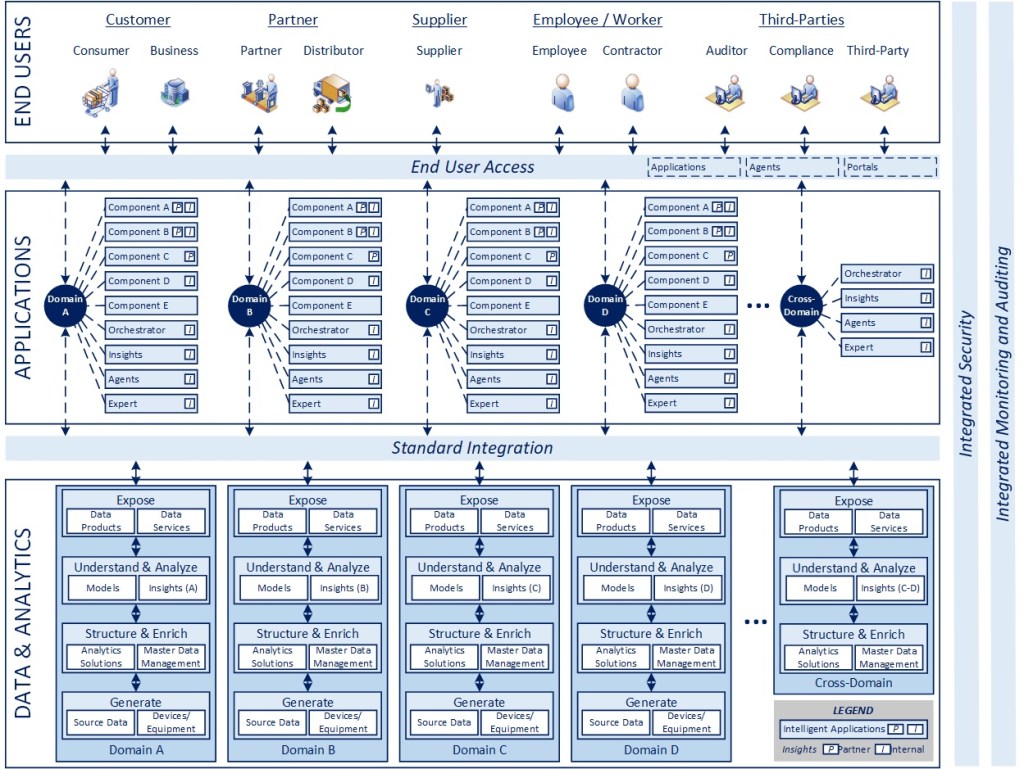
The remaining articles in this series will focus on various dimensions of what the above conceptual model means, as a framework, in terms of AI, applications, and data, and then how we approach that transition and think about it from an IT organizational perspective.
Up Next: Establishing the Framework for the future…
I hope the ideas were worth considering. Thanks for spending the time to read them. Feedback is welcome as always.
-CJG 07/24/2025
 Organized Chaos