The Intelligent Enterprise 2.0 – The Cost of Complexity

How did we get here…?

The challenges involved in managing a technology footprint today at any medium to large organization are very high for a multitude of reasons:

  • Proliferation of technologies and solutions that are disconnected or integrated in inconsistent ways, making simplification or modernization efforts difficult to deliver
  • Mergers and acquisitions that bring new systems into the landscape that aren’t rationalized with or migrated to existing systems, creating redundancy, duplication of capabilities, and cost
  • “Speed-to-market” initiatives involving unique solution approaches that increase complexity and cost of ownership
  • A blend of in-house and purchased software solutions, hosted across various platforms (including multi-cloud), increasing complexity and cost of security, integration, performance monitoring, and data movement
  • Technologies advancing at a rate, especially with the introduction of artificial intelligence (AI), that organizations can’t integrate them quickly enough to do so in a consistent manner
  • Decentralized or federated technology organizations that operate with relative autonomy, independent of standards, frameworks, or governance, which increases complexity and cost

The result of any of the above factors can be enough cost and complexity that the focus within a technology organization can shift from innovation and value creation to struggling to keep the lights on and maintaining a reliable and secure operating environment.

This article will be the first in a series focused on where I believe technology is heading, with an eye towards a more harmonious integration and synthesis of applications, AI, and data… what I previously referred to in March of 2022 as “The Intelligent Enterprise”.  The sooner we begin to operate off a unified view of how to align, integrate, and leverage these oftentimes disjointed capabilities today, the faster an organization will leapfrog others in their ability to drive sustainable productivity, profitability, and competitive advantage.


Why It Matters

Before getting into the dimensions of the future state, I wanted to first clarify how these technology challenges manifest themselves in meaningful ways, because complexity isn’t just an IT problem, it’s a business issue, and partnership is important in making thoughtful choices in how we approach future solutions.


Lost Productivity

A leadership team at a manufacturing facility meets first thing in the morning.  It is the first of multiple they will have throughout the course of a day.  They are setting priorities for the day collectively because the systems that support them: a combination of applications, analytics solutions, equipment diagnostics, and AI tools, are all providing different perspectives on priorities and potential issues, but in disconnected ways, and it is now on the leadership team to decide which of these should receive attention and priority in the interest of making their production targets for a day.  Are they making the best choices in terms of promoting efficiency, quality, and safety?  There’s no way to know.

Is this an unusual situation?  Not at all.  Today’s technology landscape is often a tapestry of applications with varied levels of integration and data sharing, data apps and dashboards meant to provide insights and suggestions, and now AI tools to “assist” or make certain activities more efficient for an end user.

The problem is what happens when all these pieces end up on someone’s desktop, browser, or mobile device and they are left to copy data from one solution to the other, arbitrate which of various alerts and notifications is most important, identify dependencies to help make sure they are taking the right actions in the right sequence (in a case like directed work activity), and quite often that time is lost productivity in itself, regardless of which path they take, which may amplify the impact further, given retention and/or high turnover are real issues in some jobs that reduce the experience available to navigate these challenges successfully.


Lower Profitability

The result of this lost productivity and ever-expanding technology footprint is both lost revenue (to the extent it hinders production or effective resource utilization) and higher operating cost, especially to the degree that organizations introduce the next new thing without retiring or replacing what was already in place, or integrating things effectively.  Speed-to-market is a short-term concept that tends to cause longer-term cost of ownership issues (as I previously discussed in the article “Fast and Cheap Isn’t Good”), especially to the degree that there isn’t a larger blueprint in place to make sure such advancements are done in a thoughtful, deliberate manner.

To this end, how we do something can be as important as what we intend to do, and there is an argument for thinking through the operating implications when undertaking new technology efforts with a more holistic mindset than a single project tends to take in my experience.


Lost Competitive Advantage

Beyond the financial implications, all of the varied solutions, accumulated technologies and complexity, and custom or interim band aids built to connect one solution to the next eventually catches up in a form of what one organization used to refer to as “waxy buildup” that prevents you from moving quickly on anything.  What seems on paper to be a simple addition or replacement becomes a lengthy process of analysis and design that is cumbersome and expensive, where the lost opportunity is speed-to-market in an increasingly competitive marketplace. 

This is where the new market entrants thrive and succeed, because they don’t carry the legacy debt and complexity of entrenched market players who are either too slow to respond or too resistant to change to truly transform at a level that allows them to sustain competitive advantage.  Agility gives way to a “death by a thousand paper cuts” of tactical decisions made that were appropriate and rational in the moment, but created significant amounts of technical debt that inevitably must be paid.


A Vision for the Future

So where does this leave us?  Pack up the tent and go home?  Of course not.

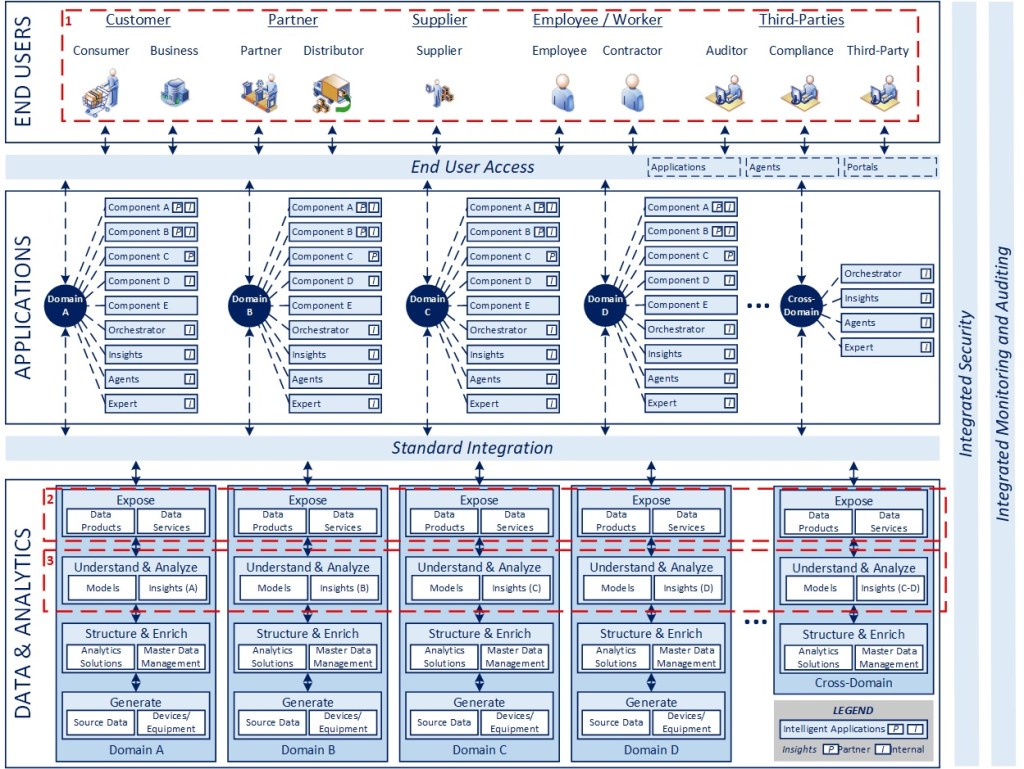
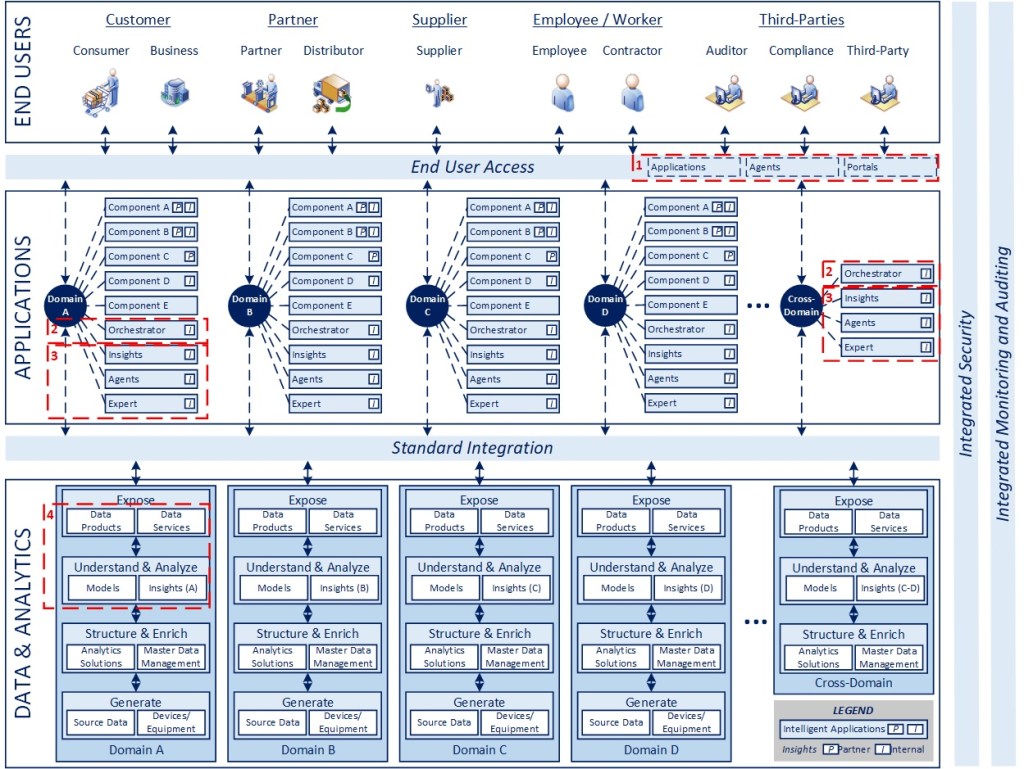
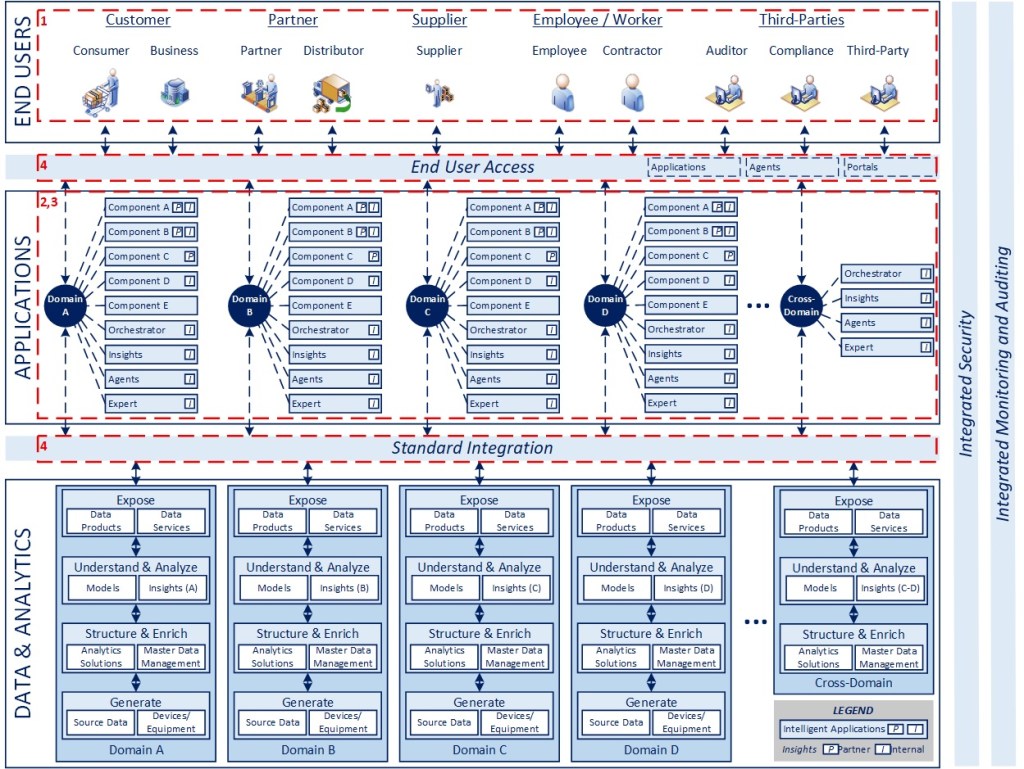
We are at a significant inflection point with AI technology that affords us the opportunity to examine where we are and to start adjusting our course to a more thoughtful and integrated future state where AI, applications, and data and analytics solutions work in concert and harmony with each other versus in a disconnected reality of confusion.

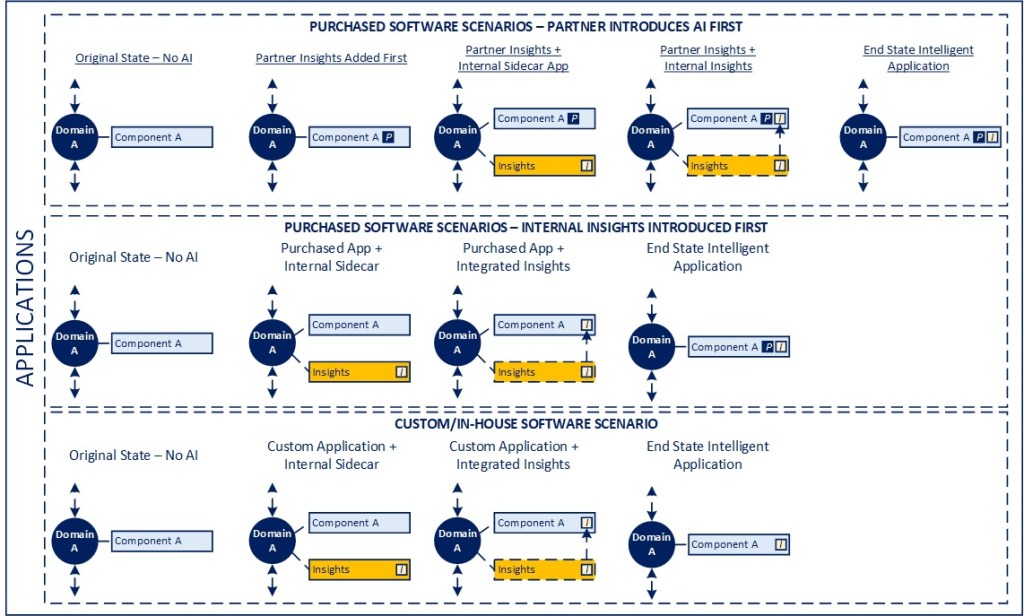
It begins with the consumers of these capabilities, supported by connected ecosystems of intelligent applications, enabled by insights, agents, and experts, that infuse intelligence into making people productive, businesses agile and competitive, and improve value derived from technology investments at a level disproportionate to what we can achieve today.

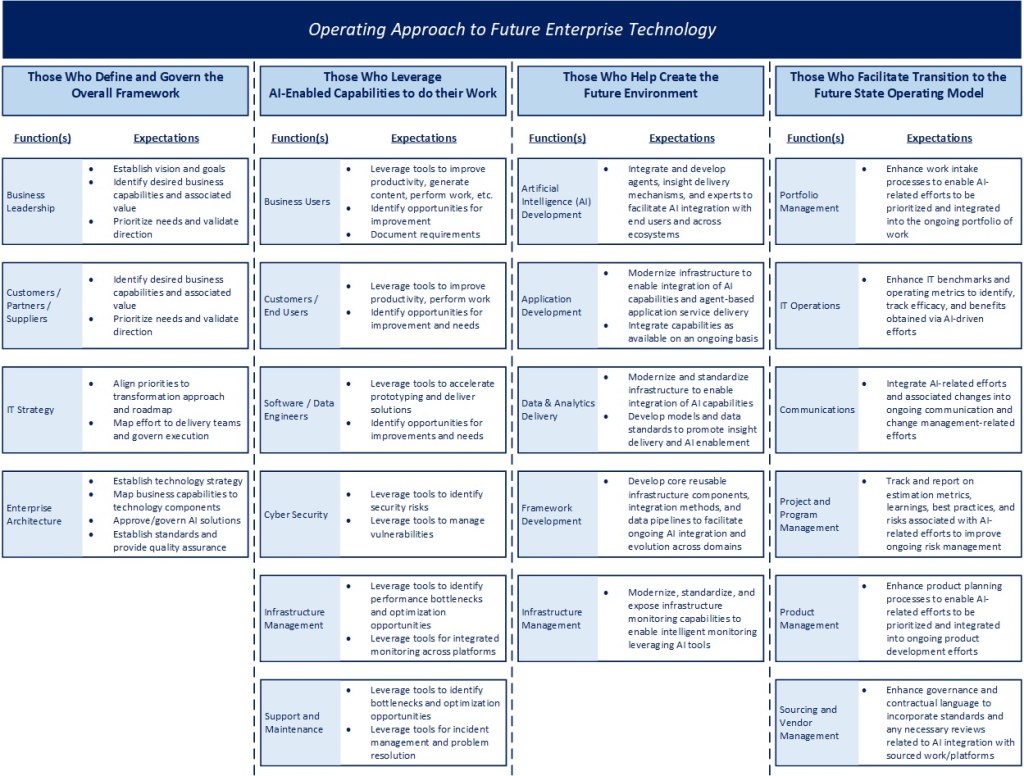
The remaining articles in this series will focus on various dimensions of what the above conceptual model means, as a framework, in terms of AI, applications, and data, and then how we approach that transition and think about it from an IT organizational perspective.

Up Next: Establishing the Framework for the future…

I hope the ideas were worth considering.  Thanks for spending the time to read them.  Feedback is welcome as always.

-CJG 07/24/2025

Approaching AI Strategy

Overview

In my first blog article back in 2021, I wrote that “we learn to value experience only once we actually have it”… and one thing I’ve certainly realized is that it’s much easier to do something quickly than to do it well.  The problem is that excellence requires discipline, especially when you want to scale or have sustainable results, and that often comes into conflict with a natural desire to achieve speed in delivery.

There is a tremendous amount of optimism in the transformative value AI can create across a wide range of areas.  While much continues to be written about various tools, technologies, and solutions, there is value in having a structured approach to developing AI strategy and how we will govern it once it is implemented across an organization.

Why?  We want results.

Some historical examples on why there is a case for action:

  • Many organizations have leveraged SharePoint as a way to manage documents. Because it’s relatively easy to use, access to the technology generally is provided to a broad set of users, with little or no guidance on how to use it (e.g., metatagging strategy), and over time there becomes a sprawl of content that may contain critical, confidential, or proprietary information with limited overall awareness of what exists and where
  • In the last number of years, Citizen Development has become popular, with the rise of low code, no code, and RPA tools, creating accessibility to automation that is meant to enable business (and largely non-technical) resources to rapidly create solutions, from the trivial to relatively complex. Quite often these solutions aren’t considered part of a larger application portfolio, are managed with little or no oversight, and become difficult to integrate, leverage, or support effectively
  • In data and analytics, tools like Alteryx can be deployed across a broad set of users who, after they are given access to requested data sources, create their own transformations, dashboards, and other analytical outputs to inform ongoing business decisions. The challenge occurs when the underlying data changes, is not understood properly (and downstream inferences can be incorrect), or these individuals leave or transition out of their roles and the solutions they built are not well understood or difficult for someone else to leverage or support

What these situations have in common is the introduction of something meant to serve as an enabler that has relative ease of use and accessibility across a broad audience, but where there also may be a lack of standards and governance to make sure the capabilities are introduced in a thoughtful and consistent manner, leading to inefficiency, increased cost, and lost opportunity.  With the amount of hype surrounding AI, the proliferation of tools, and general ease of use that they provide, the potential for organizations to create a mess in the wake of their experimentation with these technologies seems very significant. 

The focus of the remainder of this article is to explore some dimensions to consider in developing a strategy for the effective use and governance of AI in an organization.  The focus will be on the approach, not the content of an AI strategy, which can be the subject of a later article.  I am not suggesting that everything needs to be prescriptive, cumbersome, or bureaucratic to the point that nothing can get done, but I believe it is important to have a thoughtful approach to avoid the pitfalls that are common to these situations.

To the extent that, in some organizations, “governance” implies control versus enablement or there are historical real or perceived IT delivery issues, there may be concern with heading down this path.  Regardless of how the concepts are implemented, I believe they are worth considering sooner rather than later, given we are still relatively early in the adoption process of these capabilities.

Dimensions to Consider

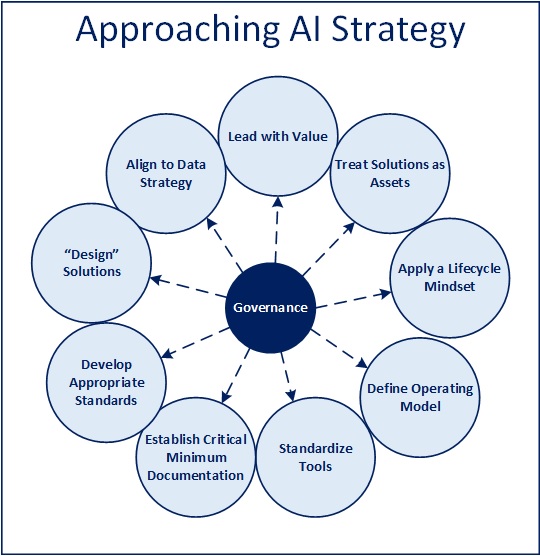
Below are various aspects of establishing a strategy and governance process for AI that are worth consideration.  I listed them somewhat in a sequential manner, as I’d think about them personally, though that doesn’t imply you can’t explore and elaborate as many as are appropriate in parallel, and in whatever order makes sense.  The outcome of the exercise doesn’t need to be rigid mandates, requirements, or guidelines per se, but nearly all of these topics likely will come up implicitly or otherwise as we delve further into leveraging these technologies moving forward.

Lead with Value

The first dimension is probably the most important in forming an AI strategy, which is to articulate the business problems being solved and value that is meant to be created.  It is very easy with new technologies to focus on the tools and not the outcomes and start implementing without a clear understanding of the impact that is intended.  As a result, measuring the value created and governing the efficacy of the solutions delivered becomes extremely difficult.

As a person who does not believe in deploying technology for technology’s sake, identifying, tracking, and measuring impact is important in knowing we will ultimately make informed decisions in how we leverage new capabilities and invest in them appropriately over time.

Treat Solutions as Assets

Along the lines of the above point, there is risk associated with being consumed by what is “cool” versus what is “useful” (something I’ve written about previously), and treating new technologies like “gadgets” versus actual business solutions.  Where we treat our investments as assets, the associated discipline we apply in making decisions surrounding them should be greater.  This is particularly important in emerging technology because the desire to experiment and leverage new tools could quickly become unsustainable as the number of one-off solutions grows and is unsupportable, eventually draining resources from new innovation.

Apply a Lifecycle Mindset

When leveraging a new technical capability, I would argue that we should look for opportunities to think of the full product lifecycle when it comes to how we identify, define, design, develop, manage, and retire solutions.  In my experience, the identify (finding new tools) and develop (delivering new solutions) aspects of the process receive significant emphasis in a speed-to-market environment, but the others much less so, and often to the overall detriment of an organization when they quickly are saddled with the resulting technical debt that comes from neglecting some of the other steps in the process.  This doesn’t necessarily imply a lot of additional steps, process overhead, or time/effort to be expended, but there is value created in each step of a product lifecycle (particularly in the early stages) and all of them need to be given due consideration if you want to establish a sustainable, performant environment.  The physical manifestation of some these steps could be as simple as a checklist to make sure there aren’t blind spots that arise later on that were avoidable or that create business risk.

Define Operating Model

Introducing new capabilities, especially ones where the barrier to entry/ease of use allows for a wide audience of users can cause unintended consequences if not managed effectively.  While it’s tempting to draw a business/technology dividing line, my experience has been that there can be very technically capable business consumers of technology and very undisciplined technologists who implement it as well.  The point of thinking through the operating model is to identify roles and responsibilities in how you will leverage new capabilities so that expectations and accountability is clear, along with guidelines for how various teams are meant to collaborate over the lifecycle mentioned above.

Whether the goal is to “empower end users” by fully distributing capabilities across teams, with some level of centralized support and governance, or fully centralizing with decentralized demand generation (or any flavor in between), the point is to understand who is best positioned to contribute at different steps of the process and promote consistency to an appropriate level so performance and efficacy of both the process and eventual solutions is something you can track, evaluate, and improve over time.  As an example, it would likely be very expensive and ineffective to hire a set of “prompt engineers” that operate in a fully distributed manner in a larger organization by comparison with having a smaller, centralized set of highly skilled resources who can provide guidance and standards to a broader set of users in a de-centralized environment.

Following onto the above, it is also worthwhile to decide whether and how these kinds of efforts should show up in a larger portfolio management process (to the extent one is in place).  Where AI and agentic solutions are meant to displace existing ways of working or produce meaningful business outcomes, the time spent delivering and supporting these solutions should likely be tracked so there is an ability to evaluate and manage these investments over time.

Standardize Tools

This will likely be one of the larger issues that organizations face, particularly given where we are with AI in a broader market context today.  Tools and technologies are advancing at such a rapid rate that having a disciplined process for evaluating, selecting, and integrating a specific set of “approved” tools is and will be challenging for some time.

While asking questions of a generic large language model like ChatGPT, Grok, DeepSeek, etc. and changing from one to the other seems relatively straightforward, there is a lot more complexity involved when we want to leverage company-specific data and approaches like RAG to produce more targeted and valuable outcomes.

When it comes to agentic solutions, there is also a proliferation of technologies at the moment.  In these cases, managing the cost, complexity, performance, security, and associated data privacy issues will also become complex if there aren’t “preferred” technologies in place and “known good” ways in which they can be leveraged.

Said differently, if we believe effective use of AI is critical to maintaining competitive advantage, we should know that the tools we are leveraging are vetted, producing quality results, and that we’re using them effectively.

Establish Critical Minimum Documentation

I realize it’s risky to use profanity in a professional article, but documentation has to be mentioned if we assume AI is a critical enabler for businesses moving forward.  Its importance can probably be summarized if you fast forward one year from today, hold a leadership meeting, and ask “what are all the ways we are using artificial intelligence, and is it producing the value we expected a year ago?”  If the response contains no specifics and supporting evidence, there should be cause for concern, because there will be significant investment made in this area over the next 1-2 years, and tracking those investments is important to realizing the benefits that are being promised everywhere you look.

Does “documentation” mean developing a binder for every prompt that is created, every agent that’s launched, or every solution that’s developed?  No, absolutely not, and that would likely be a large waste of money for marginal value.  There should be, however, a critical minimum amount of documentation that is developed in concert with these solutions to clarify their purpose, intended outcome/use, value to be created, and any implementation particulars that may be relevant to the nature of the solution (e.g. foundational model, data sets leveraged, data currency assumptions, etc.).  An inventory of the assets developed should exist, minimally so that it can be reviewed and audited for things like security, compliance, IP, and privacy-related concerns where applicable.

Develop Appropriate Standards

There are various types of solutions that could be part of an overall AI strategy and the opportunity to develop standards that promote quality, reuse, scale, security, and so forth is significant.  Whether it takes the form of a “how to” guide for writing prompts, to data sourcing and refresh standards with RAG-enabled solutions, reference architecture and design patterns across various solution types, or limits to the number of agents that can be developed without review for optimization opportunities… In this regard, something pragmatic, that isn’t overly prescriptive but that also doesn’t reflect a total lack of standards would be appropriate in most organizations.

In a decentralized operating environment, the chance that solutions will be developed in a one-off fashion, with varying levels of quality, consistency, and standardization is highly probable and that could create issues with security, scalability, technical debt, and so on.  Defining the handshake between consumers of these new capabilities and those developing standards, along with when it is appropriate to define them, could be important things to consider.

Design Solutions

Again, as I mentioned in relation to the product lifecycle mindset, there can be a strong preference to deliver solutions without giving much thought to design.  While this is often attributed to “speed to market” and a “bias towards action”, it doesn’t take long for tactical thinking to lead to a considerable amount of technical debt, an inability to reuse or scale solutions, or significant operating costs that start to slow down delivery and erode value.  These are avoidable consequences when thought is given to architecture and design up front and the effort nearly always pays off over time.

Align to Data Strategy

This topic could be an article in itself, but suffice is to say that having an effective AI strategy is heavily dependent on an organization’s overall data strategy and the health of that portfolio.  Said differently: if your underlying data isn’t in order, you won’t be able to derive much in terms of meaningful insights from it.  Concerns related to privacy and security, data sourcing, stewardship, data quality, lineage and governance, use of multiple large language models (LLMs), effective use of RAG, the relationship of data products to AI insights and agents, and effective ways of architecting for agility, interoperability, composability, evolution, and flexibility are all relevant topics to be explored and understood.

Define and Establish a Governance Process

Having laid out the above dimensions in terms of establishing and operationalizing an AI strategy, there needs to be a way to govern it.  The goal of governance is to achieve meaningful business outcomes by promoting effective use and adoption of the new capabilities, while managing exposure related to introducing change into the environment.  This could be part of an existing governance process or set up in parallel and coordinated with others in place, but the point is that you can’t optimize what you don’t monitor and manage, and the promise of AI is such that we should be thoughtful about how we govern its adoption across an organization.

Wrapping Up

I hope the ideas were worth considering.  For more on my thoughts on AI in particular, my articles Exploring Artificial Intelligence and Bringing AI to the End User can provide some perspective for those who are interested.

Thanks for spending the time to read them.  Feedback is welcome as always.

-CJG 03/17/2025

Ethics and Technology

Overview

Having worked both in consulting and corporate environments for many years and across multiple industries, we’re at an interesting juncture in how technology is leveraged at a macro-level and the broader business and societal impacts of those choices.  Whether that is AI-generated content that could easily be mistaken for “real” events to the leverage of data collection and advanced analytics in various business and consumer scenarios to create “competitive advantage”.

The latter scenario has certainly been discussed for quite a while, whether it is in relation to managing privacy while using mobile devices, trusting a search engine and how they “anonymize” your data before potentially selling it to third parties, or whether the results presented as the outcome of a search (or GenAI request) is objective and unbiased, or being presented with some level of influence given the policies or leanings of the organization sponsoring it.


The question to be explored here is: How do we define the ethical use of technology?


For the remainder of this article, I’ll suggest some ways to frame the answer in various dimensions, acknowledging that this isn’t a black-and-white issue and the specifics of a situation could make some of the considerations more or less relevant.


Considerations

What Ethical Use Isn’t

Before diving into what I believe could be helpful in framing an answer, I wanted to clarify what I don’t consider a valid approach, which is namely the argument used in a majority of cases where individuals or organizations cross a line: We can use technology in this way because it gives us competitive advantage.

Competitive advantage can tend to be an easy argument in the interest of doing something questionable, because there is a direct or indirect financial benefit associated with the decision, thereby clouding the underlying ethics of the decision itself.  “We’re making more money, increasing shareholder value, managing costs, increasing profitability, etc.” are things that tend to move the needle in terms of the roadblocks that can exist in organizations and mobilizing new ideas.  The problem is that, with all of the data collected in the interest of securing approval and funding for initiative, I haven’t seen many cases where there is a proverbial “box to check” in terms of the effort conforming to ethical standards (whether that’s specific to technology use or otherwise).


What Ethical Use Could Be

That point having been stated, below are some questions that could be considered as part of an “ethical use policy”, understanding that not all may have equal weight in an evaluation process.

They are:

  • Legal/Compliance/Privacy
    • Does the ultimate solution conform to existing laws and regulations for your given industry?
    • Is there any pending legislation related to the proposed use of technology that could create such a compliance issue?
    • Is there any industry-specific legislation that would suggest a compliance issue if it were logically applied in a new way that relates to the proposed solution?
    • Would the solution cause a compliance issue in another industry (now or in legislation that is pending)? Is there risk of that legislation being applied to your industry as well?


  • Transparency
    • Is there anything about the nature of the solution that, were it shared openly (e.g., through a press release or industry conference/trade show) would cause customers, competitors, or partners/suppliers to raise issues with the organization’s market conduct or end user policies? This can be a tricky item given the previous points on competitive advantage and what might be labeled as “trade secret” but potentially violate anti-trust, privacy, or other market expectations
    • Does anything about the nature of the solution, were it to be shared openly, suggest that it could cause trust issues between customers, competitors, suppliers, or partners with the organization and, if so, why?


  • Cultural
    • Does the solution align to your organization’s core values? As an example, if there is a transparency concern (above) and “Integrity” is a core value (which it is in many organizations), why does that conflict exist?
    • Does the solution conform to generally accepted practices or societal norms in terms of business conduct between you and your target audience (customers, vertical or horizontal partners, etc.)?


  • Social Responsibility
    • Does the solution create any potential issues from an environmental, societal, or safety standpoint that could have adverse impacts (direct or indirect)?


  • Autonomy and Objectivity
    • Does the solution provide an unbiased, fact-based (or analytically-correct) outcome, free of any potential bias, that can also be governed, audited, and verified? This is an important dimension to consider given the dependency we have on automation continues to increase and we want to be able to trust the security, reliability, accuracy, and so on of what that technology provides.


  • Competitive
    • If a competitor announced they were developing a solution of exactly the same nature as what is proposed, would it be comfortable situation or something that you would challenge as unethical or unfair business practice in any way? Quite often, the lens through which unethical decisions are made is biased with an internal focus.  If that line of sight were reversed and a competitor was open about doing exactly the same thing, would that be acceptable or not?  If there would be issues, likely there might be cause for concern in developing the solution yourself


Wrapping Up

From a process standpoint, a suggestion would be to take the above list and discuss it openly in the interest of not only determining the right criteria for you, but also to establish where these opportunities exist (because they do and will, the more analytics and AI-focused capabilities advance).  Ultimately, there should be a check-and-balance process for ethical use of technology in line with any broader compliance and privacy-related efforts that may exist within an organization today.

Ultimately, the “right thing to do” can be a murky and difficult question to answer, especially with ever-expanding tools and technologies that create capabilities a digital business can use to its advantage.  But that’s where culture and values should still exist, not simply because there is or isn’t a compliance issue, but because reputations are made and reinforced over time through these kinds of decisions, and they either help build a brand or can damage it when the right questions aren’t explored at the right time.

It’s interesting to consider, as a final note, that most companies have an “acceptable use of IT” policy for employees, contractors, and so forth, in terms of setting guidelines for what they can or can’t do (e.g., accessing ‘prohibited’ websites / email accounts or using a streaming platform while at work), but not necessarily for technology directed outside the organization.  As we enter a new age of AI-enabled capabilities, perhaps it’s a good time to look at both.

I hope the ideas were worth considering.  Thanks for spending the time to read them.  Feedback is welcome as always.

-CJG 10/25/2024

Bringing AI to the End User

Overview

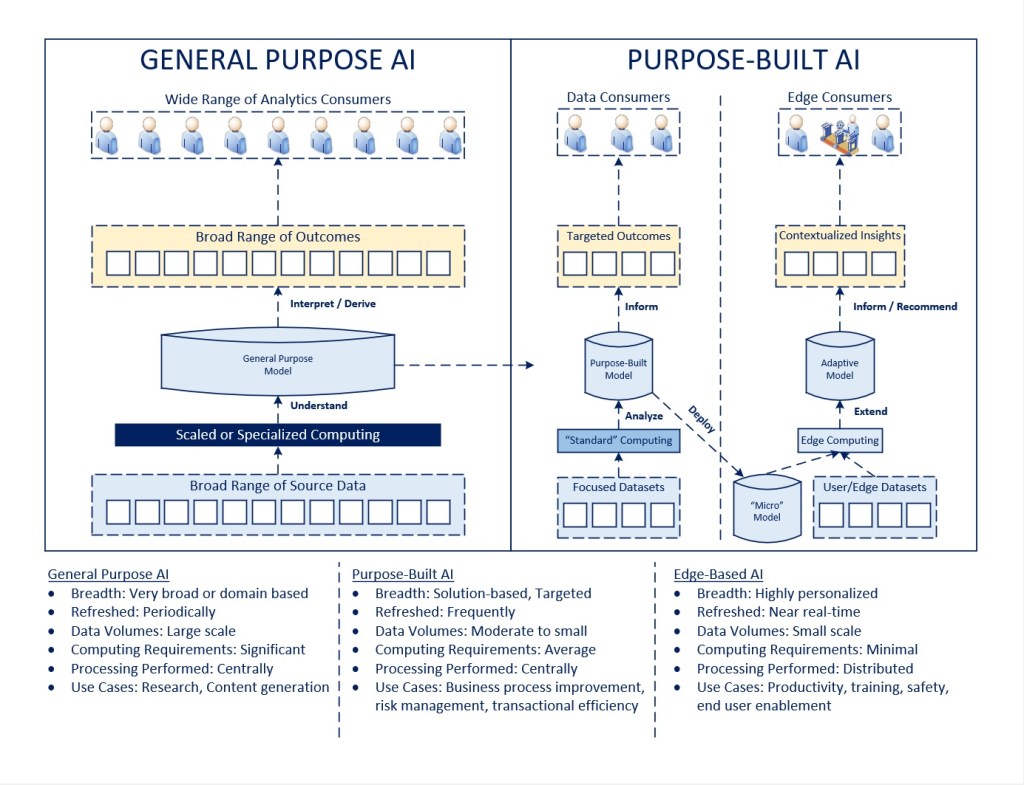
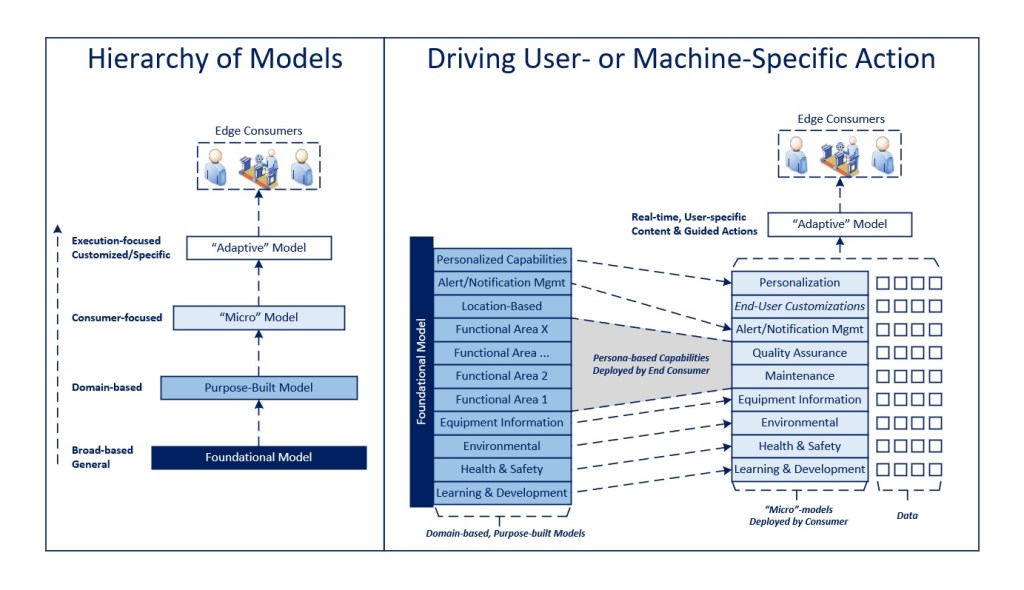
In my recent article on Exploring Artificial Intelligence, I covered several dimensions of how I think about the direction of AI, including how models will evolve from general-purpose and broad-based to be more value-focused and end consumer-specific as the above diagram is intended to illustrate.

The purpose of this article is to dive a little deeper into a mental model for how I believe the technology could become more relevant and valuable in an end-user (or end consumer) specific context.

Before that, a few assertions related to the technology and end user application of the technology:

  • The more we can passively collect data in the interest of simplifying end-user tasks and informing models, the better. People can be both inconsistent and unreliable in how they capture data.  In reality, our cell phones are collecting massive amounts of data on an ongoing basis that is used to drive targeted advertising and other capabilities to us without our involvement.  In a business context, however, the concept of doing so can be met with significant privacy and other concerns and it’s a shame because, while there is data being collected on our devices regardless, we aren’t able to benefit from it in the context of doing our work
  • Moving from a broad- or persona-based means of delivering technology capabilities to a consumer-specific approach is a potentially significant advancement in enabling productivity and effectiveness. This would be difficult or impossible to achieve without leveraging an adaptive approach that synthesizes various technologies (personalization, customization, dynamic code generation, role-based access control, AI/ML models, LLMs, content management, and so forth) to create a more cohesive and personalized user experience
  • While I am largely focusing on end-user application of the technology, I would argue that the same concepts and approach could be leveraged for the next generation of intelligent devices and digital equipment, such as robotics in factory automation scenarios
  • To make the technology both performant and relevant, part of the design challenge is to continually reduce and refine to level of “model” information that is needed at the next layer of processing so as not to overload the end computing device (presumably a cell phone or tablet) with a volume of data that isn’t required to enable effective action on behalf of the data consumer.

The rest of this article will focus on providing a mental model for how to think about the relationship across the various kinds of models that may make up the future state of AI.

Starting with a “Real World” example

Having spent a good portion of my time off traveling across the U.S., while I had a printed road atlas in my car, I was reminded of the trust I place in Google Maps more than once, particularly when driving through an “open range” gravel road with cattle roaming about in northwest Nebraska on my way to South Dakota.  In many ways, navigation software represents a good starting point for where I believe intelligent applications will eventually go in the business environment.

Maps is useful as a tool because it synthesizes what data is has on roads and navigation options with specific information like my chosen destination, location, speed traps, delays, and accident information that is specific to my potential routes, allowing for a level of customization if I prefer to take routes that avoid tolls and so on.  From an end-user perspective, it provides a next recommended action, remaining contextually relevant to where I am and what I need to do, along with how long it will be both until that action needs to be taken as well as the distance remaining and time I should arrive at my final destination.

In a connected setting, navigation software pulls pieces of its overall model and applies data on where I am and where I’m going, to (ideally) help me get where I’m going as efficiently as possible.  The application is useful because it is specific to me, to my destination, and to my preferred route, and is different than what would be delivered to a car immediately behind me, despite leveraging the same application and infrastructure.  This is the direction I believe we need to go with intelligent applications, to drive individual productivity and effectiveness

Introducing the “Tree of Knowledge” concept

The Overall Model

The visual above is meant to represent the relationship of general-purpose and foundational models to what ultimately are delivered to an end-user (or piece of digital equipment) in a distributed fashion.

Conceptually, I think of the relationship across data sets as if it were a tree. 

  • The general-purpose model (e.g., LLM) provides the trunk that establishes a foundation for downstream analytics
  • Domain-specific models (e.g., RAG) act as the branches that rely on the base model (i.e., the trunk) to provide process- or function-specific capabilities that can span a number of end-user applications, but have specific, targeted outcomes in mind
  • A “micro”-model is created when specific branches of the tree are deployed to an end-user based on their profile. This represents the subset that is relevant to that data consumer given their role, permissions, experience level, etc.
  • The data available at the end point (e.g., mobile device) then provides the leaves that populate the branches of the “micro”-models that have been deployed to create an adaptive model used to inform the end user and drive meaningful and productive action.

The adaptive model should also take into account user preferences (via customization options) and personalization to tune their experience as closely as possible to what they need and how they work.

In this way, the progression of models moves from general to very specific, end-user focused solutions that are contextualized with real-time data much the same as the navigation example above.

It is also worth noting that, in addition to delivering these capabilities, the mobile device (or endpoint) may collect and send data back to further inform and train the knowledge models by domain (e.g., process performance data) and potentially develop additional branches based on gaps that may surface in execution.

Applying the Model

Having set context on the overall approach, there are some notable differences from how these capabilities could create a different experience and level of productivity than today, namely:

  • Rather than delivering content and transactional capabilities based on an end-user’s role and persona(s), those capabilities would be deployed to a user’s device (the branches of the “micro”-model), but synthesized with other information (the “leaves”) like the user’s experience level, preferences, location, training needs, equipment information (in a manufacturing-type context), to generate an interface specific to them that continually evolves to optimize their individual productivity
  • As new capabilities (i.e., “branches”) are developed centrally, they could be deployed to targeted users and their individual experiences would adapt to incorporate in ways that work best for them and their given configuration, without having to relearn the underlying application(s)

Going Back to Navigation

On the last point above, a parallel example would be the introduction of weather information into navigation. 

At least in Google Maps, while there are real-time elements like speed traps, traffic delays, and accidents factored into the application, there is currently no mechanism to recognize or warn end users about significant weather events that also may surface along the route.  In practice, where severe weather is involved, this could represent safety risk to the traveler and, in the event that the model was adapted to include a “branch” for this kind of data, one would hope that the application would behave the same from an end-user standpoint, but with the additional capability integrated into the application.

Wrapping Up

Understanding that we’re still early in the exploration of how AI will change the way we work, I believe that defining a framework for how various types of models can integrate and work across purposes would enable significant value and productivity if designed effectively.

I hope the ideas were worth considering.  Thanks for spending the time to read them.  Feedback is welcome as always.

-CJG 09/14/2024

Transforming Manufacturing

Overview

Growing Up in Manufacturing

My father ran his own business when I was growing up.  His business had two components: first, he manufactured pinion wire (steel or brass rods of various diameters with teeth from which gears are cut) and, second, as a producer of specialty gears that were used in various applications (e.g., the timing mechanism of an oil pump).  It was something he used to raise and support a large Italian family and it was pretty much a one-man show, with help from his kids as needed, whether that was counting and quality testing gears with mating parts or cutting, packing, and shipping material to various customers across North America.  He acquired and learned how to operate screw machines to produce pinion wire but eventually shifted to a distribution business, where he would buy finished material in quantity and then distribute to middle market customers at lower volumes at a markup. 

His business was as low tech as you could get, with a little card file he maintained that had every order by customer written out on an index card, tracking the specific item/part, volume, and pricing so he had a way to understand history as new requests for quotes and orders came in and also understand purchase patterns over time.  It was largely a relationship business, and he took his customer commitments to heart at a level that dinner conversation could easily deflect into a worry about a disruption in his supply chain (e.g., something not making it to the electroplater on time) and whether he might miss his promised delivery date.  Integrity and accountability were things that mattered and it was very clear his customers knew it.  He had a note pad on which he’d jot things down to keep some subset of information on customer / prospect follow ups, active orders, pending quotes, and so on, but to say there was a system outside what he kept in his head would be unfair to his mental capacity, which was substantial.

It was a highly manual business and, as a person who taught myself how to write software in the third grade, I was always curious what he could do to make things a little easier, more structured, and less manual, even though that was an inescapable part of running his business on the whole.  That isn’t to say he had that issue or concern, given he’d developed a system and way of operating over many years, knew exactly how it worked, and was entirely comfortable with it.  There was also a small point of my father being relatively stubborn, but that didn’t necessarily deter me from suggesting things could be improved.  I do like a challenge, after all… 

As it happened, when I was in high school, we got our first home computer (somewhere in the mid-1980s) and, despite its relatively limited capacity, I thought it would be a good idea to figure out a way to make something about running his business a little easier with technology.  To that end, I wrote a piece of software that would take all of his order management off of the paper index cards and put it into an application.  The ability to look up customer history, enter new orders, look at pricing differences across customers, etc. were all things I figured would make life a lot easier, not mention reducing the need to maintain this overstuffed card file that seemed highly inefficient to me.

By this point, I suspect it’s clear to the reader what happened… which is that, while my father appreciated the good intentions and concept, there was no interest in changing the way he’d been doing business for decades in favor of using technology he found a lot more confusing and intimidating than what he already knew (and that worked to his level of satisfaction).  I ended up relatively disappointed, but learned a valuable lesson, which is that, the first challenge in transformation is changing mindsets… without that, the best vision in the world will fail, no matter what value it may create.

It Starts with Mindset

I wanted to start this article with the above story because, despite nearly forty years having passed since I tried to introduce a little bit of automation to my father’s business, manufacturing in today’s environment can be just as antiquated and resistant to change as it was then, seeing technology as an afterthought, a bolt on, or cost of doing business rather than the means to unlock the potential that exists to transform a digital business in even the most “low tech” of operating environments.

While there is an inevitable and essential dependence on people, equipment, and processes, my belief is that we have a long way to go on understanding the critical role technology plays in unlocking the potential of all of those things to optimize capacity, improve quality, ensure safety, and increase performance in a production setting.

The Criticality of Discipline

Having spent a number of years understanding various approaches to digital manufacturing, one point that I wanted to raise prior to going into more of the particulars is the importance of operating with a holistic vision and striking the balance between agility and long-term value creation.  As I addressed in my article Fast and Cheap Isn’t Good, too much speed without quality can lead to complexity, uncontrolled and inflated TCO, and an inability to integrate and scale digital capabilities over time.  Wanting something “right now” isn’t an excuse not to do things the right way and eventually there is a price to pay for tactical thinking when solutions don’t scale or produce more than incremental gains. 

This is also related to “Framework-Driven Design” that I talk about in my article on Excellence by Design.  It is rarely the case that there is an opportunity to start from scratch in modernizing a manufacturing facility, but I do believe there is substantial value in making sure that investments are guided by an overall operating concept, technology strategy, and evolving standards that will, over time, transform the manufacturing environment as a whole and unlock a level of value that isn’t possible where incremental gains are always the goal.  Sustainable change takes time.

The remainder of this article will focus on a set of areas that I believe form the core of the future digital manufacturing environment.  Given this is a substantial topic, I will focus on the breadth of the subject versus going too deep into any one area.  Those can be follow-up articles as appropriate over time.


Leveraging Data Effectively

The Criticality of Standards

It is a foregone conclusion that you can’t optimize what you can’t track, measure, and analyze in real-time.  To that end, starting with data and standards is critical in transforming to a digital manufacturing environment.  Without standards, the ability to benchmark, correlate, and analyze performance will be severely compromised.  This can be a basic as how a camera system, autonomous vehicle, drone, conveyor, or digital sensor is integrated within a facility, to the representation of equipment hierarchies, or how operator roles and processes are tracked across a set of similar facilities.  Where standards for these things don’t exist, value will be constrained to a set of individual point solutions, use cases, and one-off successes.  Where standards are, however, implemented and scaled over time, the value opportunity will eventually cross over into exponential gains that aren’t otherwise possible, because the technical debt associated with retrofitting and mapping across various standards in place will create a significant maintenance effort that limits focus on true innovation and optimization.  This isn’t to suggest that there is a one-size-fits-all way to thinking about standards and that every solution needs to conform for the sake of an ivory tower ideal.  The point is that it’s worth slowing down the pace of “progress” at times to understand the value in designing solutions for longer-term value creation.

The Role of Data Governance

It’s impossible to discuss the criticality of standards without also highlighting the need for active, ongoing data governance, both to ensure standards are followed, that data quality at the local and enterprise level is given priority (especially to the degree that analytical insights and AI become core to informed decision making), and also to help identify and surface additional areas of opportunity where standards may be needed to create further insights and value across the operating environment.  The upshot of this is that there need to be established roles and accountability for data stewards at the facility and enterprise level if there is an aspiration to drive excellence in manufacturing, no matter what the present level of automation is across facilities.


Modeling Distributed Operations

Applying Distributed Computing

There is a power in distributed computing that enables you to scale execution at a rate that is beyond the capacity you can achieve with a single machine (or processor).  The model requires an overall coordinator of activity to distribute work and monitor execution and then the individual processors to churn out calculations as rapidly as they are able.  As you increase processors, you increase capacity, so long as the orchestrator can continue to manage and coordinate the parallel activity effectively.

From a manufacturing standpoint, the concept applies well across a set of distributed facilities, where the overall goal is to optimize the performance and utilization of available capacity given varying demand signals, individual operating characteristics of each facility, cost considerations, preventative maintenance windows, etc.  It’s a system that can be measured, analyzed, and optimized, with data gathered and measured locally, a subset of which is used to inform and guide the macro-level process.

Striking the Balance

While I will dive into this a little further towards the tail end of this article, the overall premise from an operating standpoint is to have a model that optimizes the coordination of activity between individual operating units (facilities) that are running as autonomously as possible at peak efficiency, while distributing work across them in a way that maximizes production, availability, cost, or whatever other business parameters are most critical. 

The key point being that the technology infrastructure for distributing and enabling production across and within facilities should ideally be a matter of business parameters that can be input and adjusted at the macro-level and the entire system of facilities be adjusted in real-time in a seamless, integrated way.  Conversely, the system should be a closed loop where a disruption at the facility level can inform a change across the overall ecosystem such that workloads are redistributed (if possible) to minimize the impact on overall production.  This could be manifest in one or more micro-level events (e.g., a higher than expected occurrence of unplanned outages) that informs production scheduling and distribution of orders to a major event (e.g., a fire or substantial facility outage) that redirects work across other facilities to minimize end customer impact.  Arguably there are elements that exist within ERP systems that can account for some of this today, but the level and degree of customization required to make it a robust and inclusive process would be substantial, given much of the data required to inform the model exists outside the ERP ecosystem itself, in equipment, devices, processes, and execution within individual facilities themselves.

Thinking about Mergers, Acquisitions, and Divestitures

As I mentioned in the previous section on data, establishing standards is critical to enabling a distributed paradigm for operations, the benefit of which is also the speed at which an acquisition could be leveraged effectively in concert with an existing set of facilities.  This assumes there is an ability to translate and integrate systems rapidly to make the new facility function as a logical extension of what is already in place, but ultimately a number of those technology-related challenges would have to be worked through in the interest of optimizing individual facility performance regardless.  The alternative to having this macro-level dynamic ecosystem functioning would likely be excess cost, inefficiency, and wasted production capacity.


Advancing the Digital Facility

The Role of the Digital Facility

At a time when data and analytics can inform meaningful action in real-time, the starting point for optimizing performance is the individual “processor”, which is a digital facility.  While the historical mental model would focus on IT and OT systems and integrating them in a secure way, the emergence of digital equipment, sensors, devices, and connected workers has led to more complex infrastructure and an exponential amount of available data that needs to be thoughtfully integrated to maximize the value it can contribute over time.  With this increased reliance on technology, likely some of which runs locally and some in the cloud, the reliability of wired and wireless connectivity has also become a critical imperative of operating and competing as a digital manufacturer.

Thinking About Auto Maintenance

Drawing on a consumer example, I brought my car in for maintenance recently.  The first thing the dealer did was plug in and download a set of diagnostic information that was gathered over the course of my road trips over the last year and a half.  The data was collected passively, provided the technicians with input on how various engine components were performing, and also some insight on settings that I could adjust given my driving habits that would enable the car to perform better (e.g., be more fuel efficient).  These diagnostics and safety systems are part of having a modern car and we take them for granted.

Turning back to a manufacturing facility, a similar mental model should apply for managing data at a local and enterprise level, which is that there should be a passive flow of data to a central repository that is mapped to processes, equipment, and operators in a way that enables ongoing analytics to help troubleshoot problems, identify optimization and maintenance opportunities, and look across facilities for efficiencies that could be leveraged at broader scale.

Building Smarter Equipment

Taking things a step further… what if I were to attach a sensor under the hood of my car, take the data, build a model, and try to make driving decisions using that model and my existing dashboard as input?  The concept seems a little ridiculous given the systems already in place within a car to help make the driving experience safe and efficient.  That being said, in a manufacturing facility with legacy equipment, that intelligence isn’t always built in, and the role of analytics can become an informed guessing game of how a piece of equipment is functioning without the benefit of the knowledge of the people who built the equipment to begin with. 

Ultimately, the goal should be for the intelligence to be embedded within the equipment itself, to enable a level of self-healing or alerting, and then within control systems to look at operating conditions across a connected ecosystem to determine appropriate interventions as they occur, whether that be a minor adjustment to operating parameters or a level of preventative maintenance.

The Role of Edge Computing and Facility Data

The desire to optimize performance and safety at the individual facility level means that decisions need to be informed and actions taken in near real-time as much as possible.  This premise then suggests that facility data management and edge computing will continue to increase in criticality as more advanced uses of AI become part of everyday integrated work processes and facility operations.


Enabling Operators with Intelligence

The Knowledge Challenge

With the general labor shortage in the market and retirement of experienced, skilled laborers, managing knowledge and accelerating productivity is a major issue to be addressed in manufacturing facilities.  There are a number of challenges associated with this situation, not the least of which can be safety related depending on the nature of the manufacturing environment itself.  Beyond that, the longer it takes to make an operator productive in relation to their average tenure (something that statistics would suggest is continually shrinking over time), the effectiveness of the average worker can become a limiting factor in the operating performance of a facility overall.

Understanding Operator Overload

One way that things have gotten worse is the proliferation of systems that comes with “modernizing” the manufacturing environment itself.  When confronted with the ever-expanding set of control, IT, ERP, and analytical systems, all of which can be sending alerts and requesting action (to varying degrees of criticality) on a relatively continuous basis, the pressure being created on individual operators and supervisors in a facility has increased substantially (with the availability of exponential amounts of data itself).  This is further complicated in situations where an individual “wears multiple hats” in terms of fulfilling multiple roles/personas within a given facility and arbitrating which actions to take against that increased number of demands can be considerably more complex.

Why Digital Experience Matters

While the number of applications that are part of an operating environment may not be something that is easy to reduce or simplify without significant investment (and time to make change happen), it is possible to look at things like digital experience platforms (DXPs) as a means to manage multiple applications into a single, integrated experience, inclusive of AR/VR/XR technologies as appropriate.  Organizing around an individual operator’s responsibilities can help reduce confusion, eliminate duplicated data entry, improve data quality, and ultimately improve productivity, safety, and effectiveness by extension.

The Role of the Intelligent Agent

With a foundation in place to organize and present relevant information and actions to an operator on a real-time basis, the next level of opportunity comes with the integration of intelligent agents (AI-enabled tools) into a digital worker platform to inform meaningful and guided actions that will ultimate create the most production and safety impact on an ongoing basis.  Again, there is a significant dependency on edge computing, wireless infrastructure, facility data, mobile devices, a delivery mechanism (the DXP mentioned above), and a sound underlying technology strategy to enable this at scale, but it is ultimately where AI tools can have a major impact in manufacturing moving forward.


Optimizing Performance through Orchestration

Why Orchestration Matters

Orchestration itself isn’t a new concept in manufacturing from my perspective, as the legacy versions of it are likely inherent in control and MES systems themselves.  The challenge occurs when you want to scale that concept out to include digital equipment, digital workers, digital devices, control systems, and connected applications into one, seamless, integrated end-to-end process.  Orchestration provides the means to establish configurable and dynamic workflow and associated rules into how you operate and optimize performance within and across facilities in a digital enterprise.

While this is definitely a capability that would need to be developed and extended over time, the concept is to think of the manufacturing ecosystem as a seamless collaboration of operators and equipment to ultimately drive efficient and safe production of finished goods. Having established the infrastructure to coordinate and track activity, the process performance can be automatically recorded and analyzed to inform continuous improvement on an ongoing basis.

Orchestrating within the Facility

The number of uses of orchestration within a facility can be as simple as coordinating and optimizing material movement between autonomous vehicles and fork lifts within a facility, to computer vision applications for safety and quality management.  With the increasing number of connected solutions within a facility, having the means to integrate and coordinate activity between and across them offers a significant opportunity in digital manufacturing moving forward.

Orchestrating across the Enterprise

Scaling back out to the enterprise level, looking across facilities, there are opportunities to look at things like procurement of MRO supplies and optimizing inventory levels, managing and optimizing production planning across similar facilities, benchmarking and analyzing process performance and looking for improvements that can be applied across facilities in a way that will create substantially greater impact than is possible if the focus is limited to the individual facility alone.  Given that certain enterprise systems like ERPs tend to operate at largely a global versus local level, having infrastructure in place to coordinate activity across both can create visibility to improvement opportunities and thereby substantial value over time.

Coordinated Execution

Finally, to coordinate between the local and global levels of execution, a thoughtful approach to managing data and the associated analytics needs to be taken.  As was mentioned in the opening, the overall operating model is meant to leverage a configurable, distributed paradigm, so the data that is shared and analyzed within and across layers is important to calibrate as part of the evolving operating and technology strategy.


Wrapping Up

There is a considerable amount of complexity associated with moving between a legacy, process and equipment-oriented mindset to one that is digitally enabled and based on insight-driven, orchestrated action.  That being said, the good news is that the value that can be unlocked with a thoughtful digital strategy is substantial given we’re still on the front-end of the evolution overall.

I hope the ideas were worth considering.  Thanks for spending the time to read them.  Feedback is welcome as always.

-CJG 02/12/2024