

“Are we set up for success?”
This is a question that I’ve heard asked many times, particularly when there is a strategic initiative or transformation effort being kicked off. Normally, the answer is an enthusiastic “Yes”, because most programs start with a lot of optimism (which is a good thing), but not always a full understanding of risk. The question is… How do you know whether you have the necessary capabilities to deliver?
In any type of organization, there is a blend of skills and experience, whether that is across a leadership team or within an individual team itself. Given that reality and the ongoing nature of organizations to evolve, realign, and reorganize, it is not uncommon to leverage some form of evaluation (such as a Kolbe assessment) to understand the natural strengths, communication, or leadership styles of various individuals to help facilitate understanding and improve collaboration.
But what about knowledge and experience? This part I haven’t seen done as often partially because, if not done well, it can lead to a cumbersome and manually intensive process that doesn’t create value.
The focus of this article is to suggest a means to understand and evaluate the breadth of knowledge and skills across a team. To the extent we can visualize collective capability, it can be a useful tool to inform various things from a management standpoint, which are outlined in the second section below.
Necessary caveats: The example used is not meant to be prescriptive or exhaustive and this activity doesn’t need to be focused on IT alone. The goal in the illustration used here was to provide enough specificity to help the reader visualize the concept at a practical level, but the data is entirely made up and not meant to be taken as a representation of an actual set of people.
On the Approach
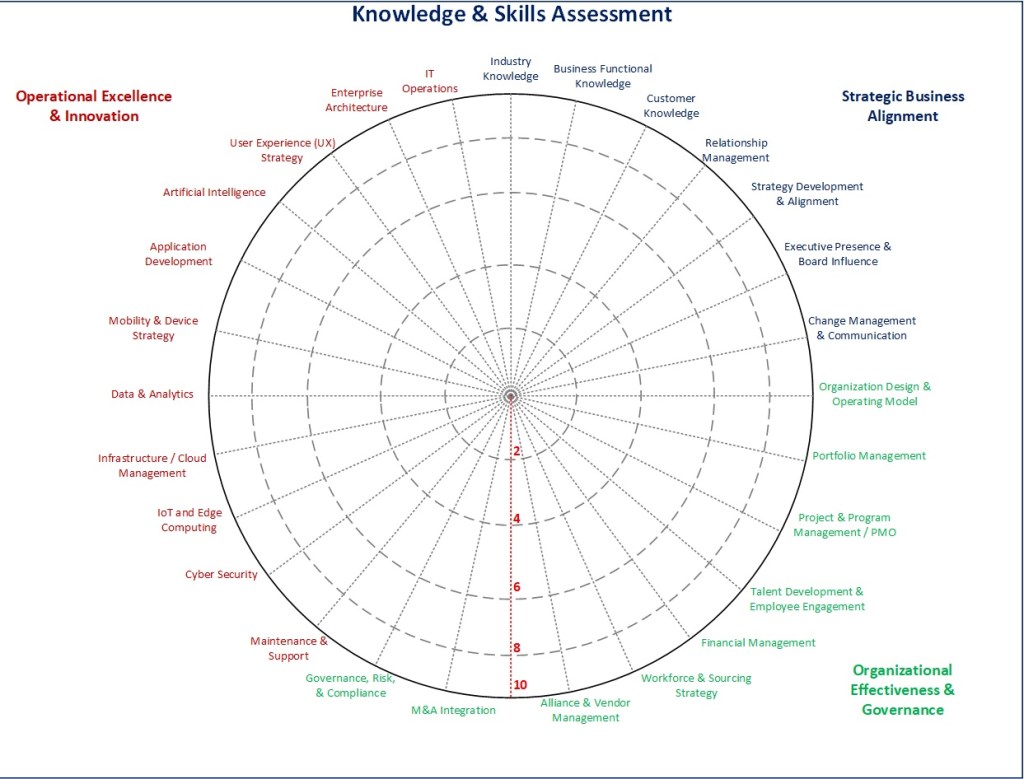
Thinking through the Dimensions
The diagram above breaks out 27 dimensions from a knowledge and skills standpoint, ranging from business understanding to operations and execution. The dimensions chosen for the purposes of this exercise don’t particularly matter, but I wanted to select a set that covered many of the aspects of an IT organization as a whole.
From an approach standpoint, the goal would be to identify what is being evaluated, select the right set of dimensions, define them, then determine “what good looks like” in terms of having a baseline for benchmarking (e.g., 10 means X, 8 means Y, 6 means Z, etc.). With the criteria established, one should then explain the activity to the group being evaluated, prepare a simple survey, and gather the data. The activity is meant to be rapid and directionally accurate, not to supplant individual performance evaluations, career development, or succession plans that should exist at a more detailed level. Ideally the dimensions should also align to the competency model for an organization, but the goal of this activity is directional, so that step isn’t critical if it requires too much effort.
Once data has been collected, individual results can be plotted in a spider graph like the one below to provide a perspective on where there are overlaps and gaps across a team.
Ways of Applying the Concept
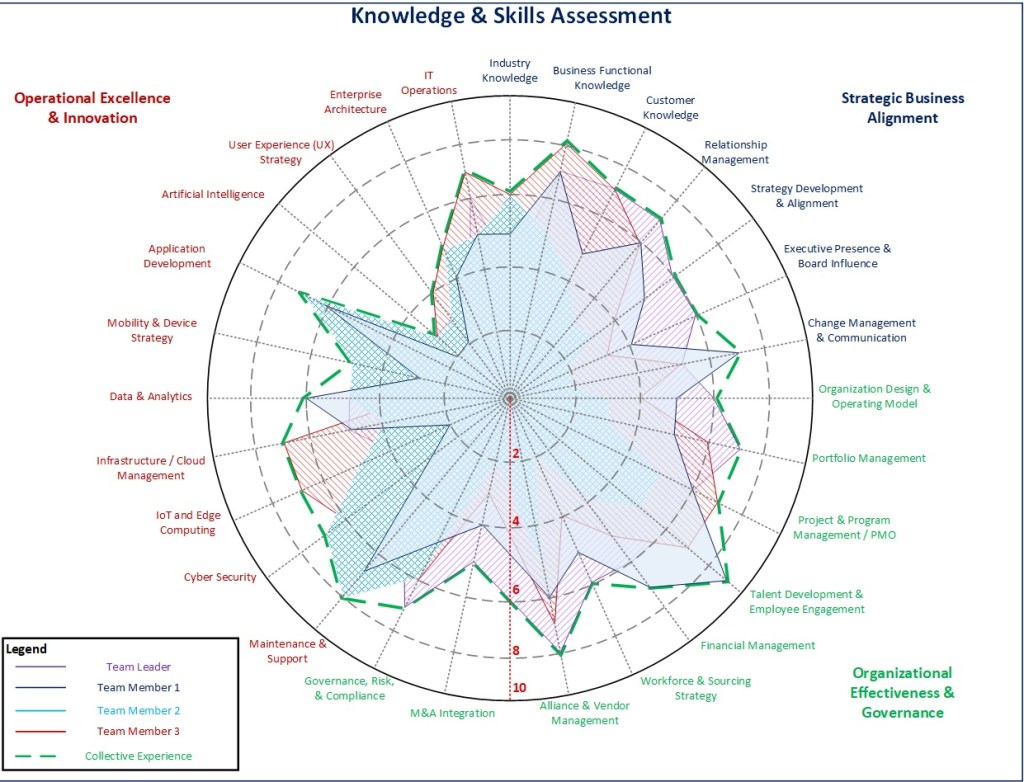
With the individual inputs from a team having been provided, it’s possible to think about the data in two different respects: how it reflects individual capabilities, gaps, and overlaps as well as what it shows as the collective experience of the team as a whole (the green dotted outline above).
The data now being assembled, there are a number of ways to potentially leverage the information outlined below.
Talent Development: The strengths and gaps in any individual view can be used to inform individual development plans or identify education needs for the team as a whole. It can also be used to sanity check individual roles and accountability against the actual experience of individuals on the team. This isn’t to suggest rotations and “learn on the job” situations aren’t a good thing, but rather to raise awareness of those situations so that they can be managed proactively with the individual or the team as a whole. To the extent that a gap with one person is a strength in another, there could be cross-training opportunities that surface through the process.
Coordination and Collaboration: With overlaps and gaps visible across a team, there can be areas identified where individual team members see opportunities to consult with others who have a similar skillset, and also perhaps a different background that could surface different ways to approach and solve problems. In larger organizations, it can often be difficult to know “who to invite” to a conversation, where the default becomes inviting everyone (or making everyone ‘mandatory’ versus ‘optional’), which ultimately can lead to less productive or over-attended conversations that lack focus.
Leaders and Teams: In the representative data above, I deliberately highlighted areas where team members were not as experienced as the person leading the team, but the converse situation as well. In my experience, it is almost never the case that the leader is the most experienced in everything within the scope of what a team has to do. If that was the case, it could suggest that the potential of that team could be limited to that leader’s individual capabilities and vision, because others lack the experience to help inform direction. In the event that team members have more experience than their leader, there can also be opportunities for individuals to step up and provide direction, assuming the team leader creates space and a supportive environment for that occur. Again, the point of the activity is to identify and determine what, if anything, to do with these disparities where they exist.
Sourcing Strategy: Where significant gaps exist (e.g., there is no one with substantial AI experience in the example data above), these could be areas where finding a preferred partner with a depth of experience in the topic could be beneficial while internal talent is acquired or developed (to the extent it is deemed strategic to the organization).
Business Partnership: The visibility could serve as input to a partnership discussion to align expectations for where business leaders expect support and capability from their technology counterparts versus areas where they are comfortable taking the lead or providing direction. This isn’t always a very deliberate conversation in my experience, and sometimes that can lead to missed expectations in complex delivery situations.
Risk Management: One of the most important things to recognize about a visualization like this is not just what it shows about a teams’ capability, it’s also what isn’t there.
Using Donald Rumsfeld’s now famous concept:
- There is known – something for which we have facts and experience
- There is known unknown – something we know is needed, but which is not yet clear
- And the pure unknown – something outside our experience, and therefore a blind spot
The last category is where we should also focus in an activity like this, because the less experience that exists individually and collectively in a leadership team, there will be a substantial increase in risk because there is a lack of awareness of all the “known unknowns” that can have a material impact on delivering solutions and operating IT. To the extent that a team is relatively inexperienced, no matter how motivated they may be, there is an increased probability that something will be compromised, whether that is cost, quality, schedule, morale, or something else. To that end, this tool can be an important mechanism to identify and manage risk.
Wrapping Up
Having recently written a fairly thorough set of articles on the future of enterprise technology, I wanted to back up and look at something a little less complex, but also with a focus on improving transparency and informing leadership discussions on risk, development, and coordination.
Whether through a mechanism like this or some other avenue, I believe there is value in understanding the breadth of capabilities that exist within a team and across a leadership group as a means for promoting excellence overall.
I hope the ideas were worth considering. Thanks for spending the time to read them. Feedback is welcome as always.
-CJG 08/24/2025
 Organized Chaos