
Overview
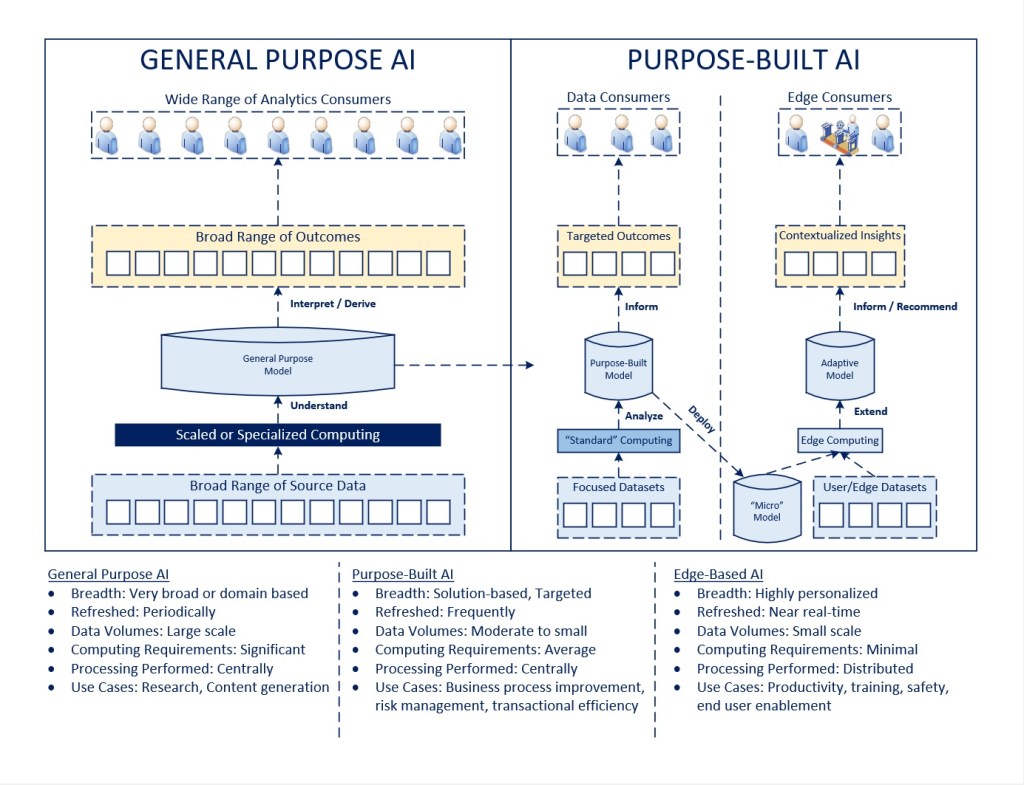
In my recent article on Exploring Artificial Intelligence, I covered several dimensions of how I think about the direction of AI, including how models will evolve from general-purpose and broad-based to be more value-focused and end consumer-specific as the above diagram is intended to illustrate.
The purpose of this article is to dive a little deeper into a mental model for how I believe the technology could become more relevant and valuable in an end-user (or end consumer) specific context.
Before that, a few assertions related to the technology and end user application of the technology:
- The more we can passively collect data in the interest of simplifying end-user tasks and informing models, the better. People can be both inconsistent and unreliable in how they capture data. In reality, our cell phones are collecting massive amounts of data on an ongoing basis that is used to drive targeted advertising and other capabilities to us without our involvement. In a business context, however, the concept of doing so can be met with significant privacy and other concerns and it’s a shame because, while there is data being collected on our devices regardless, we aren’t able to benefit from it in the context of doing our work
- Moving from a broad- or persona-based means of delivering technology capabilities to a consumer-specific approach is a potentially significant advancement in enabling productivity and effectiveness. This would be difficult or impossible to achieve without leveraging an adaptive approach that synthesizes various technologies (personalization, customization, dynamic code generation, role-based access control, AI/ML models, LLMs, content management, and so forth) to create a more cohesive and personalized user experience
- While I am largely focusing on end-user application of the technology, I would argue that the same concepts and approach could be leveraged for the next generation of intelligent devices and digital equipment, such as robotics in factory automation scenarios
- To make the technology both performant and relevant, part of the design challenge is to continually reduce and refine to level of “model” information that is needed at the next layer of processing so as not to overload the end computing device (presumably a cell phone or tablet) with a volume of data that isn’t required to enable effective action on behalf of the data consumer.
The rest of this article will focus on providing a mental model for how to think about the relationship across the various kinds of models that may make up the future state of AI.
Starting with a “Real World” example
Having spent a good portion of my time off traveling across the U.S., while I had a printed road atlas in my car, I was reminded of the trust I place in Google Maps more than once, particularly when driving through an “open range” gravel road with cattle roaming about in northwest Nebraska on my way to South Dakota. In many ways, navigation software represents a good starting point for where I believe intelligent applications will eventually go in the business environment.
Maps is useful as a tool because it synthesizes what data is has on roads and navigation options with specific information like my chosen destination, location, speed traps, delays, and accident information that is specific to my potential routes, allowing for a level of customization if I prefer to take routes that avoid tolls and so on. From an end-user perspective, it provides a next recommended action, remaining contextually relevant to where I am and what I need to do, along with how long it will be both until that action needs to be taken as well as the distance remaining and time I should arrive at my final destination.
In a connected setting, navigation software pulls pieces of its overall model and applies data on where I am and where I’m going, to (ideally) help me get where I’m going as efficiently as possible. The application is useful because it is specific to me, to my destination, and to my preferred route, and is different than what would be delivered to a car immediately behind me, despite leveraging the same application and infrastructure. This is the direction I believe we need to go with intelligent applications, to drive individual productivity and effectiveness.
Introducing the “Tree of Knowledge” concept
The Overall Model
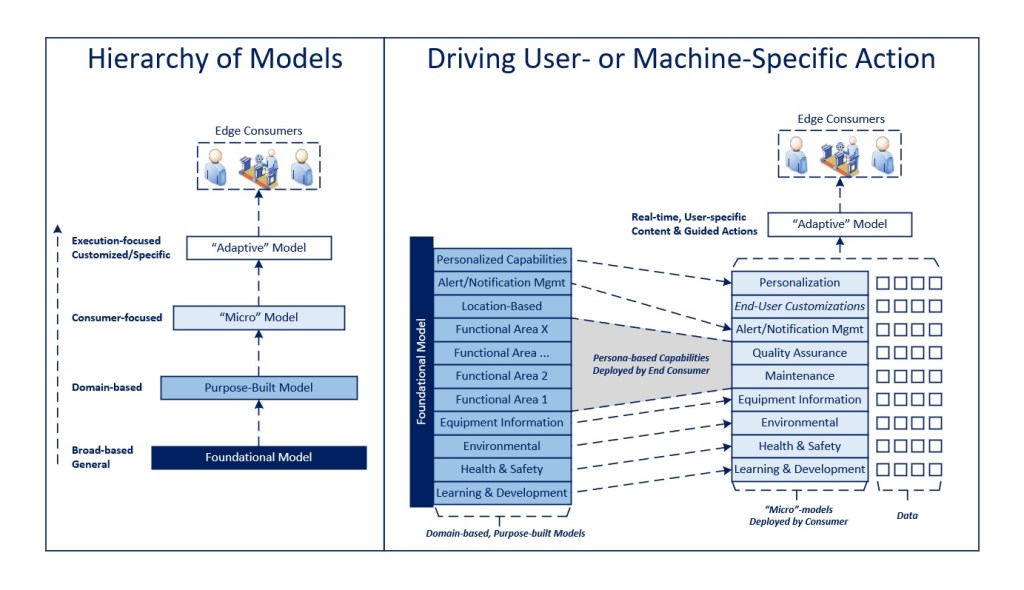
The visual above is meant to represent the relationship of general-purpose and foundational models to what ultimately are delivered to an end-user (or piece of digital equipment) in a distributed fashion.
Conceptually, I think of the relationship across data sets as if it were a tree.
- The general-purpose model (e.g., LLM) provides the trunk that establishes a foundation for downstream analytics
- Domain-specific models (e.g., RAG) act as the branches that rely on the base model (i.e., the trunk) to provide process- or function-specific capabilities that can span a number of end-user applications, but have specific, targeted outcomes in mind
- A “micro”-model is created when specific branches of the tree are deployed to an end-user based on their profile. This represents the subset that is relevant to that data consumer given their role, permissions, experience level, etc.
- The data available at the end point (e.g., mobile device) then provides the leaves that populate the branches of the “micro”-models that have been deployed to create an adaptive model used to inform the end user and drive meaningful and productive action.
The adaptive model should also take into account user preferences (via customization options) and personalization to tune their experience as closely as possible to what they need and how they work.
In this way, the progression of models moves from general to very specific, end-user focused solutions that are contextualized with real-time data much the same as the navigation example above.
It is also worth noting that, in addition to delivering these capabilities, the mobile device (or endpoint) may collect and send data back to further inform and train the knowledge models by domain (e.g., process performance data) and potentially develop additional branches based on gaps that may surface in execution.
Applying the Model
Having set context on the overall approach, there are some notable differences from how these capabilities could create a different experience and level of productivity than today, namely:
- Rather than delivering content and transactional capabilities based on an end-user’s role and persona(s), those capabilities would be deployed to a user’s device (the branches of the “micro”-model), but synthesized with other information (the “leaves”) like the user’s experience level, preferences, location, training needs, equipment information (in a manufacturing-type context), to generate an interface specific to them that continually evolves to optimize their individual productivity
- As new capabilities (i.e., “branches”) are developed centrally, they could be deployed to targeted users and their individual experiences would adapt to incorporate in ways that work best for them and their given configuration, without having to relearn the underlying application(s)
Going Back to Navigation
On the last point above, a parallel example would be the introduction of weather information into navigation.
At least in Google Maps, while there are real-time elements like speed traps, traffic delays, and accidents factored into the application, there is currently no mechanism to recognize or warn end users about significant weather events that also may surface along the route. In practice, where severe weather is involved, this could represent safety risk to the traveler and, in the event that the model was adapted to include a “branch” for this kind of data, one would hope that the application would behave the same from an end-user standpoint, but with the additional capability integrated into the application.
Wrapping Up
Understanding that we’re still early in the exploration of how AI will change the way we work, I believe that defining a framework for how various types of models can integrate and work across purposes would enable significant value and productivity if designed effectively.
I hope the ideas were worth considering. Thanks for spending the time to read them. Feedback is welcome as always.
-CJG 09/14/2024
 Organized Chaos
One thought on “Bringing AI to the End User”