
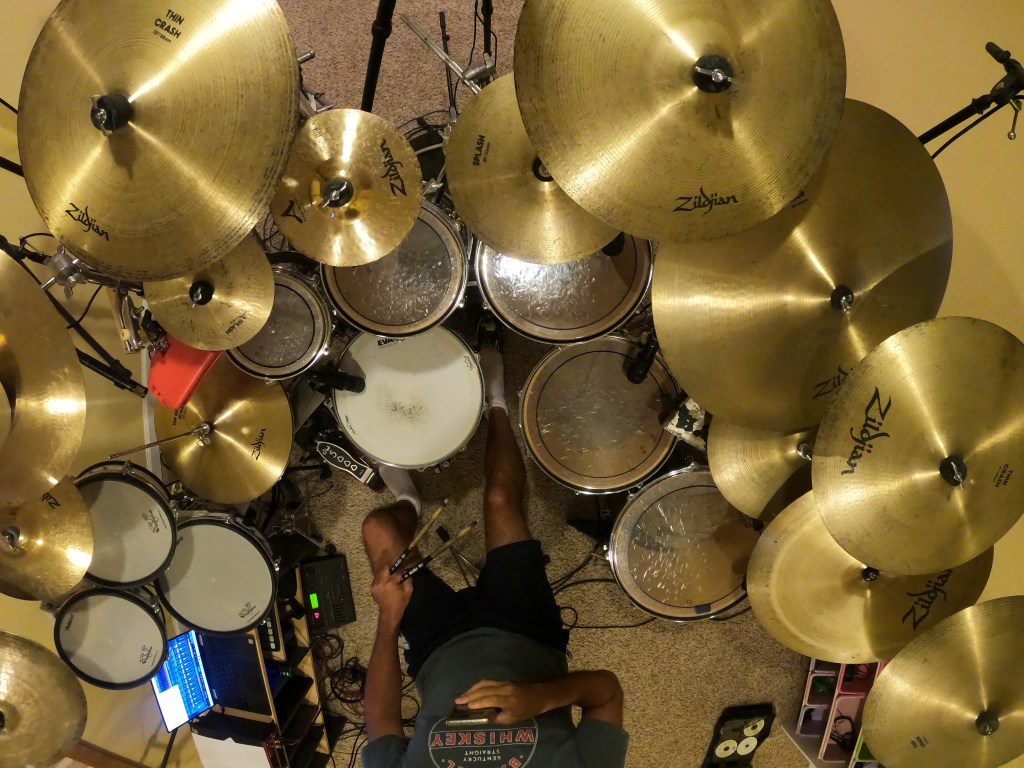
It’s been a while since I’ve had a chance to post an article, so I thought I’d take a pause on two of them that are in process and write about the relationship I’ve seen between music and work, because it’s been the source of reflection at different points in time over the years.
To set the stage, I’ve been playing the drums for over forty years, performing various styles of music, from trio jazz and big band, to blues, R&B, fusion, rock, pop music, and probably others I’m not remembering at the moment. At my busiest time, I played forty jobs with eight groups over the course of a year separate from my “day job”, which was a lot to handle, but very fun at the same time. Eventually, when there wasn’t time to “play out”, I started a YouTube channel where I continue to record and share music to the extent that I can. The point being that music has been a lifelong passion, and I’ve learned things over time that have parallels to what I’ve experienced in the work environment, which I wanted to share here.
To provide some structure, I’ll tackle this in three parts:
- Performing and high-performance teams
- Being present in the moment
- Tenacity, commitment, and role of mentoring
Performing and High-Performance Teams
I’ll start with a simple point: the quality of the music you hear in a live performance is not solely about the competence of the individual musicians, it’s how they play as a group.
Having performed with many musicians over the years, one of the amazing feelings that occurs is when you are in the middle of a song, everyone is dialed in, the energy level is palpable, and it feels like anything is possible with where the music could go. It’s particularly noticeable in settings like small group jazz, where you can change the style of the song on the fly, with the nod of your head or a subtle rhythmic cue to the other musicians, and suddenly everyone moves in a different direction. The same is possible in other styles of music, but sometimes with less range of options. The energy in those moments is amazing, both for the performers and the audience, in part because everyone is creating together and the experience is very fluid and dynamic as it unfolds.
There are three things that make an experience like this possible:
- Everyone has to be engaged in what’s going on
- Everyone has to be listening, communicating, and collaborating in an effective manner
- The group has to be comprised of highly capable players, because the overall quality of the experience will be limited by the least effective or competent of the collaborators
It’s not difficult to see how this relates to a business setting, where high performance teams achieve greater results because of their ability to make the most of everyone’s individual contributions through effective communication and collaboration. Where teams don’t communicate or adapt and evolve together, productivity and impact are immediately compromised.
The litmus test for the above could be asking the questions:
- Is everyone on a team engaged?
- Is everyone listening, contributing, and collaborating effectively (regardless of their role)?
- Is everyone “on their game” at an individual performance level?
If any of the above isn’t a resounding “yes”, then there is probably opportunity to improve.
Being Present In the Moment
The second observation also relates to performing and handling mistakes.
One thing that I’ve always enjoyed about performing live is the challenge of creating an incredible experience for the audience. That experience really comes down to the energy they feel from the performers and putting everything you have out there over the course of a show so there is nothing left to give by the time you’re done.
What is very liberating and fun in that environment is that an audience doesn’t care what you do “as a day job” when they arrive at the venue or club where you’re performing. As far as they are concerned, you’re “in the band” and the expectation (at some level) is that you’re going to be a professional and perform at a level that meets or exceeds their expectations.
Two things are interesting by comparison with a work environment in this regard:
- First, it doesn’t matter as a performer what you did yesterday, last week, last month, or last year when you step on stage. The only thing the audience cares about is how you show up that night. It’s a great mental model for the business environment, where it can be easy to become complacent, fall back on things that one did in the past and forget that we prove ourselves in the value we create each day.
- Second, the minute you make a mistake on stage (and the more you stretch for things in the course of a performance, the more likely it will occur), you recover and you move forward. You don’t waste time looking backwards because music is experienced in the moment you create it, the moment passes, and there is a new opportunity to make something special happen. This is something I’ve struggled with and worked on over time because, as a highly motivated person, it’s frustrating to make mistakes and that can lead to a tendency to beat yourself up over them when they happen. Unfortunately, while there is a benefit to reflecting and learning from mistakes, the most important thing when they occur is not to let one mistake lead to another one, but rather to focus, recover, and make adjustments so the next set of things you do are solid.
On the latter point, it’s worth noting that when I record music for my channel, I try to do so using a single take every time. I do that because it’s the most like live performance and forces a level of focus and intensity as a result. The approach can lead to a mistake here or there in a recording, and that’s ok. I’d rather make mistakes reaching for something difficult than do something “perfectly” that is easy by comparison.
Tenacity, Commitment, and the Role of Mentoring
The final portion of this article is a story in a couple stages, and it’s about dealing with adversity.
Dealing with Failure
When I arrived my freshman year at the University of Illinois, I signed up for tryouts for both the concert and jazz bands. In the case of concert band, I knew what to expect (for the most part), given there were prepared selections, a couple solo pieces you were asked to prepare, and a level of sightreading that you were asked to do in the audition itself. The audition was in front of a set of fourteen people, including all of the directors, and, while relatively uncomfortable, I nailed the parts pretty well, made the First Concert Band, and I was set. Felt good… Check the box.
For jazz band, I didn’t know what to expect, other than going to sign up for a time slot at the Music building, showing up, and just doing whatever was needed. Having played for at least two years in high school leading up to the audition, I thought I had things together and wasn’t really worried. That was probably my first mistake: complacency. What I didn’t consider was that, in any given year, there were between 24-32 drummers trying out for between 6-8 spots in the four jazz bands at the time, and some positions were already assumed given guys returning from the previous year (even though they were in the pool of people “auditioning”). Generally speaking, none of the people auditioning were bad players either and it was much more competitive than I realized or prepared for. As is probably obvious, I did the audition, didn’t necessarily mess anything up, but I also didn’t crush it either. I didn’t make it and was massively disappointed, because I didn’t want to have to give up on playing for an entire year.
This is where the first pivot happened, which is that I decided, regardless of having failed, I wasn’t going to stop playing. I brought my drums down to school, even though I had to squeeze them into the closet of my dorm room. I met with the director of the second jazz band and told him that, while I didn’t make it, I wanted to form a small group and to be able to have a place to practice, and asked for his help. In response, he not only got me access and permission to have a room in the music building where I could go to practice (myself or with others), but also he gave me the contact sheet for everyone who made the four jazz bands. I then called everyone on the list, starting with the top band, asking if anyone was interested in getting together to play. Eventually, I was able to cobble together a group between members of the third and fourth band, we met a number of times over the course of the year, I had a friend help shuttle me and my equipment to the music building, and I was able to keep playing despite the situation.
Separately, I also attended many of the performances of the bands over the course of the year, so I could see the level of ability of the drummers who did make the cut as well as the style and relative difficulty of the music they had to play. In this regard, I wanted to understand what was expected so I could prepare myself effectively the following year.
The learning for me from this, many years before I experienced it in a professional setting, was that I don’t look at challenges or adversity as a limiting constraint, I see them as something to be worked around and overcome. That is ultimately about tenacity and commitment. I could have spent that year on the sidelines, but instead I found another way to get valuable experience, play with musicians who were in the bands and build some relationships and, probably (to a degree) make an impression on one of the directors that I was willing to do whatever it took to keep playing.
The Role of a Mentor
Having found a way to stay active, the other primary thing that was on my mind heading into the summer after my freshman year was doing everything I could to not fail again.
I sought out a teacher who was very well known, with an exceptional reputation in Chicago, having taught for probably forty years at the time. He was teaching through a local community college, so I signed up to a “class” for private instruction and we scheduled two, one-hour lessons a week. In preparation, he told me to buy two books, both of which looked like they were printed in 1935 (ok, probably more like 1952), and I immediately thought I might have made a mistake.
Despite the painful learning of the previous year, I somehow went into my first lesson thinking, “ok, I’m going to impress him, and he’ll help me figure out what went wrong last fall and fix it.” That wasn’t how things went. Rather than have me play anything on the drum set, he had me read from one of the books, on a practice pad, in a way that felt like I was back in third grade doing basic percussion stuff I hadn’t really thought about in a long time. That was my first lesson: it took him less than 5 minutes to establish where I was at and rip me down to my foundation. There was no “impressing” him, there was work to do and seemingly quite a lot of it. He then took notes in each of the books and gave me assignments to work on, the last of which was to apply patterns from the second book to the drum set, which was essentially a third activity in itself. That lesson was on Monday. I had until Thursday. I left thinking “there is literally no way I’m going to be ready.”
And so, it began. I set up my drums and a practice pad in my parents’ garage, and set out practicing two hours a day, every day. I wanted to show him I could do it. I got to the next lesson and nailed every one of the exercises perfectly. He nodded his approval marked up both books again… and I left thinking “there is literally no way I’m going to be able to do that again.” The next lesson was Monday.
I did the same thing, practiced two hours a day, nailed it all, he gave me more, and the cycle repeated. By the end of the summer, we completed both books, a set of work on brush techniques, latin music styles, and some other things he had in his bag of tricks. I never missed a single lesson. I never missed a day of practice the entire summer.
Overall, once I got past those first couple lessons, two things happened:
- I didn’t want to disappoint him
- I didn’t want to blow the streak I had going. I wanted to finish with a perfect record
Returning in the fall, I was completely in control of what I was doing and I made the fourth jazz band. He told me I was one of the best students he ever had, which was very humbling given what an exceptional teacher he was and over so many decades and students he taught.
In retrospect, part of what really drove me was the level of respect I had for him as a teacher and mentor. He was very direct and not always gentle in his choice of words, but his goal was discipline and excellence, and it was clear that he was only invested in making me as good as I could be if I put in the work.
The parallels to the work environment are pretty obvious here as well, which is the value of hard work itself and having a good mentor to guide you along the way. A great coach knows how to help you address your gaps in the interest of being the best you can be, but you also have to be open and receptive to that teaching and that’s not always easy when all of us want to believe we’re fundamentally doing a “good job”. Sometimes our greatest challenges are basic blocking and tackling issues that he made evident to me within five minutes of our first lesson.
Wrapping Up
I’ve said for many years that I wish I could think of things “at work” the way that I do when I perform. In both cases, I strive for excellence, but in the case of music, I think I’ve historically been more accepting of the reality that mistakes are part of learning and getting better, probably because I don’t believe as much is “at stake” when I play versus when I work.
Hopefully some of the ideas have been worth sharing. Thanks for taking the time to read them. Feedback and reactions are welcome as always.
-CJG 09/29/2022
 Organized Chaos