

In discussing the five dimensions of Excellence By Design, I began with the criticality of courageous leadership, because of the influence it has on everything else.
The question is: What should the focus of a leader be to optimize value and effectiveness? The goal of this article is to explore this concept in a couple dimensions: how a leader engages with their team and how they engage with their customers.
Over the course of thirty years and seven organizations, I’ve had the benefit of working with pretty much every form of leader, and it’s relatively safe to say that almost no one operates with one “leadership style” 100% of the time. The question is how a leader engages in their work on an average basis, at what level of detail, and with what level of ownership. The implications on both their team and the operating performance of the organization as a whole can be significant, which is why considering these dimensions is important.
It’s somewhat discouraging to consider is how many “managers” there are in the world and so few “leaders”… and yet, this is what creates opportunity for leaders to truly make a difference…
It isn’t particularly noteworthy to say that engaged, motivational leadership can raise the performance of a team (and the individuals therein). Unfortunately, the converse is also true, which is that ineffective leadership can and likely will erode the value an otherwise capable group will produce as well.
The good news is that I believe any leader who is invested in developing their capabilities can be coached in a manner that will ultimately increase value and impact, but an awareness of their starting point and how they engage on an average basis is a critical foundation for that journey to begin.
For discussion’s sake, consider the following conceptual diagram:
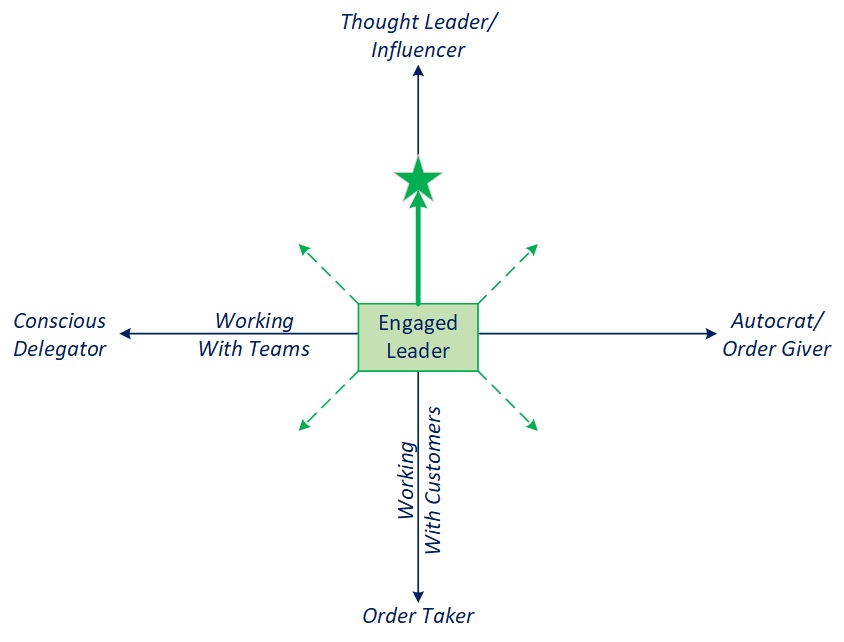
Working With Teams
Looking first at team engagement, there are two opposing ends of the spectrum:
- The Autocrat/Order Giver
- On one end, there are managers who lead by intimidation and threats, or by micro-managing things to the point that individual creativity is nearly snuffed out
- The impact on a working environment is likely one ruled by “compliance” behavior, fear, and apprehension
- In these situations, risk taking seems ill-advised and team members will have to accept that, to the extent they express a more autonomous working approach, there will come a point where they may be labeled “insubordinate”, “difficult”, or “not a team player” because of being misaligned to leadership expectations
- This situation simply doesn’t scale from a leadership standpoint. No one with any significant level of responsibility can possibly be involved in the details of every decision, no matter how competent they are. The result is either that the leader will become a bottleneck on decisions and the organization will lose agility or they will rush into making expedient and potentially short-sighted decisions that will also compromise long-term value and quality.
- The Conscious Delegator
- On the other hand, there are managers who fully delegate authority and decision making to the point where they can become disconnected with meaningful actions being taken on an ongoing basis
- This type of environment is a double-edged sword for the team members, because they can have a significant amount of autonomy and freedom of action on an ongoing basis to execute on the responsibilities of their job. The flip side is that they will tend to take 100% of the blame if something goes wrong.
- Consequently, while a fully delegated approach may initially seem to promote a high level of “empowerment”, the level of risk that team members will eventually take will be influenced by the trust they have in their leader providing air cover if things don’t go to plan. In the event that they believe they won’t have support, they will be less likely to take risks and provide courageous leadership themselves, and the quality or value coming from their work will be compromised
So where does the Engaged Leader fall by comparison? In terms of engaging with a team, I would argue that they should seek to be near the middle on average.
How I would describe the “ideal” environment:
- The leader is engaged and aware of critical and high priority issues, where they stand, dependencies, challenges, etc. and are taking an active role in helping the team navigate those situations
- They enable their team by providing direction and decisions, while promoting an inclusive and diverse environment, where individuals are encouraged to contribute, innovate, and take informed risks and action in the interest of maximizing value and enabling ongoing transformation (see the article The Power of N for more on this)
- They are “informed” even where they are not heavily “engaged”, so they can take appropriate action and intervene as and when required in the interest of supporting and enabling their team
Where someone is closer to one of the endpoints described above, a “Conscious Delegator” can be encouraged to increase awareness and engagement and an “Order Giver” can be encouraged to trust and enable their team while relinquishing a degree of control.
Working With Customers
Looking at customer engagement, the two opposing ends of the spectrum are:
- Thought Leader/Influencer
- On one end of the spectrum, a leader can be providing direction and act as a trusted partner in line with some of the concepts mentioned in On Managing Customer Relationships and Courageous Leadership, Relentless Innovation, and Pushing the Envelope
- In the digital business environment of today, it is difficult to argue why leaders should be apprehensive about engaging on how advanced technologies can enable competitive advantage and differentiation.
- There is a history of business-driven technology strategy that can and should become more balanced with the critical role that IT has in disrupting established models and helping to establish what’s possible in a world of connected ecosystems and The Intelligent Enterprise
- The caveat being that, business value and strategies inform technology strategy, and therefore, being at an extreme end of the scale may suggest a leader isn’t receptive to or understanding of their business partners goals and needs, which would ultimately be ineffective for an organization
- Order Taker
- On the other hand, if a business relationship is best described as one of subservience, one could reasonably question why an IT leader is needed at all
- In this situation, arguably you could accomplish the same level of operating results by having someone working directly for a business leader who takes direction and executes on assigned responsibilities without providing any level of feedback
- The only way this type of model would be moderately effective is when the business leader is exceptionally capable both in setting business and technology strategy, and that is an extremely rare situation that likely would work only at a very limited or narrow scale (in terms of scope)
- Looking back at operating performance of a broader team, there would likely be a limited amount of innovation occurring, because the team wouldn’t believe there is an avenue for such ideas to take hold with their customer and eventually stop trying to contribute in any material way
So where does the Engaged Leader fall by comparison? In terms of this dimension, as the star in the diagram indicates, I would argue that they should seek to be above the center line on average.
How I would describe the “ideal” environment:
- A collaborative partnership exists where technology innovation opportunities are actively discussed and integrated with business strategies and priorities where appropriate
- Technology leaders understand not only the overall business direction, but the “why” behind operating and market strategies to better inform their efforts to enable their partners to leverage strategic technologies in the most effective manner possible
Where someone is closer to one of the endpoints described above, a “Thought Leader” can be asked to make sure they are balancing business needs with proactive ideas and an “Order Taker” can be encouraged to develop trust with their customer and build a more collaborative partnership over time.
Wrapping Up
Hopefully the above concepts were useful food for thought. Again, no leader in my experience acts in a completely consistent manner, and that’s probably a good thing, because adaptive leadership is ultimately about placing focus where it needs to be, when it needs to be there.
One final point in line with a concept in the Engaged Leadership and Setting the Tone is that regardless of the leadership style of someone’s immediate manager or customer, every leader has the ability to decide what kind of leader they want to be themselves. That is ultimately an individual accountability and not something to “externalize” to someone else.
Ultimately, we all can make a difference.
We can all strive to maximize value and impact in the work we do every day.
I hope the ideas were helpful. As always, feedback is welcome and appreciated.
-CJG 10/05/2022
 Organized Chaos